
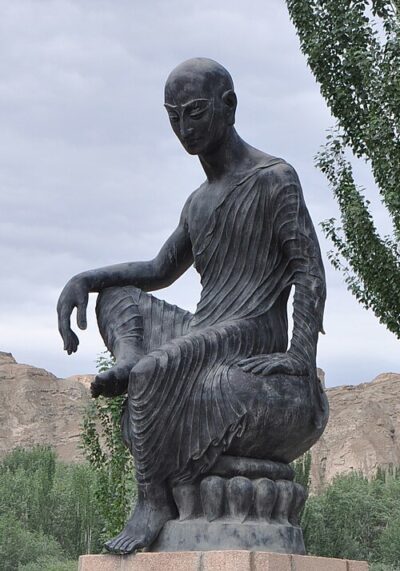
Kumārajīva
Kumārajīva was a Kuchan Buddhist monk and translator. Born 344, in Kucha. Died 413, in Chang'an.
Facts
12 facts · 0 confirmed by two sources · 4 cited · 7 from one source · 1 where the sources disagree
What’s different
- Born in: we show Kucha (Sources disagree). Wikidata also lists Kushan Empire
Where this comes from
Papalocal keeps its own record. It started from these sources; what each one said is kept here as it was copied, so a change on their side never changes this page by itself. Tap one to read its version.
What Wikidata says · copied November 16, 2026 · revision 2523052545
- Described as
- Kuchan Buddhist monk and translator (344-413)
- Other names
- Kumarajiva, Jiūmóluóshí
- Born
- 344; 344 · 1 reference
- Died
- 413 · 1 reference
- Born in
- Kucha; Kushan Empire
- Died in
- Chang'an
- Citizen of
- Eastern Jin dynasty; Later Qin
- Occupation
- translator · 1 reference; writer; monk · 1 reference
- Father
- Kumārāyana
- Mother
- Jīva
- Religion
- Buddhism
- Wikipedias with a page
- 50
Wikidata item Q335293 (wikidata.org/wiki/Q335293), public domain (CC0). Copied November 16, 2026.
What Wikipedia says · copied November 16, 2026 · revision 1375335212
Kumārajīva traditional Chinese: 鳩摩羅什; simplified Chinese: 鸠摩罗什; pinyin: Jiūmóluóshí; Wade–Giles: Chiu¹ mo² lo² shih², 344–413 CE) was a Buddhist monk, scholar, missionary and translator from the Kingdom of Kucha (present-day Aksu Prefecture, Xinjiang, China). Kumārajīva is seen as one of the greatest translators of Chinese Buddhism and a pivotal figure in the development of literary Buddhist Chinese. According to Lu Cheng, Kumarajiva's translations are "unparalleled either in terms of translation technique or degree of fidelity".
Kumārajīva first studied teachings of the Sarvastivadin schools, later studied under Buddhasvāmin, and finally became an adherent of Mahayana Buddhism, studying the Mādhyamaka doctrine of Nāgārjuna. After mastering the Chinese language, Kumārajīva settled as a translator and scholar in Chang'an (c. 401 CE) under the patronage of the Later Qin dynasty during the Sixteen Kingdoms period. He was the head of a team of translators which included his amanuensis Sengrui. This team was responsible for the translation of many Sanskrit Buddhist texts into Chinese.
Kumārajīva also introduced the Madhyamaka school of Buddhist philosophy into China which would later be called Sanlun (the "Three Treatise school").
From the Wikipedia article “Kumārajīva” (en.wikipedia.org/wiki/Kumārajīva), by its contributors, under CC BY-SA 4.0 (creativecommons.org/licenses/by-sa/4.0/). Copied November 16, 2026; not changed.
Confirmed Two sources agree. Cited One source, and it names where it got it. One source One source, without a reference of its own. Sources disagree The sources disagree. We show the best-supported value and keep theirs below.
