
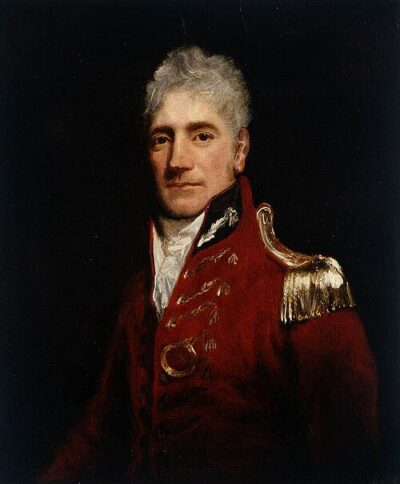
Lachlan Macquarie
Lachlan Macquarie was a Scottish British army officer and New South Wales colonial administrator. Born January 31, 1762, in Ulva. Died July 1, 1824, in London. Positions held include Governor of New South Wales (1810–1821). Educated at Royal High School. Awards include Companion of the Order of the Bath.
Facts
19 facts · 2 confirmed by two sources · 5 cited · 12 from one source
Where this comes from
Papalocal keeps its own record. It started from these sources; what each one said is kept here as it was copied, so a change on their side never changes this page by itself. Tap one to read its version.
What Wikidata says · copied November 16, 2026 · revision 2566598380
- Described as
- Scottish British army officer and New South Wales colonial administrator (1762-1824)
- Born
- January 31, 1762 · 1 reference
- Died
- July 1, 1824 · 1 reference
- Born in
- Ulva
- Died in
- London
- Buried in
- Isle of Mull · 1 reference
- Citizen of
- Australia; United Kingdom of Great Britain and Ireland
- Occupation
- explorer · 1 reference; politician · 1 reference
- Positions held
- Governor of New South Wales (1810–1821) · 1 reference
- Education
- Royal High School
- Awards
- Companion of the Order of the Bath
- Spouse
- Jane Jarvis; Elizabeth Macquarie (1807–) · 2 references
- Children
- Lachlan Macquarrie · 1 reference
- Father
- Lachlan Macquarrie of Ormaig · 1 reference
- Mother
- Margaret Maclaine · 1 reference
- Military branch
- British Army
- Military rank
- general
- Wikipedias with a page
- 32
Wikidata item Q467694 (wikidata.org/wiki/Q467694), public domain (CC0). Copied November 16, 2026.
What Wikipedia says · copied November 16, 2026 · revision 1385776621
Major-General Lachlan Macquarie (; Scottish Gaelic: Lachlann MacGuaire; 31 January 1762 – 1 July 1824) was a British Army officer and colonial administrator from Scotland. Macquarie served as the fifth Governor of New South Wales from 1810 to 1821, and had a leading role in the social, economic, and architectural development of the colony. He is considered by historians to have had a crucial influence on the transition of New South Wales from a penal colony to a free settlement and therefore to have played a major role in the shaping of Australian society in the early nineteenth century.
Macquarie orchestrated urban planning in the colony. He had a significant impact on the development of modern Sydney, establishing the layout upon which the modern city centre is based, establishing Hyde Park as Australia's first public park, overseeing the construction of various public buildings along Macquarie Street, and devising the layouts of a number of settlements which today are part of Western Sydney. He also ordered the designing of a street layout for Hobart. A supporter of exploration, Macquarie authorised the 1813 expedition across the Blue Mountains, the first successful British traversal of the region. He ordered the establishment of Bathurst, the first inland British settlement in Australia.
While seeking to promote morality and orderliness, Macquarie favoured the liberal treatment of ex-convicts, known as emancipists, appointing them to prominent government positions and providing generous land grants.
Macquarie expressed a desire for Aboriginal peoples to be treated kindly, and established the first school for Aboriginal children; at the same time, he gave orders that led to the Appin Massacre of Gundungurra and Dharawal people during the Hawkesbury and Nepean Wars.
- Born, in its opening lines
- January 31, 1762
- Died, in its opening lines
- July 1, 1824
From the Wikipedia article “Lachlan Macquarie” (en.wikipedia.org/wiki/Lachlan_Macquarie), by its contributors, under CC BY-SA 4.0 (creativecommons.org/licenses/by-sa/4.0/). Copied November 16, 2026; not changed.
Confirmed Two sources agree. Cited One source, and it names where it got it. One source One source, without a reference of its own. Sources disagree The sources disagree. We show the best-supported value and keep theirs below.
