
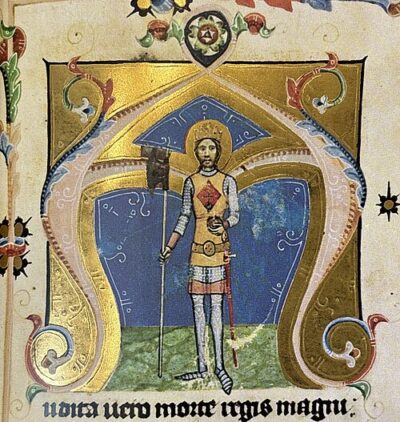
Ladislaus I of Hungary
Ladislaus I of Hungary was a King of Hungary from 1077 to 1095. Born June 27, 1040, in Kraków. Died July 29, 1095, in Nitra. Positions held include Apostolic King of Hungary (1077–1095).
Facts
19 facts · 2 confirmed by two sources · 4 cited · 13 from one source
Where this comes from
Papalocal keeps its own record. It started from these sources; what each one said is kept here as it was copied, so a change on their side never changes this page by itself. Tap one to read its version.
What Wikidata says · copied November 16, 2026 · revision 2569053659
- Described as
- King of Hungary from 1077 to 1095
- Other names
- Ladislas I 'the Saint' Arpád, King of Hungary, Ladislaus, Saint Ladislaus, Saint Ladislas
- Born
- June 27, 1040 · 2 references
- Died
- July 29, 1095 · 3 references
- Born in
- Kraków
- Died in
- Nitra · 1 reference
- Buried in
- Cathedral Basilica of St. Mary
- Citizen of
- Hungary
- Occupation
- aristocracy; monarch
- Positions held
- Apostolic King of Hungary (1077–1095) · 1 reference
- Political party
- politician before the emergence of political parties
- Spouse
- Adelaide of Rheinfelden · 1 reference
- Children
- Irene of Hungary · 1 reference
- Father
- Béla I of Hungary · 1 reference
- Mother
- Richeza of Poland, Queen of Hungary
- Siblings
- Géza I of Hungary; Helen of Hungary; Euphemia of Hungary; Sophia of Hungary
- Religion
- Catholic Church
- Wikipedias with a page
- 50
Wikidata item Q26486 (wikidata.org/wiki/Q26486), public domain (CC0). Copied November 16, 2026.
What Wikipedia says · copied November 16, 2026 · revision 1376338090
Ladislaus I (Hungarian: I. László, Croatian: Ladislav I., Slovak: Ladislav I., Polish: Władysław I; 27 June 1040 – 29 July 1095), also known as Saint Ladislas, was King of Hungary from 1077 and King of Croatia from 1091. He was the second son of King Béla I of Hungary and Richeza (or Adelaide) of Poland. After Béla's death in 1063, Ladislaus and his elder brother, Géza, acknowledged their cousin Solomon as the lawful king in exchange for receiving their father's former duchy, which included one-third of the kingdom. They cooperated with Solomon for the next decade. Ladislaus's most popular legend, which narrates his fight with a "Cuman" (a Turkic nomad marauder) who abducted a Hungarian girl, is connected to this period. The brothers' relationship with Solomon deteriorated in the early 1070s, and they rebelled against him. Géza was proclaimed king in 1074, but Solomon maintained control of the western regions of his kingdom. During Géza's reign, Ladislaus was his brother's most influential adviser.
Géza died in 1077, and his supporters made Ladislaus king. Solomon resisted Ladislaus with assistance from King Henry IV of Germany. Ladislaus supported Henry IV's opponents during the Investiture Controversy. In 1081, Solomon abdicated and acknowledged Ladislaus's reign, but he conspired to regain the royal crown, and Ladislaus imprisoned him. Ladislaus canonized the first Hungarian saints (including his distant relatives, King Stephen I and Duke Emeric) in 1085. He set Solomon free during the canonization ceremony.
After a series of civil wars, Ladislaus's main focus was the restoration of public safety. He introduced severe legislation, punishing those who violated property rights with death or mutilation. He occupied almost all Croatia in 1091, which marked the beginning of an expansion period for the medieval Kingdom of Hungary. Ladislaus's victories over the Pechenegs and Cumans ensured the security of his kingdom's eastern borders for about 150 years. His relationship with the Holy See deteriorated during the last years of his reign, as the popes claimed that Croatia was their fief, but Ladislaus denied their claims.
Ladislaus was canonized on 27 June 1192 by Pope Celestine III. Legends depict him as a pious knight-king, "the incarnation of the late-medieval Hungarian ideal of chivalry." He is a popular saint in Hungary and neighboring nations, where many churches are dedicated to him.
- Born, in its opening lines
- June 27, 1040
- Died, in its opening lines
- July 29, 1095
From the Wikipedia article “Ladislaus I of Hungary” (en.wikipedia.org/wiki/Ladislaus_I_of_Hungary), by its contributors, under CC BY-SA 4.0 (creativecommons.org/licenses/by-sa/4.0/). Copied November 16, 2026; not changed.
Confirmed Two sources agree. Cited One source, and it names where it got it. One source One source, without a reference of its own. Sources disagree The sources disagree. We show the best-supported value and keep theirs below.
