
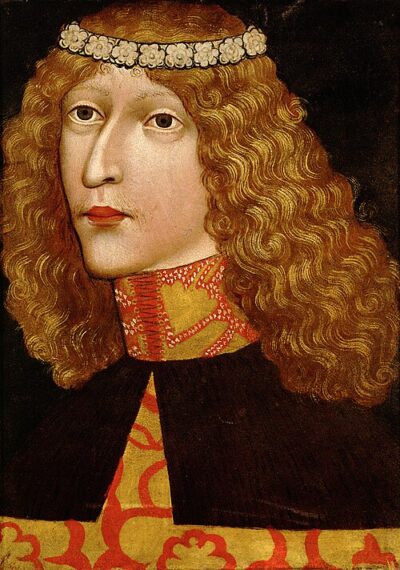
Ladislaus the Posthumous
Ladislaus the Posthumous was a King of Hungary, Bohemia and Croatia, Duke of Austria. Born February 22, 1440, in Komárno. Died November 23, 1457, in Prague. Positions held include Prince-Elector, King of Bohemia (1453–1457) and Apostolic King of Hungary (1440–1457).
Facts
16 facts · 2 confirmed by two sources · 3 cited · 11 from one source
Where this comes from
Papalocal keeps its own record. It started from these sources; what each one said is kept here as it was copied, so a change on their side never changes this page by itself. Tap one to read its version.
What Wikidata says · copied November 16, 2026 · revision 2563990796
- Described as
- King of Hungary, Bohemia and Croatia, Duke of Austria
- Other names
- Ladislaus V, Ladislaus V of Hungary
- Born
- February 22, 1440 · 1 reference
- Died
- November 23, 1457 · 2 references
- Born in
- Komárno · 1 reference
- Died in
- Prague · 3 references
- Buried in
- St. Vitus Cathedral
- Cause of death
- leukemia
- Citizen of
- Hungary
- Occupation
- ruler
- Positions held
- Prince-Elector; King of Bohemia (1453–1457); Apostolic King of Hungary (1440–1457) · 1 reference
- Father
- Albert II of Germany
- Mother
- Elizabeth of Luxembourg
- Siblings
- George of Habsburg, Heir of Austria; Elisabeth of Habsburg; Duchess Anna I, Duchess of Luxembourg
- Wikipedias with a page
- 45
Wikidata item Q116382 (wikidata.org/wiki/Q116382), public domain (CC0). Copied November 16, 2026.
What Wikipedia says · copied November 16, 2026 · revision 1384694970
Ladislaus the Posthumous, known as Ladislaus V (Hungarian: Utószülött László; Croatian: Ladislav Posmrtni; Czech: Ladislav Pohrobek; German: Ladislaus Postumus; 22 February 1440 – 23 November 1457), was Duke of Austria and King of Hungary, Croatia and Bohemia. He was the posthumous son of Albert II of Germany with Elizabeth of Luxembourg. Albert had bequeathed all his realms to his future son on his deathbed, but only the estates of Austria accepted his last will. Fearing an Ottoman invasion, the majority of the Hungarian lords and prelates offered the crown to Władysław III of Poland. The Hussite noblemen and towns of Bohemia did not acknowledge the hereditary right of Albert's descendants to the throne, but also did not elect a new king.
After Ladislaus's birth, his mother seized the Holy Crown of Hungary and had Ladislaus crowned king in Székesfehérvár on 15 May 1440. However, the Diet of Hungary declared Ladislaus's coronation invalid and elected Władysław III of Poland as king. A civil war broke out, which lasted for years. Elizabeth appointed her late husband's distant cousin, Albert VI, Archduke of Austria, as her child's guardian. However, as a representative of the interests of the Austrian and Hungarian estates, he could not defend himself against his older brother and rival, Frederick III, King of the Romans, who in turn took over his role as guardian of Ladislaus. Albert had to renounce his guardianship and, in return, received the mighty Hungarian border Forchtenstein Castle, including a principality in the Hungarian-Styrian-Carinthian area. Ladislaus lived at Frederick's court (mainly in Wiener Neustadt), where Aeneas Silvius Piccolomini (later Pope Pius II) wrote a treatise on his upbringing.
After his mother died in late 1442, Ladislaus's interests were represented by a Czech condottiere, John Jiskra of Brandýs, in Hungary, and by the Czech Catholic lord, Oldřich II of Rosenberg, in Bohemia. Ladislaus's rival in Hungary, Władysław III, fell in the Battle of Varna in November 1444. The next year, the Diet of Hungary offered to acknowledge Ladislaus as king if Frederick III renounced his guardianship. After Frederick III rejected the offer, the Diet of Hungary elected John Hunyadi regent in 1446. In Bohemia, the head of the moderate Hussites (or Utraquists), George of Poděbrady, took control of Prague in 1448. The Estates of Austria forced Frederick III to resign the guardianship and hand over Ladislaus to them in September 1452. Royal administration was formally restored in Hungary after Hunyadi resigned the regency in early 1453, but he continued to control most royal castles and revenues.
Ulrich II, Count of Celje (his mother's cousin), became Ladislaus's main advisor, but an Austrian baron, Ulrich von Eytzinger, forced Ladislaus to expel Celje from his court. Although Ladislaus was crowned king of Bohemia on 28 October 1453, Poděbrady remained in full control of the government. During the following years, Eytzinger, Hunyadi and Poděbrady closely cooperated to mutually secure their positions. Ladislaus was reconciled with Ulrich II in early 1455. With the support of the leading Hungarian barons, Ladislaus persuaded Hunyadi to withdraw his troops from most royal castles and renounce the administration of part of the royal revenues.
After the Ottoman Sultan Mehmed II decided to invade Hungary, Ladislaus and Ulrich II left the kingdom. The sultan laid siege to Belgrade. Hunyadi relieved the fortress on 22 July 1456, but he died two weeks later. Ladislaus and Ulrich II returned to Hungary and tried to force Hunyadi's son, also named Ladislaus, to renounce all royal castles and revenues, but Ladislaus Hunyadi murdered Ulrich II on 9 November, forcing Ladislaus to grant an amnesty to him. However, most Hungarian barons were hostile towards Ladislaus Hunyadi. With their support, Ladislaus captured him and his brother, Matthias Corvinus. After Ladislaus Hunyadi was executed in March 1457, his relatives stirred up a rebellion against Ladislaus, forcing him to flee from Hungary. Ladislaus died unexpectedly in Prague. He was the last male member of the Albertinian Line of the House of Habsburg.
- Born, in its opening lines
- February 22, 1440
- Died, in its opening lines
- November 23, 1457
From the Wikipedia article “Ladislaus the Posthumous” (en.wikipedia.org/wiki/Ladislaus_the_Posthumous), by its contributors, under CC BY-SA 4.0 (creativecommons.org/licenses/by-sa/4.0/). Copied November 16, 2026; not changed.
Confirmed Two sources agree. Cited One source, and it names where it got it. One source One source, without a reference of its own. Sources disagree The sources disagree. We show the best-supported value and keep theirs below.
