
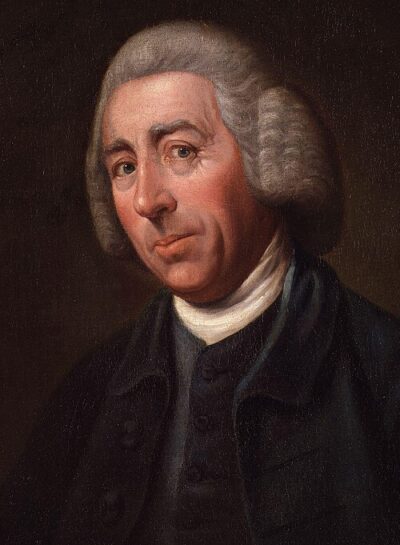
Lancelot Brown was a British landscape architect. Born August 1716, in Kirkharle. Died February 6, 1783, in London. Positions held include Sheriff of Cambridgeshire and Huntingdonshire (1770–1771).
Facts
19 facts · 2 confirmed by two sources · 10 cited · 7 from one source
Where this comes from
Papalocal keeps its own record. It started from these sources; what each one said is kept here as it was copied, so a change on their side never changes this page by itself. Tap one to read its version.
What Wikidata says · copied November 16, 2026 · revision 2568063637
- Described as
- British landscape architect (1716–1783)
- Other names
- Capability Brown, Lancelot Capability Brown, 'Capability' Brown, Lancelot 'Capability' Brown
- Born
- August 1716
- Died
- February 6, 1783 · 4 references
- Born in
- Kirkharle
- Died in
- London · 1 reference
- Citizen of
- Kingdom of Great Britain
- Occupation
- horticulturist; architect; landscape architect · 1 reference; gardener · 1 reference; garden designer · 1 reference
- Positions held
- Sheriff of Cambridgeshire and Huntingdonshire (1770–1771) · 1 reference
- Field
- landscape architecture · 1 reference; English garden · 1 reference
- Spouse
- Bridget Wayet
- Children
- Launcelot Brown; John Brown · 1 reference; Bridget Brown · 1 reference; Thomas Brown · 1 reference
- Lived in
- Fenstanton
- Wikipedias with a page
- 30
Wikidata item Q454635 (wikidata.org/wiki/Q454635), public domain (CC0). Copied November 16, 2026.
What Wikipedia says · copied November 16, 2026 · revision 1383559653
Lancelot "Capability" Brown (born c. 1715–16, baptised 30 August 1716 – 6 February 1783) was an English gardener and landscape architect, a notable figure in the history of the English landscape garden style.
Unlike other architects including William Kent, he was a hands-on gardener and provided his clients with a full turnkey service, designing the gardens and park, and then managing their landscaping and planting. He is most famous for the landscaped parks of English country houses, many of which have survived reasonably intact. However, he also included in his plans "pleasure gardens" with flower gardens and the new shrubberies, usually placed where they would not obstruct the views across the park of and from the main facades of the house. Few of his plantings of "pleasure gardens" have survived later changes. He also submitted plans for much smaller urban projects, for example the college gardens along The Backs at Cambridge.
Criticism of his style, both in his own day and subsequently, mostly centres on the claim that "he created 'identikit' landscapes with the main house in a sea of turf, some water, albeit often an impressive feature, and trees in clumps and shelterbelts", giving "a uniformity equating to authoritarianism" and showing a lack of imagination and even taste on the part of his patrons.
He designed more than 170 parks, many of which survive to this day. He was nicknamed "Capability" because he would tell his clients that their property had "capability" for improvement. His influence was so great that the contributions to the English garden made by his predecessors Charles Bridgeman and William Kent are often overlooked; even Kent's champion Horace Walpole allowed that Kent "was succeeded by a very able master".
- Born, in its opening lines
- August 30, 1716
- Died, in its opening lines
- February 6, 1783
From the Wikipedia article “Capability Brown” (en.wikipedia.org/wiki/Capability_Brown), by its contributors, under CC BY-SA 4.0 (creativecommons.org/licenses/by-sa/4.0/). Copied November 16, 2026; not changed.
Confirmed Two sources agree. Cited One source, and it names where it got it. One source One source, without a reference of its own. Sources disagree The sources disagree. We show the best-supported value and keep theirs below.
