
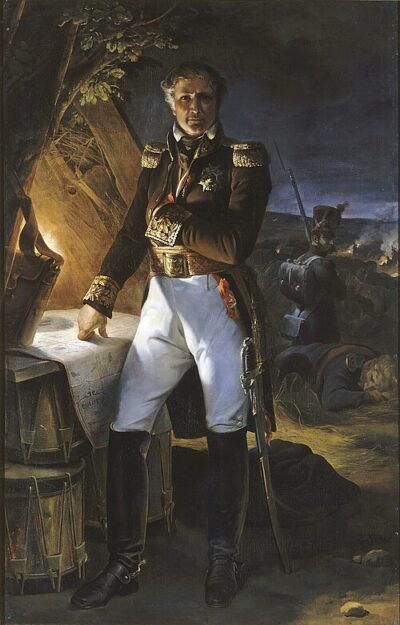
Laurent Gouvion Saint-Cyr
Laurent Gouvion Saint-Cyr was a Marshal of France. Born April 13, 1764, in Toul. Died March 17, 1830, in Hyères. Positions held include Minister of War, Pair of France and Military governor of Strasbourg. Awards include Grand Cross of the Legion of Honour, Marshal of the Empire and Knight Grand Cross of the Order of Saint Louis.
Facts
19 facts · 2 confirmed by two sources · 1 cited · 16 from one source
Where this comes from
Papalocal keeps its own record. It started from these sources; what each one said is kept here as it was copied, so a change on their side never changes this page by itself. Tap one to read its version.
What Wikidata says · copied November 16, 2026 · revision 2564826271
- Described as
- Marshal of France (1764-1830)
- Other names
- Laurent Gouvion, Marquis de Saint-Cyr, Laurent de Gouvion Saint-Cyr
- Born
- April 13, 1764 · 6 references
- Died
- March 17, 1830 · 7 references
- Born in
- Toul
- Died in
- Hyères
- Buried in
- Père Lachaise Cemetery
- Citizen of
- France
- Occupation
- politician; military personnel · 1 reference
- Positions held
- Minister of War; Pair of France; Military governor of Strasbourg
- Awards
- Grand Cross of the Legion of Honour; Marshal of the Empire (1812–); Knight Grand Cross of the Order of Saint Louis; Marshal of France; list of names inscribed on the Arc de Triomphe
- Children
- Laurent-François de Gouvion-Saint-Cyr
- Military branch
- infantry
- Military rank
- Marshal of the Empire
- Wikipedias with a page
- 36
Wikidata item Q347652 (wikidata.org/wiki/Q347652), public domain (CC0). Copied November 16, 2026.
What Wikipedia says · copied November 16, 2026 · revision 1379595902
Laurent de Gouvion Saint-Cyr, 1st Marquis of Gouvion-Saint-Cyr (English: , French: [loʁɑ̃ də ɡuvjɔ̃ sɛ̃ siʁ]; 13 April 1764 – 17 March 1830) was a French military leader of the French Revolutionary Wars and the Napoleonic Wars. He was a made a Marshal of the Empire in 1812 by Emperor Napoleon, who regarded him as his finest general in defensive warfare.
Gouvion Saint-Cyr showed an early interest in drawing, but with the onset of the French Revolution, he joined the French Revolutionary Army in September 1792 and experienced a meteoric rise through the ranks. Promoted to general of division in June 1794, he fought the Austrians in Germany and Italy under the command of generals Moreau and Jourdan.
After a period in administrative roles, Gouvion Saint-Cyr was appointed Colonel General of the cuirassiers in 1804. He served as commander-in-chief of the camp of Boulogne from 1806 to 1808 and was then sent to Spain, where he scored a series of victories at the head of the Army of Catalonia. He took command of the VI Corps of the Grande armée during the Russian campaign, where he obtained his marshal's baton for his victory at the First Battle of Polotsk. He served in the German campaign of 1813 and was taken prisoner at the capitulation of Dresden in November 1813.
Returning to France in June 1814, Gouvion Saint-Cyr played no role during the Hundred Days and became Minister of War then Minister of the Navy and Colonies under the Bourbon Restoration. His tenure was marked by several important reforms such as the law on recruitment. A talented commander, Gouvion Saint-Cyr's cold and taciturn character earned him the nickname "The Owl" (le Hibou) from his soldiers.
- Born, in its opening lines
- April 13, 1764
- Died, in its opening lines
- March 17, 1830
From the Wikipedia article “Laurent de Gouvion Saint-Cyr” (en.wikipedia.org/wiki/Laurent_de_Gouvion_Saint-Cyr), by its contributors, under CC BY-SA 4.0 (creativecommons.org/licenses/by-sa/4.0/). Copied November 16, 2026; not changed.
Confirmed Two sources agree. Cited One source, and it names where it got it. One source One source, without a reference of its own. Sources disagree The sources disagree. We show the best-supported value and keep theirs below.
