
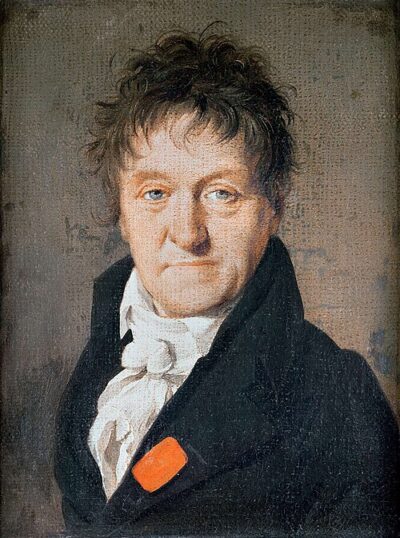
Lazare Carnot
Lazare Carnot was a French political, engineering and mathematical figure. Born May 13, 1753, in Nolay. Died August 2, 1823, in Magdeburg. Positions held include member of the French National Assembly (1791–1793), Minister of War (1800) and President of the National Convention (1794). Known for Carnot's theorem, Réflexions sur la métaphysique du calcul infinitésimal and Principes fondamentaux de l'équilibre et du mouvement. Educated at Lycée militaire in Autun and École royale du génie de Mézières. Awards include Grand Cross of the Legion of Honour, Knight of the Royal and Military Order of Saint Louis and list of names inscribed on the Arc de Triomphe.
Facts
49 facts · 2 confirmed by two sources · 22 cited · 25 from one source
Where this comes from
Papalocal keeps its own record. It started from these sources; what each one said is kept here as it was copied, so a change on their side never changes this page by itself. Tap one to read its version.
What Wikidata says · copied November 16, 2026 · revision 2568747816
- Described as
- French political, engineering and mathematical figure (1753–1823)
- Other names
- Lazare-Nicolas-Marguerite Carnot, Nicolas Carnot
- Born
- May 13, 1753 · 14 references
- Died
- August 2, 1823 · 15 references
- Born in
- Nolay · 1 reference
- Died in
- Magdeburg · 2 references
- Buried in
- Panthéon (1889–) · 1 reference; Nordfriedhof (1823–1889) · 1 reference
- Name at birth
- Lazare Nicolas Marguérite Carnot · 1 reference
- Citizen of
- France
- Occupation
- mathematician · 1 reference; politician · 1 reference; military engineer; military officer; physicist; engineer · 1 reference; poet · 1 reference; general contractor · 1 reference
- Positions held
- member of the French National Assembly (1791–1793); Minister of War (1800); President of the National Convention (1794); president of the French Academy of Sciences (1803–1804); member (1793–1794); director (1795–1797); Minister of the Interior of France (1815)
- Political party
- The Plain · 1 reference
- Worked for
- French Armed Forces (1773–1790) · 1 reference
- Education
- Lycée militaire in Autun (1768–1769) · 1 reference; École royale du génie de Mézières (1771–1773) · 1 reference
- Member of
- French Academy of Sciences; Bavarian Academy of Sciences and Humanities
- Known for
- Carnot's theorem; Réflexions sur la métaphysique du calcul infinitésimal; Principes fondamentaux de l'équilibre et du mouvement
- Awards
- Grand Cross of the Legion of Honour; Knight of the Royal and Military Order of Saint Louis; list of names inscribed on the Arc de Triomphe; 72 names on the Eiffel Tower · 1 reference
- Field
- military affairs · 1 reference; civil engineering · 1 reference; mathematics · 1 reference; physics · 1 reference; politics · 1 reference; poetry · 1 reference
- Children
- Nicolas Carnot; Hippolyte Carnot · 1 reference
- Siblings
- Claude-Marie Carnot; Joseph-François-Claude Carnot
- Military rank
- divisional general (1814–) · 1 reference; lieutenant general (1800–) · 1 reference; second lieutenant (1771–) · 1 reference
- Wikipedias with a page
- 61
Wikidata item Q310767 (wikidata.org/wiki/Q310767), public domain (CC0). Copied November 16, 2026.
What Wikipedia says · copied November 16, 2026 · revision 1381010659
Lazare Nicolas Marguerite, Comte Carnot (English: kar-NOH, French: [lazaʁ nikɔla maʁɡəʁit kaʁno]; 13 May 1753 – 2 August 1823) was a French mathematician, physicist, military officer, politician and a leading member of the Committee of Public Safety during the French Revolution. His military reforms, which included the introduction of mass conscription (levée en masse), were instrumental in transforming the French Revolutionary Army into an effective fighting force.
Carnot was elected to the National Convention in 1792, and a year later he became a member of the Committee of Public Safety, where he directed the French war effort as one of the Ministers of War during the War of the First Coalition. He oversaw the reorganization of the army, imposed discipline, and significantly expanded the French force through the imposition of mass conscription. Credited with France's renewed military success from 1793 to 1794, Carnot came to be known as the "Organizer of Victory".
Increasingly disillusioned with the radical politics of the Montagnards, Carnot broke with Maximilien Robespierre and played a role in the latter's overthrow on 9 Thermidor and subsequent execution. He became one of the five initial members of the Directory but was ousted after the Coup of 18 Fructidor in 1797 and went into exile.
Following Napoleon's rise to power, Carnot returned to France and in 1800 was briefly Minister of War. A fervent Republican, he chose to withdraw from public life after Napoleon's coronation as Emperor. In 1812, he returned to serve under Napoleon and oversaw the defense of Antwerp against the Sixth Coalition, and during the Hundred Days he was Napoleon's Minister of the Interior. Carnot was exiled after the second Bourbon Restoration and died in Magdeburg, Prussia in 1823.
In addition to his political career, Carnot was also an eminent mathematician. His 1803 Géométrie de position is considered a pioneering work in the field of projective geometry. He is also remembered for developing the Carnot wall, a system of fortification that became widely employed in continental Europe during the 19th century.
- Born, in its opening lines
- May 13, 1753
- Died, in its opening lines
- August 2, 1823
From the Wikipedia article “Lazare Carnot” (en.wikipedia.org/wiki/Lazare_Carnot), by its contributors, under CC BY-SA 4.0 (creativecommons.org/licenses/by-sa/4.0/). Copied November 16, 2026; not changed.
Confirmed Two sources agree. Cited One source, and it names where it got it. One source One source, without a reference of its own. Sources disagree The sources disagree. We show the best-supported value and keep theirs below.
