
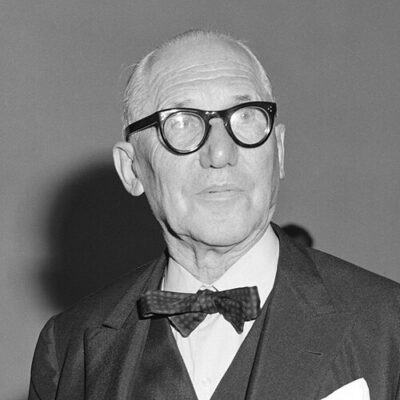
Le Corbusier
Le Corbusier was a Swiss-French architect, designer, urbanist, and writer. Born October 6, 1887, in La Chaux-de-Fonds. Died August 27, 1965, in Roquebrune-Cap-Martin. Known for Notre Dame du Haut, Villa Savoye and Unité d'habitation. Educated at École d'art de La Chaux-de-Fonds. Awards include AIA Gold Medal, Royal Gold Medal and Frank P. Brown Medal.
Facts
50 facts · 2 confirmed by two sources · 27 cited · 21 from one source
Where this comes from
Papalocal keeps its own record. It started from these sources; what each one said is kept here as it was copied, so a change on their side never changes this page by itself. Tap one to read its version.
What Wikidata says · copied November 16, 2026 · revision 2567012215
- Described as
- Swiss-French architect, designer, urbanist, and writer (1886–1965)
- Other names
- Charles Édouard Jeanneret, Edouard Jeanneret, Le Corbusier-Saugnier, Le Korbi︠u︡zʹe, Le Corbusier Jeanneret, Kebiyi, Corbusier Le, Corbu, Charles Edouard Jeanneret-Gris, Charles Edouard Jeanneret- Gris, Charles Edouard Jeanneret, Charles-Edouard Jeanneret
- Born
- October 6, 1887 · 21 references
- Died
- August 27, 1965 · 21 references
- Born in
- La Chaux-de-Fonds · 7 references
- Died in
- Roquebrune-Cap-Martin · 5 references
- Buried in
- Roquebrune-Cap-Martin
- Cause of death
- myocardial infarction
- Name at birth
- Charles-Édouard Jeanneret-Gris · 2 references
- Citizen of
- Switzerland · 4 references; France (1930–) · 3 references
- Occupation
- architect · 8 references; painter · 4 references; writer · 1 reference; urban planner · 3 references; photographer · 2 references; draftsperson · 2 references; textile artist · 1 reference; visual artist · 1 reference
- Education
- École d'art de La Chaux-de-Fonds
- Member of
- American Academy of Arts and Sciences; National Academy of Fine Arts (Argentina); Congrès International d'Architecture Moderne; Accademia delle Arti del Disegno; Academy of Arts, Berlin · 1 reference
- Known for
- Notre Dame du Haut; Villa Savoye · 1 reference; Unité d'habitation; Unité d'Habitation de Marseille · 1 reference; Chandigarh Capitol Complex; Tsentrosoyuz building (1933); Le Corbusier's grave (1957); Maison Blanche (1912); Villa Schwob (1916); Villa La Roche (1923)
- Awards
- AIA Gold Medal; Royal Gold Medal (1953) · 1 reference; Frank P. Brown Medal (1961) · 1 reference; Grand Officer of the Legion of Honour · 1 reference; Sikkens Prize (1963) · 1 reference; honorary doctor of ETH Zürich · 1 reference; Honorary doctorate from the University of Geneva · 1 reference; honorary doctorate from the University of Cambridge · 1 reference; honorary doctor of the University of Zurich · 1 reference; Commandeur des Arts et des Lettres (1957); Commander of the Legion of Honour · 1 reference
- Field
- architecture; urbanism · 1 reference
- Spouse
- Yvonne Le Corbusier (1930–) · 1 reference
- Father
- Georges-Édouard Jeanneret
- Siblings
- Albert Jeanneret
- Religion
- reformed · 1 reference
- Wikipedias with a page
- 200
Wikidata item Q4724 (wikidata.org/wiki/Q4724), public domain (CC0). Copied November 16, 2026.
What Wikipedia says · copied November 16, 2026 · revision 1383584924
Charles-Édouard Jeanneret (6 October 1887 – 27 August 1965), known as Le Corbusier, was a French-Swiss architectural designer, painter, urban planner and writer who is described as one of the pioneers of what is now regarded as modern architecture. He was born in Switzerland to French-speaking Swiss parents and acquired French nationality in 1930. He designed buildings in Europe, Japan, India, and the Americas during a five-decade career. He considered that "the roots of modern architecture are to be found in Viollet-le-Duc."
Dedicated to providing better living conditions for the residents of crowded cities, Le Corbusier was influential in urban planning, and was a founding member of the Congrès International d'Architecture Moderne (CIAM). Le Corbusier prepared the master plan for the city of Chandigarh in India, and contributed specific designs for several buildings there, especially the government buildings. In 2016, seventeen projects by Le Corbusier in seven countries were inscribed in the list of UNESCO World Heritage Sites as The Architectural Work of Le Corbusier, an Outstanding Contribution to the Modern Movement.
Le Corbusier remains a controversial figure. His ties with fascism, antisemitism, eugenics, and the dictator Benito Mussolini have resulted in some continuing contention. Some of his urban planning ideas have been criticized for their indifference to pre-existing cultural sites, social expression and equality. Le Corbusier also designed well-known furniture such as the LC4 chaise longue and the LC1 chair, both made of leather with metal framing.. Le Corbusier died of a heart attack while swimming on August 27, 1965 in Roquebrune-Cap-Martin.
- Born, in its opening lines
- October 6, 1887
- Died, in its opening lines
- August 27, 1965
From the Wikipedia article “Le Corbusier” (en.wikipedia.org/wiki/Le_Corbusier), by its contributors, under CC BY-SA 4.0 (creativecommons.org/licenses/by-sa/4.0/). Copied November 16, 2026; not changed.
Confirmed Two sources agree. Cited One source, and it names where it got it. One source One source, without a reference of its own. Sources disagree The sources disagree. We show the best-supported value and keep theirs below.
