
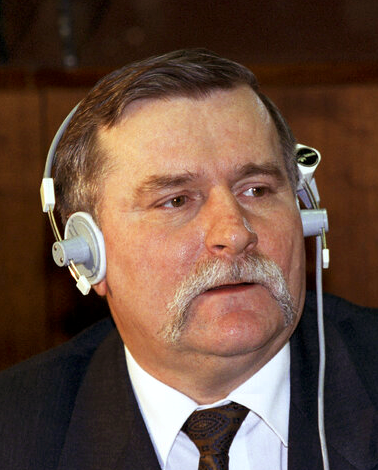
Lech Wałęsa
Lech Wałęsa is a President of Poland from 1990 to 1995. Born September 29, 1943, in Popowo. Positions held include President of the Republic of Poland (1990–1995). Awards include Nobel Peace Prize, Grand Cross of the Legion of Honour and Knight Grand Cross of the Order of the Bath.
Facts
40 facts · 1 confirmed by two sources · 7 cited · 32 from one source
Where this comes from
Papalocal keeps its own record. It started from these sources; what each one said is kept here as it was copied, so a change on their side never changes this page by itself. Tap one to read its version.
What Wikidata says · copied November 16, 2026 · revision 2568743534
- Described as
- President of Poland from 1990 to 1995 (born 1943)
- Other names
- L.Wałęsa, Lech Walesa, Wałęsa, Lech Walensa, L.Wałesa
- Born
- September 29, 1943 · 8 references
- Born in
- Popowo · 1 reference
- Citizen of
- Poland · 1 reference
- Occupation
- politician · 1 reference; electrician · 1 reference; trade unionist; dissident (–1989); political activist; activist; anti-communist
- Positions held
- President of the Republic of Poland (1990–1995)
- Political party
- Solidarity Electoral Action
- Member of
- Solidarity; Liga Przyjaciół Żołnierza · 1 reference; Związek Młodzieży Socjalistycznej
- Awards
- Nobel Peace Prize (1983) · 2 references; Grand Cross of the Legion of Honour (1991); Knight Grand Cross of the Order of the Bath (1991); Order of the White Eagle (1992); Grand cross of the Order of the White Lion (1999); Presidential Medal of Freedom (1989) · 1 reference; Order of Francisco de Miranda (1989); Ernst Reuter Medal (2009) · 1 reference; Fritt Ord Award (1982); European Human Rights Prize; Philadelphia Liberty Medal (1989); Freedom Award (1989); Monismanien Prize (1981); Pacem in Terris Award (2001); Integrity Award (1986)
- Spouse
- Danuta Wałęsa (1969–) · 1 reference
- Children
- Jarosław Wałęsa; Sławomir Wałęsa; Przemysław Wałęsa; Bogdan Wałęsa; Brygida Wałęsa; Maria Wiktoria Wałęsa; Anna Wałęsa; Magdalena Wałęsa
- Religion
- Catholic Church
- Wikipedias with a page
- 176
Wikidata item Q444 (wikidata.org/wiki/Q444), public domain (CC0). Copied November 16, 2026.
What Wikipedia says · copied November 16, 2026 · revision 1384372687
Lech Wałęsa (born 29 September 1943) is a Polish statesman, anti-communist dissident and Nobel Peace Prize laureate who served as the president of Poland between 1990 and 1995. After winning the 1990 election, Wałęsa became the first democratically elected president of Poland since 1922 and the first-ever Polish president elected by popular vote. An electrician by trade, Wałęsa became the leader of the opposition Solidarity movement and led a successful pro-democratic effort, which in 1989 ended Communist rule in Poland and ushered in the end of the Cold War.
While working at the Lenin Shipyard (now Gdańsk Shipyard), Wałęsa, an electrician, became a trade-union activist, for which he was persecuted by the government, placed under surveillance, fired in 1976 and arrested several times. In August 1980, he was instrumental in political negotiations that led to the ground-breaking Gdańsk Agreement between striking workers and the government. He co-founded the Solidarity trade union, whose membership rose to more than ten million.
After martial law in Poland was imposed and Solidarity was outlawed, Wałęsa was arrested again. Released from custody, he continued his activism and was prominent in the establishment of the Round Table Agreement that led to the semi-free 1989 Polish parliamentary election and a Solidarity-led government. He presided over Poland's transition from Marxist–Leninist state socialism into a market-based liberal democracy, but his active role in Polish politics diminished after he narrowly lost the 1995 Polish presidential election. In 1995, he established the Lech Wałęsa Institute.
Since 1980, Wałęsa has received hundreds of prizes, honors and awards from multiple countries and organisations worldwide. He was named the Time Man of the Year (1981) and one of Time's 100 most important people of the 20th century (1999). In 1983, he was awarded the Nobel Peace Prize, which was received by his wife, as he worried the authorities would not let him return. He has received more than forty honorary degrees, including from Harvard University, Fordham University
and Columbia University, as well as dozens of high state orders, including being awarded the Presidential Medal of Freedom, and being appointed a Knight Grand Cross of the Order of the Bath, and a Grand Cross of the Legion of Honour. In 1989, Wałęsa was the first foreign non-head of state to address the Joint Meeting of the U.S. Congress. The Gdańsk Lech Wałęsa Airport has borne his name since 2004.
- Born, in its opening lines
- September 29, 1943
From the Wikipedia article “Lech Wałęsa” (en.wikipedia.org/wiki/Lech_Wałęsa), by its contributors, under CC BY-SA 4.0 (creativecommons.org/licenses/by-sa/4.0/). Copied November 16, 2026; not changed.
Confirmed Two sources agree. Cited One source, and it names where it got it. One source One source, without a reference of its own. Sources disagree The sources disagree. We show the best-supported value and keep theirs below.
