
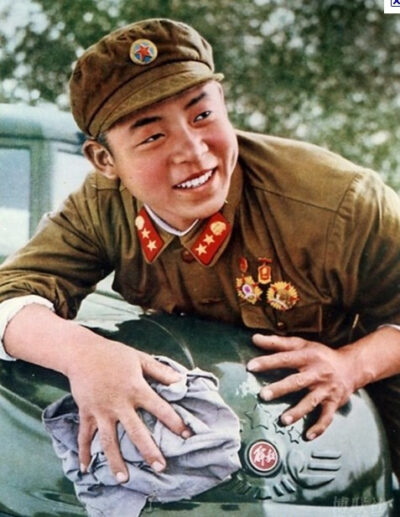
Lei Feng
Lei Feng was a Chinese soldier and communist icon. Born December 18, 1940, in Wangcheng District. Died August 15, 1962, in Anshan.
Facts
10 facts · 2 confirmed by two sources · 1 cited · 7 from one source
Where this comes from
Papalocal keeps its own record. It started from these sources; what each one said is kept here as it was copied, so a change on their side never changes this page by itself. Tap one to read its version.
What Wikidata says · copied November 16, 2026 · revision 2553833170
- Described as
- Chinese soldier and communist icon (1940–1962)
- Born
- December 18, 1940
- Died
- August 15, 1962
- Born in
- Wangcheng District
- Died in
- Anshan
- Cause of death
- traffic collision
- Citizen of
- People's Republic of China
- Occupation
- military personnel; soldier · 1 reference
- Political party
- Chinese Communist Party
- Military rank
- Sergeant
- Wikipedias with a page
- 34
Wikidata item Q379835 (wikidata.org/wiki/Q379835), public domain (CC0). Copied November 16, 2026.
What Wikipedia says · copied November 16, 2026 · revision 1382626882
Lei Feng (18 December 1940 – 15 August 1962), born Lei Zhengxing, was a Chinese soldier in the People's Liberation Army who was the object of several major propaganda campaigns in China. The most well-known of these campaigns in 1963 promoted the slogan "Follow the examples of Comrade Lei Feng." Lei was portrayed as a model citizen, and the masses were encouraged to emulate his selflessness, modesty, and devotion to Mao Zedong. In the following years, Lei Feng was portrayed as a symbol and model of party revolution by both the Chinese Communist Party and Government of China. For decades, he was used to promote the "Learn from Lei Feng as a Model" in the media. Political ideology closely follows the Chinese Communist Party, actively helping others in work and daily life, practicing frugality and thrift, and upholding the socialist spirit of "one for all, all for one" which is known as the Lei Feng spirit. After Mao's death, Chinese state media continued to promote Lei Feng as a model of earnestness and service, and his image still appears in popular forms such as on T-shirts and memorabilia.
The biographical details of Lei Feng's life, and especially his diary, are generally believed by Western historians to be propaganda creations; even the historicity of Lei Feng himself is sometimes questioned. Contemporary research believed that Lei's diary was edited and propagandized, but not fabricated. The continuing use of Lei in government propaganda has become a source of cynicism and even derision amongst segments of the Chinese population. Nevertheless, Lei's function as a propaganda icon has survived decades of political change in China.
- Born, in its opening lines
- December 18, 1940
- Died, in its opening lines
- August 15, 1962
From the Wikipedia article “Lei Feng” (en.wikipedia.org/wiki/Lei_Feng), by its contributors, under CC BY-SA 4.0 (creativecommons.org/licenses/by-sa/4.0/). Copied November 16, 2026; not changed.
Confirmed Two sources agree. Cited One source, and it names where it got it. One source One source, without a reference of its own. Sources disagree The sources disagree. We show the best-supported value and keep theirs below.
