
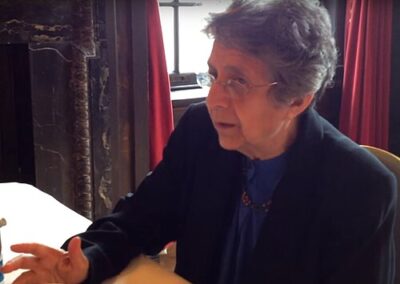
Leila Ahmed
Leila Ahmed is an Egyptian-American writer and professor. Born May 29, 1940, in Heliopolis. Educated at University of Massachusetts Amherst. Awards include Grawemeyer Awards.
Facts
12 facts · 1 confirmed by two sources · 1 cited · 10 from one source
Where this comes from
Papalocal keeps its own record. It started from these sources; what each one said is kept here as it was copied, so a change on their side never changes this page by itself. Tap one to read its version.
What Wikidata says · copied November 15, 2026 · revision 2568440465
- Described as
- Egyptian-American writer and professor
- Born
- May 29, 1940 · 1 reference
- Born in
- Heliopolis
- Citizen of
- Egypt; United States
- Occupation
- university teacher; writer · 1 reference
- Worked for
- Harvard University; University of Massachusetts Amherst
- Education
- University of Massachusetts Amherst
- Awards
- Grawemeyer Awards (2013)
- Field
- gender studies
- Religion
- Islam
- Wikipedias with a page
- 33
Wikidata item Q438645 (wikidata.org/wiki/Q438645), public domain (CC0). Copied November 15, 2026.
What Wikipedia says · copied November 15, 2026 · revision 1379785111
Leila Ahmed (Arabic: لیلى أحمد; born 29 May 1940) is an Egyptian-American scholar of women's studies and religion. In 1992 she published her book Women and Gender in Islam, which is regarded as a pioneering historical analysis of the position of women in Arab Muslim societies. She became the first professor of women's studies in religion at Harvard Divinity School in 1999, and has held the Victor S. Thomas Professor of Divinity chair since 2003. She was later awarded the Victor S. Thomas Research Professor of Divinity in 2020.
- Born, in its opening lines
- May 29, 1940
From the Wikipedia article “Leila Ahmed” (en.wikipedia.org/wiki/Leila_Ahmed), by its contributors, under CC BY-SA 4.0 (creativecommons.org/licenses/by-sa/4.0/). Copied November 15, 2026; not changed.
Confirmed Two sources agree. Cited One source, and it names where it got it. One source One source, without a reference of its own. Sources disagree The sources disagree. We show the best-supported value and keep theirs below.
