
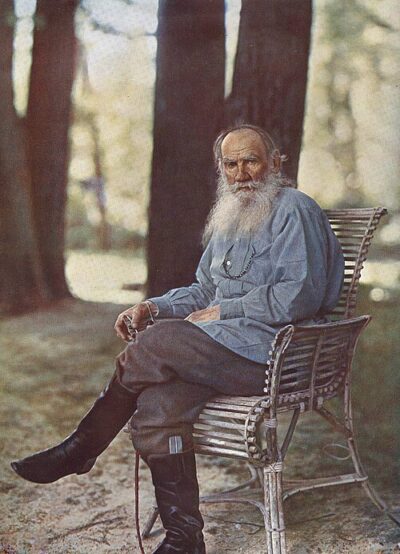
Leo Tolstoy
Leo Tolstoy was a Russian author. Born August 28, 1828, in Yasnaya Polyana. Died November 7, 1910, in Astapovo. Known for War and Peace, Anna Karenina and A Confession. Educated at Kazan Imperial University. Awards include Order of Saint Anna, 4th class, Medal For defence of Sebastopol and Medal In memory of Crimean War.
Facts
66 facts · 0 confirmed by two sources · 23 cited · 40 from one source · 3 where the sources disagree
What’s different
- Born: we show August 28, 1828 (Sources disagree). Wikipedia says September 9, 1828
- Died: we show November 7, 1910 (Sources disagree). Wikipedia says November 20, 1910
- Name at birth: we show Lev Nikolayevich Tolstoy (Sources disagree). Wikidata also lists Lev Nikolajevitsj Tolstoj
Where this comes from
Papalocal keeps its own record. It started from these sources; what each one said is kept here as it was copied, so a change on their side never changes this page by itself. Tap one to read its version.
What Wikidata says · copied November 16, 2026 · revision 2565597139
- Described as
- Russian author (1828–1910)
- Other names
- Tolstoĭ, Lev Nikolaevich, graf, Tolstoy, Leo, graf, Leo Tolstoi, Lev Nikolayevich Tolstoĭ, Count Lev Nikolayevich Tolstoy, Lev Nikolayevich Tolstoy
- Born
- August 28, 1828 · 9 references
- Died
- November 7, 1910 · 6 references
- Born in
- Yasnaya Polyana · 6 references
- Died in
- Astapovo · 2 references
- Buried in
- Yasnaya Polyana
- Cause of death
- pneumonia
- Name at birth
- Lev Nikolayevich Tolstoy · 1 reference; Lev Nikolajevitsj Tolstoj
- Citizen of
- Russian Empire · 2 references
- Occupation
- writer · 6 references; playwright · 1 reference; philosopher · 3 references; novelist · 1 reference; pedagogue; essayist · 1 reference; children's writer; diarist
- Worked for
- Saint Petersburg Academy of Sciences
- Education
- Kazan Imperial University
- Member of
- Serbian Academy of Sciences and Arts (1910); Russian Academy of Sciences (1873–) · 1 reference
- Genre
- short novel; drama
- Known for
- War and Peace · 1 reference; Anna Karenina · 1 reference; A Confession · 1 reference; The Kingdom of God Is Within You; What Is Art?; Boyhood; Childhood; Hadji Murat; The Kreutzer Sonata; Resurrection
- Awards
- Order of Saint Anna, 4th class; Medal For defence of Sebastopol; Medal In memory of Crimean War; Medal In memory of 50th anniversary of defence of Sevastopol · 1 reference
- Field
- philosophy; fiction; creative and professional writing · 1 reference; drama · 1 reference; opinion journalism · 1 reference; pedagogy · 1 reference
- Spouse
- Sophia Tolstaya (1862–1910) · 2 references
- Children
- Sergey Tolstoy; Tatyana Sukhotina-Tolstaya · 1 reference; Ilya Tolstoy · 1 reference; Lev Lvovich Tolstoy · 1 reference; Maria L'vovna Tolstaya · 1 reference; Andrey Tolstoy; Mikhail Tolstoy · 1 reference; Alexandra Tolstaya · 1 reference
- Father
- Nikolay Tolstoy
- Mother
- Mariya Volkonskaya
- Siblings
- Mariya Tolstaya; Nikolay Tolstoy; Sergey Tolstoy; Dmitry Tolstoy
- Religion
- Eastern Orthodoxy (–1901); Tolstoyan movement
- Lived in
- Yapeeva Street · 1 reference; Dzerzhinsky Street, 11/2 · 1 reference; Tolstoy Urama, 25/68 (1845–1846) · 2 references; Pyatnitskaya Street · 1 reference; Lev Tolstoy Street · 1 reference
- Website
- https://tolstoy.ru; https://leotolstoy.blog/
- Wikipedias with a page
- 282
Wikidata item Q7243 (wikidata.org/wiki/Q7243), public domain (CC0). Copied November 16, 2026.
What Wikipedia says · copied November 16, 2026 · revision 1384373421
Count Lev Nikolayevich Tolstoy (; Russian: Лев Николаевич Толстой, IPA: [ˈlʲef nʲɪkɐˈla(j)ɪvʲɪtɕ tɐlˈstoj] ; 9 September [O.S. 28 August] 1828 – 20 November [O.S. 7 November] 1910), usually referred to in English as Leo Tolstoy, was a Russian writer. He is regarded as one of the greatest and most influential authors of all time.
Born to an aristocratic family, Tolstoy achieved acclaim in his twenties with his semi-autobiographical trilogy, Childhood, Boyhood and Youth (1852–1856), and with Sevastopol Sketches (1855), based on his experiences in the Crimean War. War and Peace (1869), Anna Karenina (1878), and Resurrection (1899), which is based on his "youthful sins", are often cited as pinnacles of realist fiction and three of the greatest novels ever written. His oeuvre includes short stories such as "Alyosha the Pot" (1911) and "After the Ball" (1911) and novellas such as Family Happiness (1859), The Death of Ivan Ilyich (1886), The Kreutzer Sonata (1889), The Devil (1911), and Hadji Murat (1912). He also wrote plays and essays concerning philosophical, moral and religious themes.
In the 1870s, Tolstoy experienced a profound moral crisis, followed by what he regarded as an equally profound spiritual awakening, as outlined in his non-fiction work Confession (1882). His literal interpretation of the ethical teachings of Jesus, centering on the Sermon on the Mount, caused him to become a fervent Christian anarchist and pacifist. His ideas on nonviolent resistance, expressed in such works as The Kingdom of God Is Within You (1894), had a profound impact on such pivotal 20th-century figures as Mahatma Gandhi, Ludwig Wittgenstein, Martin Luther King Jr., and James Bevel. He also became a dedicated advocate of Georgism, the economic philosophy of Henry George, which he incorporated into his writing, particularly in Resurrection.
Tolstoy received praise from countless authors and critics, both during his lifetime and after. Virginia Woolf called Tolstoy "the greatest of all novelists", and Gary Saul Morson referred to War and Peace as the greatest of all novels. He received nominations for the Nobel Prize in Literature every year from 1902 to 1906 and for the Nobel Peace Prize in 1901, 1902, and 1909. Tolstoy never being awarded a Nobel Prize remains a major Nobel Prize controversy.
- Born, in its opening lines
- September 9, 1828
- Died, in its opening lines
- November 20, 1910
From the Wikipedia article “Leo Tolstoy” (en.wikipedia.org/wiki/Leo_Tolstoy), by its contributors, under CC BY-SA 4.0 (creativecommons.org/licenses/by-sa/4.0/). Copied November 16, 2026; not changed.
Confirmed Two sources agree. Cited One source, and it names where it got it. One source One source, without a reference of its own. Sources disagree The sources disagree. We show the best-supported value and keep theirs below.
