
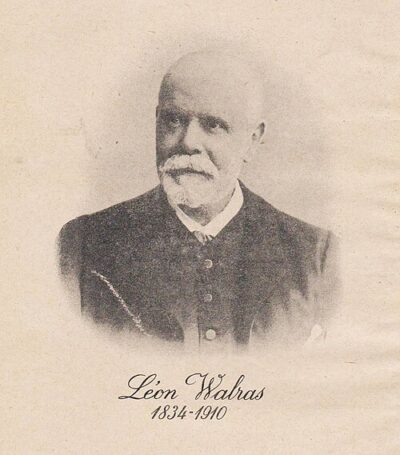
Léon Walras
Léon Walras was a French mathematical economist (*1834 – †1910). Born December 16, 1834, in Évreux. Died January 5, 1910, in Clarens. Educated at Mines ParisTech.
Facts
16 facts · 2 confirmed by two sources · 6 cited · 8 from one source
Where this comes from
Papalocal keeps its own record. It started from these sources; what each one said is kept here as it was copied, so a change on their side never changes this page by itself. Tap one to read its version.
What Wikidata says · copied November 16, 2026 · revision 2567363461
- Described as
- French mathematical economist (*1834 – †1910)
- Other names
- Leon Walras
- Born
- December 16, 1834 · 7 references
- Died
- January 5, 1910 · 6 references
- Born in
- Évreux · 2 references
- Died in
- Clarens · 1 reference
- Buried in
- Cemetery of Clarens
- Name at birth
- Léon Walras
- Citizen of
- France
- Occupation
- economist; professor; mathematician; Master's Degree in Economics · 1 reference; university teacher · 1 reference
- Worked for
- University of Lausanne
- Education
- Mines ParisTech
- Father
- Auguste Walras · 1 reference
- Religion
- Catholicism · 1 reference
- Wikipedias with a page
- 51
Wikidata item Q13509 (wikidata.org/wiki/Q13509), public domain (CC0). Copied November 16, 2026.
What Wikipedia says · copied November 16, 2026 · revision 1379800373
Marie-Esprit-Léon Walras (French: [valʁas]; 16 December 1834 – 5 January 1910) was a French mathematical economist and Georgist. He formulated the marginal theory of value (independently of William Stanley Jevons and Carl Menger) and pioneered the development of general equilibrium theory. Walras is best known for his book Éléments d'économie politique pure, a work that has contributed greatly to the mathematization of economics through the concept of general equilibrium.
For Walras, exchanges only take place after a Walrasian tâtonnement (French for "trial and error"), guided by the auctioneer, has made it possible to reach market equilibrium. It was the general equilibrium obtained from a single hypothesis, rarity, that led Joseph Schumpeter to consider him "the greatest of all economists". The notion of general equilibrium was very quickly adopted by major economists such as Vilfredo Pareto, Knut Wicksell and Gustav Cassel. John Hicks and Paul Samuelson used the Walrasian contribution in the elaboration of the neoclassical synthesis. For their part, Kenneth Arrow and Gérard Debreu, from the perspective of a logician and a mathematician, determined the conditions necessary for equilibrium.
- Born, in its opening lines
- December 16, 1834
- Died, in its opening lines
- January 5, 1910
From the Wikipedia article “Léon Walras” (en.wikipedia.org/wiki/Léon_Walras), by its contributors, under CC BY-SA 4.0 (creativecommons.org/licenses/by-sa/4.0/). Copied November 16, 2026; not changed.
Confirmed Two sources agree. Cited One source, and it names where it got it. One source One source, without a reference of its own. Sources disagree The sources disagree. We show the best-supported value and keep theirs below.
