
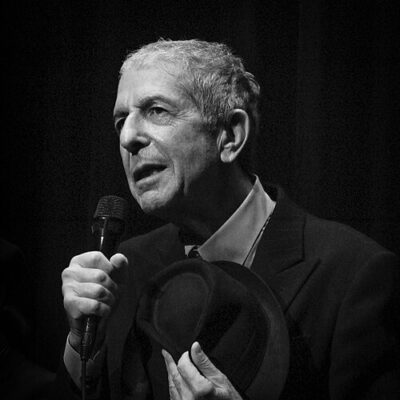
Leonard Cohen
Leonard Cohen was a Canadian singer, songwriter and poet. Born September 21, 1934, in Montreal. Died November 7, 2016, in Los Angeles. Known for Songs from a Room, Various Positions and Old Ideas. Educated at McGill University and Columbia University. Awards include Companion of the Order of Canada, Grammy Lifetime Achievement Award and Songwriters Hall of Fame.
Facts
70 facts · 2 confirmed by two sources · 43 cited · 25 from one source
Where this comes from
Papalocal keeps its own record. It started from these sources; what each one said is kept here as it was copied, so a change on their side never changes this page by itself. Tap one to read its version.
What Wikidata says · copied November 13, 2026 · revision 2559537360
- Described as
- Canadian singer, songwriter and poet (1934–2016)
- Other names
- Leonard Norman Cohen
- Born
- September 21, 1934 · 15 references
- Died
- November 7, 2016 · 13 references
- Born in
- Montreal · 3 references
- Died in
- Los Angeles · 4 references
- Buried in
- Shaar Hashomayim Cemetery · 2 references
- Cause of death
- falling · 1 reference
- Name at birth
- Leonard Norman Cohen · 2 references
- Citizen of
- Canada · 1 reference
- Occupation
- singer-songwriter · 4 references; poet · 4 references; street artist · 1 reference; novelist · 1 reference; writer · 2 references; musician · 1 reference; pianist · 1 reference; screenwriter · 1 reference
- Education
- McGill University (1951–1955); Columbia University; Westmount High School; Camp B'nai Brith; Pripstein's Camp Mishmar; Roslyn Elementary School
- Member of
- American Academy of Arts and Sciences · 1 reference
- Genre
- rock music · 3 references; spoken word · 3 references; folk rock · 3 references; sophisti-pop · 3 references; world music · 3 references; soft rock · 1 reference
- Instrument
- guitar · 1 reference; piano; voice · 1 reference
- Record label
- Columbia Records · 1 reference
- Known for
- Songs from a Room; Various Positions; Old Ideas; The Future; Hallelujah; The Favourite Game; The Energy of Slaves; Parasites of Heaven; Beautiful Losers
- Awards
- Companion of the Order of Canada (2003) · 2 references; Grammy Lifetime Achievement Award (2010) · 2 references; Songwriters Hall of Fame (2010) · 1 reference; Glenn Gould Prize (2011) · 1 reference; Grand Officer of the National Order of Quebec (2008) · 1 reference; Governor General's Performing Arts Award (1993) · 1 reference; Princess of Asturias Literary Prize (2011) · 1 reference; Rock and Roll Hall of Fame (2008) · 1 reference; Canadian Music Hall of Fame (1991); Juno Award for Video of the Year (1993); Juno Award for Songwriter of the Year (2 times) (1994, 2013); Grammy Award for Album of the Year (2007) · 1 reference; Juno Award for Artist of the Year (2013); Governor General's Award for English-language poetry or drama (1968) · 1 reference; Canada's Walk of Fame (2018) · 1 reference
- Field
- music · 1 reference; poetry · 1 reference
- Spouse
- Suzanne Elrod · 1 reference
- Children
- Adam Cohen · 1 reference; Lorca Cohen · 3 references
- Father
- Nathan Bernard Cohen
- Mother
- Marsha Klonitsky
- Religion
- Orthodox Judaism · 1 reference; Buddhism in the West · 1 reference
- Lived in
- Montreal · 1 reference; Westmount · 1 reference
- Height
- 1.75 m (5 ft 9 in) · 1 reference
- Website
- https://www.leonardcohen.com/
- Wikipedias with a page
- 131
Wikidata item Q1276 (wikidata.org/wiki/Q1276), public domain (CC0). Copied November 13, 2026.
What Wikipedia says · copied November 13, 2026 · revision 1384415684
Leonard Norman Cohen (September 21, 1934 – November 7, 2016) was a Canadian songwriter, singer, poet, and novelist. Themes commonly explored throughout his work include faith and mortality, isolation and depression, betrayal and redemption, social and political conflict, sexual and romantic love, desire, regret, and loss. He was inducted into the Canadian Music Hall of Fame, the Canadian Songwriters Hall of Fame, and the Rock and Roll Hall of Fame. He was invested as a Companion of the Order of Canada, the nation's highest civilian honour. In 2011, he received one of the Prince of Asturias Awards for literature and the ninth Glenn Gould Prize. In 2023, Rolling Stone magazine named Cohen the 103rd-greatest singer of all time.
Cohen pursued a career as a poet and novelist during the 1950s and early 1960s, and did not begin a music career until 1966. His first album, Songs of Leonard Cohen (1967), was followed by three more albums of folk music: Songs from a Room (1969), Songs of Love and Hate (1971) and New Skin for the Old Ceremony (1974). His 1977 record Death of a Ladies' Man, co-written and produced by Phil Spector, was a move away from Cohen's previous minimalist sound.
In 1979, Cohen returned with the more traditional Recent Songs, which blended his acoustic style with jazz, East Asian, and Mediterranean influences. Cohen's most famous song, "Hallelujah", was released on his seventh album, Various Positions (1984). I'm Your Man in 1988 marked Cohen's turn to synthesized productions. In 1992, Cohen released its follow-up, The Future, which had dark lyrics and references to political and social unrest.
Cohen returned to music in 2001 with the release of Ten New Songs, a major hit in Canada and Europe. His eleventh album, Dear Heather, followed in 2004. In 2005, Cohen discovered that his manager had stolen most of his money and sold his publishing rights, prompting a return to touring to recoup his losses. Following a successful string of tours between 2008 and 2013, he released three albums in the final years of his life: Old Ideas (2012), Popular Problems (2014), and You Want It Darker (2016), the last of which was released three weeks before his death. His fifteenth studio album, Thanks for the Dance, was released posthumously in November 2019.
- Born, in its opening lines
- September 21, 1934
- Died, in its opening lines
- November 7, 2016
From the Wikipedia article “Leonard Cohen” (en.wikipedia.org/wiki/Leonard_Cohen), by its contributors, under CC BY-SA 4.0 (creativecommons.org/licenses/by-sa/4.0/). Copied November 13, 2026; not changed.
Confirmed Two sources agree. Cited One source, and it names where it got it. One source One source, without a reference of its own. Sources disagree The sources disagree. We show the best-supported value and keep theirs below.
