
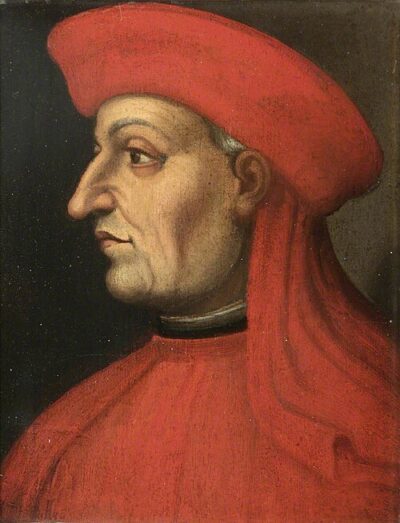
Leonardo Bruni was an Italian humanist historian (c. 1370–1444). Born 1370, in Arezzo. Died March 9, 1444, in Florence. Known for Historiae Florentini populi, Rerum suo tempore gestarum commentarius and De bello italico adversus Gothos.
Facts
28 facts · 2 confirmed by two sources · 10 cited · 16 from one source
What’s different
- Born: we show 1370 (Confirmed). Wikidata also lists 1369
Where this comes from
Papalocal keeps its own record. It started from these sources; what each one said is kept here as it was copied, so a change on their side never changes this page by itself. Tap one to read its version.
What Wikidata says · copied November 16, 2026 · revision 2564775116
- Described as
- Italian humanist historian (c. 1370–1444)
- Other names
- Lionardo Aretino, Lionardo Bruni, Leonardus Arrentinus, Lionardo Bruni d'Arezzo, Leonardo Bruni Aretino, Leonhardus Aretinus, Leonardus Aretinus, Lionardo Bruni Aretino, Leonardus Brunus Aretinus, Leonardo Aretino, Leonardi Aretini, Leonardo Aretino Bruni
- Born
- 1369 · 2 references; 1370 · 1 reference
- Died
- March 9, 1444 · 1 reference
- Born in
- Arezzo · 1 reference
- Died in
- Florence · 1 reference
- Buried in
- Basilica of Santa Croce
- Citizen of
- Republic of Florence
- Occupation
- philosopher; writer · 1 reference; translator; historian · 1 reference; politician; humanist · 2 references; scribe · 1 reference
- Known for
- Historiae Florentini populi; Rerum suo tempore gestarum commentarius; De bello italico adversus Gothos; Commentarius de bello Punico; De militia; Dialogi ad Petrum Paulum Histrum; De interpretatione recta; Crito; De studiis et litteris liber; Tyrannus
- Field
- humanism · 1 reference; literature · 1 reference; history · 1 reference; translation · 1 reference
- Religion
- Catholic Church
- Wikipedias with a page
- 50
Wikidata item Q314488 (wikidata.org/wiki/Q314488), public domain (CC0). Copied November 16, 2026.
What Wikipedia says · copied November 16, 2026 · revision 1385563565
Leonardo Bruni or Leonardo Aretino (c. 1370 – 9 March 1444) was an Italian humanist, historian and statesman, often recognized as the most important humanist historian of the early Renaissance. He has been called the first modern historian. He was the earliest person to write using the three-period view of history: Antiquity, Middle Ages, and Modern. The dates Bruni used to define the periods are not exactly what modern historians use today, but he laid the conceptual groundwork for a tripartite division of history.
- Born, in its opening lines
- c. 1370
- Died, in its opening lines
- March 9, 1444
From the Wikipedia article “Leonardo Bruni” (en.wikipedia.org/wiki/Leonardo_Bruni), by its contributors, under CC BY-SA 4.0 (creativecommons.org/licenses/by-sa/4.0/). Copied November 16, 2026; not changed.
Confirmed Two sources agree. Cited One source, and it names where it got it. One source One source, without a reference of its own. Sources disagree The sources disagree. We show the best-supported value and keep theirs below.
