
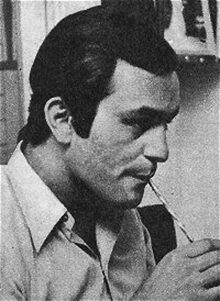
Leonardo Favio
Leonardo Favio was an Argentine singer, actor and filmmaker. Born May 28, 1938, in Las Catitas. Died November 5, 2012, in Buenos Aires.
Facts
21 facts · 2 confirmed by two sources · 9 cited · 10 from one source
Where this comes from
Papalocal keeps its own record. It started from these sources; what each one said is kept here as it was copied, so a change on their side never changes this page by itself. Tap one to read its version.
What Wikidata says · copied November 17, 2026 · revision 2569134688
- Described as
- Argentine singer, actor and filmmaker (1938–2012)
- Other names
- Fuad Jorge Jury Olivera
- Born
- May 28, 1938 · 4 references
- Died
- November 5, 2012 · 4 references
- Born in
- Las Catitas · 2 references
- Died in
- Buenos Aires · 1 reference
- Buried in
- Mausoleum of the Argentine Society of Authors and Composers
- Cause of death
- pneumonia
- Name at birth
- Fuad Jorge Jury · 1 reference
- Citizen of
- Argentina · 3 references
- Occupation
- film director · 1 reference; screenwriter · 1 reference; film producer; actor; singer · 1 reference; film actor · 1 reference; composer · 1 reference
- Political party
- Justicialist Party
- Instrument
- voice
- Spouse
- María Vaner (1967–1973)
- Children
- Leonardo Jury
- Mother
- Laura Favio
- Siblings
- Jorge Zuhair Jury
- Wikipedias with a page
- 26
Wikidata item Q44529 (wikidata.org/wiki/Q44529), public domain (CC0). Copied November 17, 2026.
What Wikipedia says · copied November 17, 2026 · revision 1329154387
Fuad Jorge Jury (28 May 1938 – 5 November 2012), better known by his stage name Leonardo Favio (Spanish pronunciation: [leoˈnaɾðo ˈfaβjo]), was an Argentine singer, actor and filmmaker. He is considered one of Argentina's best film directors and one of the country's most enduring cultural figures, as well as a popular singer-songwriter throughout Latin America.
Much beloved in Latin America, Favio was one of the most successful Argentine singers in the 1960s and 1970s, with big hits like "Ding, dong, estas cosas del amor" (with Carola Leyton), "O quizás simplemente le regale una rosa", "Fuiste mía un verano", "Ella ya me olvidó", "Quiero aprender de memoria", "Mí tristeza es mía y nada más", "Para saber cómo es la soledad", "Mi amante niña mi compañera", "Ni el clavel ni la rosa", "La foto de carnet", "No jueges más", "Chiquillada" and "La cita". He also starred in many films before establishing himself as a director.
At the time he began his singing career (mid-1960s), Favio was already an established film director. His first feature movie – Chronicle of a Boy Alone – and the second one – El Romance del Aniceto y la Francisca – are considered to be some of the best Argentine movies of all times. He continued writing and directing, releasing the now-classic films El dependiente (1969), Juan Moreira (1973) and Nazareno Cruz y el Lobo (1975), which remains the highest-grossing Argentine film in country's history. In 1976, he released the comedy-drama Soñar, soñar, with Gian Franco Pagliaro and Carlos Monzón, which had a mixed critical reception at the time of its release; it is currently considered a cult film. That same year, right after the beginning of the Argentina's last civil-military dictatorship (1976–1983), Favio was forced to go into exile to save his life from the State-sponsored terrorism which prevailed in the country. He returned to Argentina after democracy was reestablished during the 1980s onwards, later breaking a 17-year gap without filming when he released the successful biopic Gatica, el mono, before embarking in the making of his colossal six-hours' documentary Perón, sinfonía del sentimiento. Favio's last film was Aniceto (2008), a musical remake of El romance del Aniceto y la Francisca, refashioned as a ballet-inspired drama.
- Born, in its opening lines
- May 28, 1938
- Died, in its opening lines
- November 5, 2012
From the Wikipedia article “Leonardo Favio” (en.wikipedia.org/wiki/Leonardo_Favio), by its contributors, under CC BY-SA 4.0 (creativecommons.org/licenses/by-sa/4.0/). Copied November 17, 2026; not changed.
Confirmed Two sources agree. Cited One source, and it names where it got it. One source One source, without a reference of its own. Sources disagree The sources disagree. We show the best-supported value and keep theirs below.
