
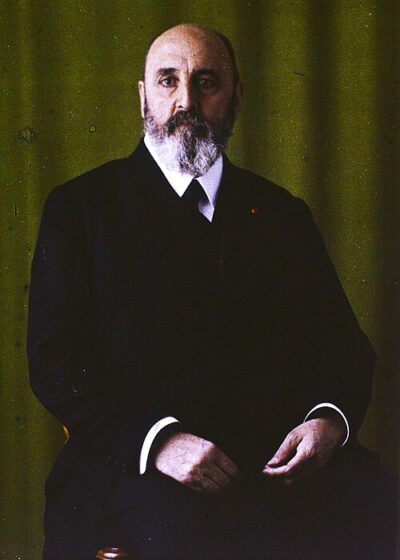
Leonardo Torres Quevedo
Leonardo Torres Quevedo was a Spanish engineer and mathematician. Born December 28, 1852, in Santa Cruz. Died December 18, 1936, in Madrid. Positions held include vocal of the Junta para Ampliación de Estudios e Investigaciones científicas (1907–), president of the Royal Academy of Exact, Physical and Natural Sciences (1928–1934) and Member of the Consultative National Assembly (1927–1930). Known for Whirlpool Aero Car, Telekine and electromechanical arithmometer. Educated at Technical University of Madrid. Awards include Grand Cross of the Order of Charles III, Grand cross of the Civil Order of Alfonso XII and Echegaray Medal.
Facts
45 facts · 2 confirmed by two sources · 16 cited · 27 from one source
Where this comes from
Papalocal keeps its own record. It started from these sources; what each one said is kept here as it was copied, so a change on their side never changes this page by itself. Tap one to read its version.
What Wikidata says · copied November 18, 2026 · revision 2557425396
- Described as
- Spanish engineer and mathematician (1852-1936)
- Other names
- Leonardo Torres y Quevedo, Torres Quevedo, Leonardo
- Born
- December 28, 1852 · 4 references
- Died
- December 18, 1936 · 5 references
- Born in
- Santa Cruz · 2 references
- Died in
- Madrid · 1 reference
- Buried in
- San Isidro Cemetery
- Citizen of
- Spain
- Occupation
- inventor; Esperantist; computer scientist; engineer; politician · 1 reference
- Positions held
- vocal of the Junta para Ampliación de Estudios e Investigaciones científicas (1907–) · 2 references; president of the Royal Academy of Exact, Physical and Natural Sciences (1928–1934) · 1 reference; Member of the Consultative National Assembly (1927–1930) · 1 reference; Member of the Royal Academy of Exact, Physical and Natural Sciences (1901–1936) · 1 reference; Member of the Royal Spanish Academy (1920–1936) · 1 reference; president of the Royal Spanish Mathematical Society (1920–1924) · 1 reference; president (1919–1920) · 1 reference
- Worked for
- Junta para Ampliación de Estudios e Investigaciones Científicas
- Education
- Technical University of Madrid · 1 reference
- Member of
- Royal Spanish Academy (1920–) · 1 reference; Royal Academy of Exact, Physical and Natural Sciences (1901–1936) · 2 references; French Academy of Sciences (1920–) · 1 reference; Sociedad de Amigos de Portugal · 1 reference; Royal Spanish Mathematical Society; Sociedad Científica Argentina (1910–); Société de physique et d'histoire naturelle de Genève (1923); Ateneo de Madrid · 2 references; Spanish association for the progress of sciences
- Known for
- Whirlpool Aero Car; Telekine; electromechanical arithmometer; Astra-Torres; El Ajedrecista
- Awards
- Grand Cross of the Order of Charles III (1921) · 1 reference; Grand cross of the Civil Order of Alfonso XII (1906) · 3 references; Echegaray Medal (1916) · 1 reference; Commander of the Legion of Honour (1922); Band of the Order of the Republic; doctor honoris causa from the University of Paris (1923) · 2 references
- Field
- aeronautics; automation; engineering; mathematics
- Lived in
- Espartinas (1889–)
- Wikipedias with a page
- 23
Wikidata item Q716862 (wikidata.org/wiki/Q716862), public domain (CC0). Copied November 18, 2026.
What Wikipedia says · copied November 18, 2026 · revision 1386316447
Leonardo Torres Quevedo (Spanish: [leoˈnaɾðo ˈtores keˈβeðo]; 28 December 1852 – 18 December 1936) was a Spanish civil engineer, mathematician, and inventor who developed numerous engineering innovations related to aerial trams, airships, catamarans, and remote control. He was also a pioneer in the fields of computing and robotics, while maintaining an active role in several scientific and cultural institutions. He held prominent positions, such as Seat N of the Real Academia Española (1920–1936) and the presidency of the Spanish Royal Academy of Sciences (1928–1934). In 1927, he became a foreign associate of the French Academy of Sciences.
His first innovative design was a cableway system patented in 1887 for the safe transport of passengers, an endeavor that led to the Mount Ulia aerial ropeway in 1907 and culminated in 1916 with the opening of the Whirlpool Aero Car at Niagara Falls. In the 1890s, Torres focused his efforts on analog computation. He published Sur les machines algébriques (1895) and Machines à calculer (1901), technical studies that earned him recognition in France for his construction of machines capable of solving real and complex roots of polynomials. At the beginning of the 20th century, he made significant aeronautical contributions by developing the non-rigid Astra-Torres airships, whose trilobed structure helped the British and French armies counter Germany's submarine warfare during World War I. This work in aeronautics led him to become a key figure in the development of radio control systems between 1901 and 1905 with the Telekino, which introduced modern wireless remote control operation principles.
From his Laboratory of Automatics established in Madrid in 1907, Torres built El Ajedrecista (The Chess Player) in 1912, an electromagnetic device capable of playing a chess endgame which demonstrated that machines could follow specific rules and heuristics, contributing to early developments in physical automata and artificial intelligence. Expanding upon the work of Charles Babbage, Torres published Essays on Automatics (1914), where he explored theories of thinking machines and designed a special-purpose electromechanical calculator that conceptually foreshadowed floating-point arithmetic. British historian Brian Randell described it as "a fascinating work which well repays reading even today." Torres later demonstrated the feasibility of an electromechanical analytical engine by successfully producing a typewriter-controlled calculating machine in 1920.
Before his retirement in 1930, Torres conceived other advanced designs, particularly in the field of naval architecture. Among the most notable were the Buque campamento (Camp-Vessel, 1913), a balloon carrier designed to transport airships attached to a mooring mast of his invention, and the Binave (Twin Ship, 1916), a multihull steel vessel featuring flexible structural joints and independent propulsion systems that solved the stability and torsion issues of earlier catamarans. In addition to his interests in engineering, Torres also stood out in the field of letters and was a prominent speaker and supporter of Esperanto.
- Born, in its opening lines
- December 28, 1852
- Died, in its opening lines
- December 18, 1936
From the Wikipedia article “Leonardo Torres Quevedo” (en.wikipedia.org/wiki/Leonardo_Torres_Quevedo), by its contributors, under CC BY-SA 4.0 (creativecommons.org/licenses/by-sa/4.0/). Copied November 18, 2026; not changed.
Confirmed Two sources agree. Cited One source, and it names where it got it. One source One source, without a reference of its own. Sources disagree The sources disagree. We show the best-supported value and keep theirs below.
