
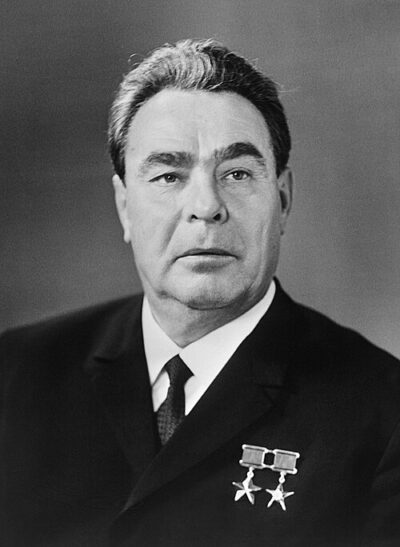
Leonid Brezhnev
Leonid Brezhnev was a General Secretary of the Communist Party of the Soviet Union. Born December 6, 1906, in Kamyanske. Died November 10, 1982, in Zarechye. Positions held include General Secretary of the Communist Party of the Soviet Union (1964–1982), Chairman of the Presidium of the Supreme Soviet of the Soviet Union (2 times) (1960–1982) and member of the Supreme Soviet of the Russian Soviet Federative Socialist Republic. Known for Brezhnev's trilogy. Educated at Dniprovsky State Technical University. Awards include Order of Lenin (8 times), Medal "For the Victory over Germany in the Great Patriotic War 1941–1945" and Order of the Red Banner (2 times).
Facts
52 facts · 1 confirmed by two sources · 6 cited · 44 from one source · 1 where the sources disagree
What’s different
- Born: we show December 6, 1906 (Sources disagree). Wikipedia says December 19, 1906
Where this comes from
Papalocal keeps its own record. It started from these sources; what each one said is kept here as it was copied, so a change on their side never changes this page by itself. Tap one to read its version.
What Wikidata says · copied November 16, 2026 · revision 2568964979
- Described as
- General Secretary of the Communist Party of the Soviet Union (1906–1982)
- Other names
- Brezhnev, Leonid Ilyich Brezhnev
- Born
- December 6, 1906
- Died
- November 10, 1982 · 10 references
- Born in
- Kamyanske
- Died in
- Zarechye
- Buried in
- Kremlin Wall Necropolis
- Cause of death
- myocardial infarction
- Citizen of
- Russian Empire; Russian Socialist Federative Soviet Republic (–1922); Soviet Union
- Occupation
- politician · 2 references; engineer; military personnel; surveyor; film actor · 1 reference
- Positions held
- General Secretary of the Communist Party of the Soviet Union (1964–1982); Chairman of the Presidium of the Supreme Soviet of the Soviet Union (2 times) (1960–1982) · 2 references; member of the Supreme Soviet of the Russian Soviet Federative Socialist Republic; First Secretary of the Central Committee of the Communist Party of Kazakhstan (1955–1956); Secretary of the Communist Party of the Soviet Union (1963–1964); Candidate member of the Politburo of the CPSU Central Committee (2 times) (1952–1957); Member of the Politburo of the CPSU Central Committee (1957–1982)
- Political party
- Communist Party of the Soviet Union (1931–1982)
- Education
- Dniprovsky State Technical University (1931–1935)
- Member of
- Politburo of the Central Committee of the Communist Party of the Soviet Union (1957–1982)
- Known for
- Brezhnev's trilogy
- Awards
- Order of Lenin (8 times) (1947, 1956, 1961, 1966, 1971, 1976, 1978, 1981); Medal "For the Victory over Germany in the Great Patriotic War 1941–1945" (1945); Order of the Red Banner (2 times) (1942, 1944); Order of the Red Star (1943); Order of the October Revolution (2 times) (1979, 1980); Order of Karl Marx (3 times) (1974, 1979, 1981) · 1 reference; Order of the White Lion (1946); Order of Klement Gottwald (4 times) (1970, 1976, 1978, 1981); Order of the Patriotic War, 1st class (1943); Order of Victory (1978–1989); Order of Bogdan Khmelnitsky, 2nd class (1945); Medal "For the Defence of Odessa" (1942); Medal "For Battle Merit"; Medal "For the Defence of the Caucasus" (1944); Medal "For the Liberation of Warsaw"
- Spouse
- Viktoria Brezhneva (1928–1982)
- Children
- Yuri Brezhnev; Galina Brezhneva
- Father
- Ilya Brezhnev · 1 reference
- Mother
- Natalia Brezhneva · 1 reference
- Siblings
- Yakov Brezhnev
- Religion
- atheism
- Military branch
- Soviet Army · 1 reference
- Military rank
- Marshal of the Soviet Union (1976–); brigade commissar (1941–); colonel (1942–)
- Lived in
- Moscow
- Wikipedias with a page
- 140
Wikidata item Q765165 (wikidata.org/wiki/Q765165), public domain (CC0). Copied November 16, 2026.
What Wikipedia says · copied November 16, 2026 · revision 1385846236
Leonid Ilyich Brezhnev (19 December 1906 – 10 November 1982) was a Soviet politician who served as General Secretary of the Communist Party of the Soviet Union from 1964 until his death in 1982. He also held office as Chairman of the Presidium of the Supreme Soviet (head of state) from 1960 to 1964 and later from 1977 to 1982. His tenure as General Secretary was second only to Joseph Stalin's in duration.
Brezhnev was born to a working-class family in Kamenskoye within the Yekaterinoslav Governorate of the Russian Empire. After the October Revolution created the Soviet Union, he joined the ruling Communist party's youth league in 1923 before becoming an official party member in 1929. When Nazi Germany invaded the Soviet Union in June 1941, he joined the Red Army as a commissar and rose rapidly through the ranks to become a major general during World War II. After the war ended, Brezhnev was promoted to the party's Central Committee in 1952 and became a full member of the Politburo by 1957. In 1964, he took part in the removal of Nikita Khrushchev as leader of the Soviet Union and replaced him as First Secretary of the CPSU. When Khrushchev was ousted, Brezhnev formed a triumvirate alongside Premier Alexei Kosygin and CC Secretary Nikolai Podgorny that initially led the country in Khrushchev's place. By the end of the 1960s, he had successfully consolidated power to become the dominant figure within the Soviet leadership.
In the short term, Brezhnev's governance improved the Soviet Union's international standing while stabilizing the position of its ruling party at home. Whereas Khrushchev regularly enacted policies without consulting the Politburo, Brezhnev was careful to minimize dissent among the party elite by reaching decisions through consensus, thereby restoring the semblance of collective leadership. Additionally, while pushing for détente between the two Cold War superpowers, he achieved nuclear parity with the United States and strengthened Moscow's dominion over Central and Eastern Europe. Furthermore, the country's massive arms buildup and widespread military interventionism under Brezhnev's leadership served to substantially expand Soviet influence abroad, particularly in the Middle East and Africa. By the mid-1970s, numerous observers argued that the Soviet Union had surpassed the United States to become the world's strongest military power.
Conversely, Brezhnev's leadership also witnessed a significant increase in repression and censorship throughout the Soviet Union compared with the relatively liberal years of the Khrushchev Thaw. Ultimately, Brezhnev's hostility towards political and economic reform ushered in an era of socioeconomic decline referred to as the Era of Stagnation. In addition to pervasive corruption within the country, this period was characterized by the shrinking availability of consumer goods and declining economic growth.
After 1975, Brezhnev's health rapidly deteriorated and he increasingly withdrew himself from governing the country despite remaining its highest authority. He eventually died on 10 November 1982 and was succeeded as General Secretary by Yuri Andropov. Upon coming to power in 1985, Mikhail Gorbachev denounced Brezhnev's government for its inefficiency and inflexibility before launching a campaign to liberalize the Soviet Union. Notwithstanding the backlash to his regime's policies in the mid-1980s, Brezhnev's rule has received consistently high approval ratings in public polls conducted in post-Soviet Russia.
- Born, in its opening lines
- December 19, 1906
- Died, in its opening lines
- November 10, 1982
From the Wikipedia article “Leonid Brezhnev” (en.wikipedia.org/wiki/Leonid_Brezhnev), by its contributors, under CC BY-SA 4.0 (creativecommons.org/licenses/by-sa/4.0/). Copied November 16, 2026; not changed.
Confirmed Two sources agree. Cited One source, and it names where it got it. One source One source, without a reference of its own. Sources disagree The sources disagree. We show the best-supported value and keep theirs below.
