
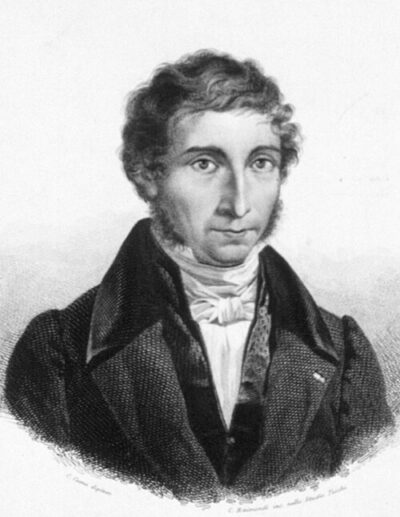
Leopoldo Nobili
Leopoldo Nobili was a physicist. Born July 5, 1784, in Trassilico. Died August 22, 1835, in Florence. Educated at Military Academy of Modena. Awards include Knight of the Legion of Honour and honorary member of the Physics Association (Frankfurt am Main, Germany).
Facts
13 facts · 0 confirmed by two sources · 7 cited · 6 from one source
Where this comes from
Papalocal keeps its own record. It started from these sources; what each one said is kept here as it was copied, so a change on their side never changes this page by itself. Tap one to read its version.
What Wikidata says · copied November 17, 2026 · revision 2568681660
- Described as
- physicist (1784-1835)
- Born
- July 5, 1784 · 2 references
- Died
- August 22, 1835 · 1 reference
- Born in
- Trassilico · 1 reference
- Died in
- Florence · 2 references
- Occupation
- physicist · 1 reference
- Education
- Military Academy of Modena
- Member of
- Royal Prussian Academy of Sciences; Accademia Nazionale delle Scienze detta dei XL; Académie Nationale de Médecine; Academy of Sciences of Turin (1829–) · 1 reference
- Awards
- Knight of the Legion of Honour; honorary member of the Physics Association (Frankfurt am Main, Germany) (1835) · 1 reference
- Field
- physics
- Wikipedias with a page
- 24
Wikidata item Q983393 (wikidata.org/wiki/Q983393), public domain (CC0). Copied November 17, 2026.
What Wikipedia says · copied November 17, 2026 · revision 1367146887
Leopoldo Nobili, born on 5 July 1784 in Trassilico (Toscana) and died on 22 August 1835 in Florence, was an Italian physicist who invented a number of instruments critical to investigating thermodynamics and electrochemistry.
Born Trassilico, Garfagnana, after attending the Military Academy of Modena he became an artillery officer. He was awarded the Légion d'honneur for his service in Napoleon's invasion of Russia.
In 1825, he developed the astatic galvanometer.He worked with Macedonio Melloni on the thermomultiplier, a combination of thermopile and galvanometer, before being appointed professor of physics at the Reale Museo di Fisica e Storia Naturale (Royal Museum of Physics and Natural History) in Florence where he worked with Vincenzo Antinori on electromagnetic induction.
He was also credited with the discovery of 'Nobili's Rings'. "When a dilute solution of copper acetate is placed on a bright silver plate and a strip of zinc is touched to the silver beneath the copper, a series of rings of copper are formed by electrolysis around the zinc."
From the Wikipedia article “Leopoldo Nobili” (en.wikipedia.org/wiki/Leopoldo_Nobili), by its contributors, under CC BY-SA 4.0 (creativecommons.org/licenses/by-sa/4.0/). Copied November 17, 2026; not changed.
Confirmed Two sources agree. Cited One source, and it names where it got it. One source One source, without a reference of its own. Sources disagree The sources disagree. We show the best-supported value and keep theirs below.
