
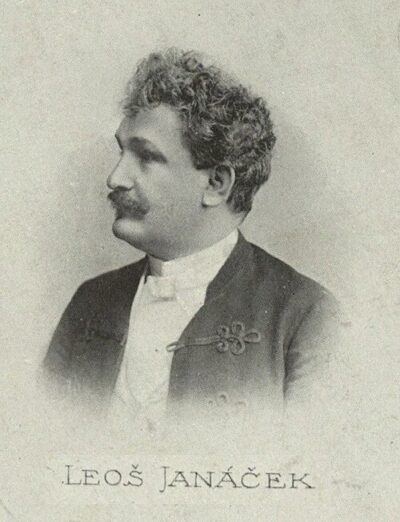
Leoš Janáček
Leoš Janáček was a Czech composer. Born July 3, 1854, in Hukvaldy. Died August 12, 1928, in Moravská Ostrava. Known for Jenůfa, The Cunning Little Vixen and Káťa Kabanová. Educated at University of Music and Theatre Leipzig. Awards include honorary doctorate of the Masaryk University.
Facts
35 facts · 2 confirmed by two sources · 14 cited · 19 from one source
Where this comes from
Papalocal keeps its own record. It started from these sources; what each one said is kept here as it was copied, so a change on their side never changes this page by itself. Tap one to read its version.
What Wikidata says · copied November 16, 2026 · revision 2568736099
- Described as
- Czech composer (1854–1928)
- Other names
- Leosh I︠A︡nachek, L. I︠A︡nachek, Leo Eugen Janáček, L. Janáček, Leos Janácek, Leos Janacek
- Born
- July 3, 1854 · 21 references
- Died
- August 12, 1928 · 22 references
- Born in
- Hukvaldy · 4 references
- Died in
- Moravská Ostrava · 1 reference
- Buried in
- Brno Central Cemetery · 1 reference
- Cause of death
- pneumonia
- Name at birth
- Leo Eugen Janáček
- Citizen of
- Austrian Empire; Czechoslovakia
- Occupation
- composer · 5 references; musicologist; pedagogue; conductor · 2 references; librettist; teacher · 2 references; folklorist · 2 references; music critic · 1 reference
- Education
- University of Music and Theatre Leipzig (1879–1880) · 1 reference
- Member of
- Sokol Brno I · 1 reference; Czech Academy of Science and Art · 1 reference
- Genre
- classical music; opera
- Instrument
- organ
- Known for
- Jenůfa; The Cunning Little Vixen; Káťa Kabanová; The Makropulos Affair; From the House of the Dead; Sinfonietta
- Awards
- honorary doctorate of the Masaryk University (1925) · 1 reference
- Spouse
- Zdeňka Janáčková (1881) · 1 reference
- Children
- Olga Janáčková
- Father
- Jiří Janáček · 1 reference
- Mother
- Amálie Janáčková
- Religion
- atheism
- Wikipedias with a page
- 65
Wikidata item Q184933 (wikidata.org/wiki/Q184933), public domain (CC0). Copied November 16, 2026.
What Wikipedia says · copied November 16, 2026 · revision 1373621220
Leoš Janáček (Czech: [ˈlɛoʃ ˈjanaːtʃɛk] ; 3 July 1854 – 12 August 1928) was a Czech composer, music theorist, folklorist, and teacher. He was inspired by Moravian and other Slavic music, including Eastern European folk music, to create an original, modern musical style.
Born in Hukvaldy, Janáček demonstrated musical talent at an early age and was educated in Brno, Prague, Leipzig, and Vienna. He then returned to live in Brno, where he married his pupil Zdenka Schulzová and devoted himself mainly to folkloristic research. His earlier musical output was influenced by contemporaries such as Antonín Dvořák, but around the turn of the century he began to incorporate his earlier studies of national folk music, as well as his transcriptions of "speech melodies" of spoken language, to create a modern, highly original synthesis. The death of his daughter Olga in 1903 had a profound effect on his musical output; these notable transformations were first evident in the opera Jenůfa (often called the "Moravian national opera"), which premiered in 1904 in Brno.
In the following years, Janáček became frustrated with a lack of recognition from Prague, but this was finally relieved by the success of a revised edition of Jenůfa at the National Theatre in 1916, which gave Janáček access to the world's great opera stages. Janáček's later works are his most celebrated. They include operas such as Káťa Kabanová and The Cunning Little Vixen, the Sinfonietta, the Glagolitic Mass, the rhapsody Taras Bulba, two string quartets, and other chamber works. Many of Janáček's later works were influenced by Czech and Russian literature, his pan-Slavist sentiments, and his infatuation with Kamila Stösslová.
After his death in 1928, Janáček's work was heavily promoted on the world opera stage by the Australian conductor Charles Mackerras, who also restored some of his compositions to their original, unrevised forms. In his homeland he inspired a new generation of Czech composers including several of his students. Today he is considered one of the most important Czech composers, along with Dvořák and Bedřich Smetana.
- Born, in its opening lines
- July 3, 1854
- Died, in its opening lines
- August 12, 1928
From the Wikipedia article “Leoš Janáček” (en.wikipedia.org/wiki/Leoš_Janáček), by its contributors, under CC BY-SA 4.0 (creativecommons.org/licenses/by-sa/4.0/). Copied November 16, 2026; not changed.
Confirmed Two sources agree. Cited One source, and it names where it got it. One source One source, without a reference of its own. Sources disagree The sources disagree. We show the best-supported value and keep theirs below.
