
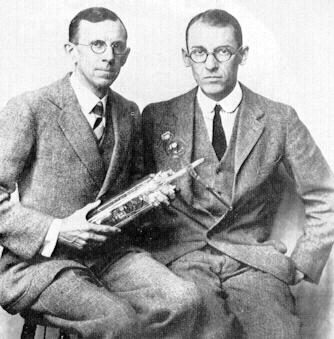
Lester Germer
Lester Germer was an American physicist. Born October 10, 1896, in Chicago. Died October 3, 1971, in Shawangunk Ridge. Educated at Columbia University. Awards include Elliott Cresson Medal and Fellow of the American Physical Society.
Facts
12 facts · 2 confirmed by two sources · 3 cited · 7 from one source
Where this comes from
Papalocal keeps its own record. It started from these sources; what each one said is kept here as it was copied, so a change on their side never changes this page by itself. Tap one to read its version.
What Wikidata says · copied November 15, 2026 · revision 2569693928
- Described as
- American physicist (1896–1971)
- Other names
- L. H. Gemer, Lester Halbert Germer, L.H. Germer
- Born
- October 10, 1896 · 3 references
- Died
- October 3, 1971 · 3 references
- Born in
- Chicago · 1 reference
- Died in
- Shawangunk Ridge
- Citizen of
- United States
- Occupation
- physicist · 1 reference; mountaineer · 1 reference
- Education
- Columbia University
- Sport
- mountaineering
- Awards
- Elliott Cresson Medal (1931) · 1 reference; Fellow of the American Physical Society
- Field
- physics · 1 reference
- Wikipedias with a page
- 25
Wikidata item Q496877 (wikidata.org/wiki/Q496877), public domain (CC0). Copied November 15, 2026.
What Wikipedia says · copied November 15, 2026 · revision 1376345185
Lester Halbert Germer (October 10, 1896 – October 3, 1971) was an American physicist. With Clinton Davisson, he proved the wave-particle duality of matter in the Davisson–Germer experiment, which was important to the development of the electron microscope. These studies supported the theoretical work of De Broglie. He also studied thermionics, erosion of metals, and contact physics. He was awarded the Elliott Cresson Medal in 1931.
A former fighter pilot in World War I, Germer started to work at Bell Labs in 1919, while the Labs was still part of Western Electric. He was a graduate student lab assistant at the time he worked on the famous experiment that would eventually bring the Nobel Prize to Davisson. (Despite being nominated for the Nobel Prize 26 times alongside Davisson, Germer did not share the award.) Later, he headed the Labs’ contact physics department, and developed equipment that allowed for the visual display of low-energy electron diffraction patterns on a fluorescent screen. He retired in early 1960s.
In 1945 (at the age of 49), Germer launched a side career as a rock climber. He climbed widely around the Northeast United States, and especially at New York's Shawangunk Ridge. Although the Appalachian Mountain Club was dominant in the area at the time, and strictly regulated rock climbing, Lester was never associated with the club, and found himself in conflict with the leading climber in the area, Hans Kraus, who was head of the AMC's Safety Committee. He was once turned down for climbing certification with the comment "Likes people too much and is too enthusiastic." Lester was known for being generous and friendly. He was once called "A one man climbing school."
In 1971, one week before his 75th birthday, Lester Germer died of a massive heart attack while lead climbing a rock climb at the Shawangunk Ridge (Double Chin, 5.6). Until that moment, Lester had a 26-year perfect safety record in rock climbing; he had never even taken a leader fall.
- Born, in its opening lines
- October 10, 1896
- Died, in its opening lines
- October 3, 1971
From the Wikipedia article “Lester Germer” (en.wikipedia.org/wiki/Lester_Germer), by its contributors, under CC BY-SA 4.0 (creativecommons.org/licenses/by-sa/4.0/). Copied November 15, 2026; not changed.
Confirmed Two sources agree. Cited One source, and it names where it got it. One source One source, without a reference of its own. Sources disagree The sources disagree. We show the best-supported value and keep theirs below.
