
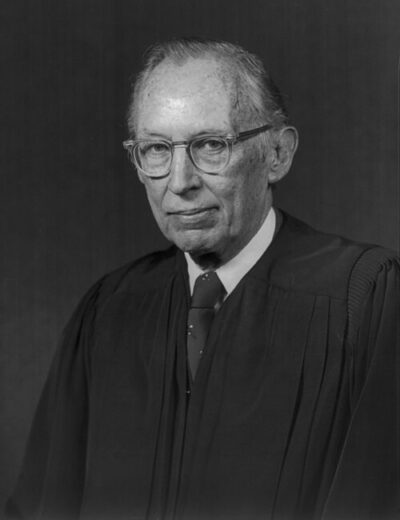
Lewis F. Powell Jr.
Lewis F. Powell Jr. was an American jurist (1907–1998); US Supreme Court justice from 1972 to 1987. Born September 19, 1907, in Suffolk. Died August 25, 1998, in Richmond. Positions held include Associate Justice of the Supreme Court of the United States (1972–1987). Known for Attack on American Free Enterprise System. Educated at Washington and Lee University and Harvard Law School. Awards include Bronze Star Medal and Legionnaire of Legion of Merit.
Facts
20 facts · 2 confirmed by two sources · 2 cited · 16 from one source
Where this comes from
Papalocal keeps its own record. It started from these sources; what each one said is kept here as it was copied, so a change on their side never changes this page by itself. Tap one to read its version.
What Wikidata says · copied November 18, 2026 · revision 2554059140
- Described as
- American jurist (1907–1998); US Supreme Court justice from 1972 to 1987
- Other names
- Lewis Franklin Powell, Jr., Lewis Franklin Powell Jr., Lewis Powell, Lewis F. Powell, Lewis Franklin Powell, Louis Powell
- Born
- September 19, 1907 · 4 references
- Died
- August 25, 1998 · 5 references
- Born in
- Suffolk
- Died in
- Richmond
- Buried in
- Hollywood Cemetery · 1 reference
- Cause of death
- pneumonia
- Citizen of
- United States
- Occupation
- judge; lawyer; politician; jurist · 1 reference
- Positions held
- Associate Justice of the Supreme Court of the United States (1972–1987)
- Political party
- Democratic Party
- Education
- Washington and Lee University; Harvard Law School; Washington and Lee University School of Law
- Member of
- American Academy of Arts and Sciences
- Known for
- Attack on American Free Enterprise System
- Awards
- Bronze Star Medal; Legionnaire of Legion of Merit
- Wikipedias with a page
- 15
Wikidata item Q252739 (wikidata.org/wiki/Q252739), public domain (CC0). Copied November 18, 2026.
What Wikipedia says · copied November 18, 2026 · revision 1369477262
Lewis Franklin Powell Jr. (September 19, 1907 – August 25, 1998) was an American lawyer and jurist who served as an associate justice of the Supreme Court of the United States from 1972 to 1987.
Born in Suffolk, Virginia, he graduated from Washington and Lee University School of Law and Harvard Law School and served in the United States Army Air Forces during World War II. He worked for Hunton & Williams, a large law firm in Richmond, Virginia, focusing on corporate law and representing clients such as the Tobacco Institute. His 1971 Powell Memorandum became the blueprint for the rise of the American conservative movement and the formation of a network of influential right-wing think tanks and lobbying organizations, such as The Heritage Foundation and the American Legislative Exchange Council. In 1971, President Richard Nixon appointed Powell to succeed the late Associate Justice Hugo Black. He retired from the court during the administration of President Ronald Reagan, and was eventually succeeded by Anthony Kennedy.
His tenure largely overlapped with that of Chief Justice Warren Burger, and Powell was often a key swing vote on the Burger Court. His majority opinions include United States v. Brignoni-Ponce (1975), Gregg v. Georgia (1976), First National Bank of Boston v. Bellotti (1978), Solem v. Helm (1983), and McCleskey v. Kemp (1987), and he wrote an influential opinion in Regents of the University of California v. Bakke (1978). He notably joined the majority in controversial cases such as United States v. United States District Court (1972), Roe v. Wade (1973), Milliken v. Bradley (1974), Harris v. McRae (1980), Plyler v. Doe (1982), and Bowers v. Hardwick (1986).
- Born, in its opening lines
- September 19, 1907
- Died, in its opening lines
- August 25, 1998
From the Wikipedia article “Lewis F. Powell Jr.” (en.wikipedia.org/wiki/Lewis_F._Powell_Jr.), by its contributors, under CC BY-SA 4.0 (creativecommons.org/licenses/by-sa/4.0/). Copied November 18, 2026; not changed.
Confirmed Two sources agree. Cited One source, and it names where it got it. One source One source, without a reference of its own. Sources disagree The sources disagree. We show the best-supported value and keep theirs below.
