
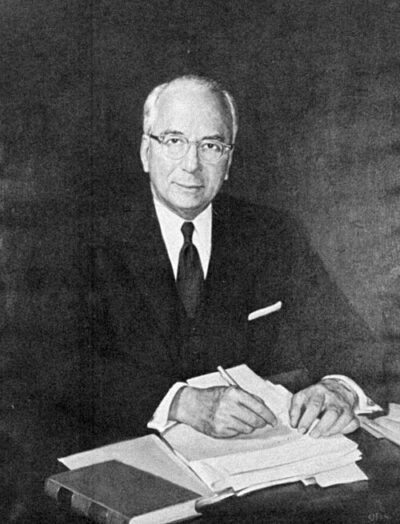
Lewis Strauss
Lewis Strauss was an American banker and chairman of the U.S. Atomic Energy Commission. Born January 31, 1896, in Charleston. Died January 21, 1974, in Brandy Station. Positions held include United States Secretary of Commerce. Awards include Medal of Freedom.
Facts
17 facts · 2 confirmed by two sources · 5 cited · 10 from one source
Where this comes from
Papalocal keeps its own record. It started from these sources; what each one said is kept here as it was copied, so a change on their side never changes this page by itself. Tap one to read its version.
What Wikidata says · copied November 15, 2026 · revision 2562687281
- Described as
- American banker and chairman of the U.S. Atomic Energy Commission (1896-1974)
- Other names
- Lewis Lichtenstein Strauss, Lewis L. Strauss
- Born
- January 31, 1896 · 3 references
- Died
- January 21, 1974 · 3 references
- Born in
- Charleston
- Died in
- Brandy Station
- Buried in
- Salem Fields Cemetery · 1 reference
- Citizen of
- United States
- Occupation
- politician · 2 references; businessperson · 1 reference; naval officer; admiral · 1 reference; banker · 1 reference
- Positions held
- United States Secretary of Commerce
- Political party
- Republican Party
- Awards
- Medal of Freedom (1958) · 1 reference
- Military branch
- United States Navy Reserve (1925–1941); United States Navy (1941–1945)
- Military rank
- rear admiral
- Wikipedias with a page
- 25
Wikidata item Q1822160 (wikidata.org/wiki/Q1822160), public domain (CC0). Copied November 15, 2026.
What Wikipedia says · copied November 15, 2026 · revision 1384097644
Lewis Lichtenstein Strauss (; January 31, 1896 – January 21, 1974) was an American government official, businessman, philanthropist, and naval officer. He was one of the original members of the United States Atomic Energy Commission (AEC) in 1946 and he served as the commission's chairman in the 1950s. Strauss was a major figure in the development of nuclear weapons after World War II, nuclear energy policy, and nuclear power in the United States.
Raised in Richmond, Virginia, Strauss became an assistant to Herbert Hoover as part of the Commission for Relief in Belgium during World War I and the American Relief Administration after that. Strauss then worked as an investment banker at Kuhn, Loeb & Co. during the 1920s and 1930s, where he amassed considerable wealth. As a member of the executive committee of the American Jewish Committee and several other Jewish organizations in the 1930s, Strauss made several attempts to change U.S. policy in order to accept more refugees from Nazi Germany but was unsuccessful. He also came to know and fund some of the research of refugee nuclear physicist Leo Szilard. During World War II, Strauss served as an officer in the U.S. Navy Reserve and rose to the rank of rear admiral due to his work in the Bureau of Ordnance in managing and rewarding plants engaged in production of munitions.
As a founding commissioner with the AEC during the early years of the Cold War, Strauss emphasized the need to protect U.S. atomic secrets and to monitor and stay ahead of atomic developments within the Soviet Union. Accordingly, he was a strong proponent of developing the hydrogen bomb. During his stint as chairman of the AEC, Strauss urged the development of peaceful uses of atomic energy, and he predicted that atomic power would make electricity "too cheap to meter". At the same time, he downplayed the possible health effects of radioactive fallout such as that experienced by Pacific Islanders following the Castle Bravo thermonuclear test.
Strauss was the driving force behind physicist J. Robert Oppenheimer's security clearance hearing, held in April and May 1954 before an AEC Personnel Security Board, in which Oppenheimer's security clearance was revoked. President Dwight D. Eisenhower's nomination of Strauss to become U.S. secretary of commerce resulted in a prolonged, public political battle in 1959 where Strauss was not confirmed by the U.S. Senate.
- Born, in its opening lines
- January 31, 1896
- Died, in its opening lines
- January 21, 1974
From the Wikipedia article “Lewis Strauss” (en.wikipedia.org/wiki/Lewis_Strauss), by its contributors, under CC BY-SA 4.0 (creativecommons.org/licenses/by-sa/4.0/). Copied November 15, 2026; not changed.
Confirmed Two sources agree. Cited One source, and it names where it got it. One source One source, without a reference of its own. Sources disagree The sources disagree. We show the best-supported value and keep theirs below.
