
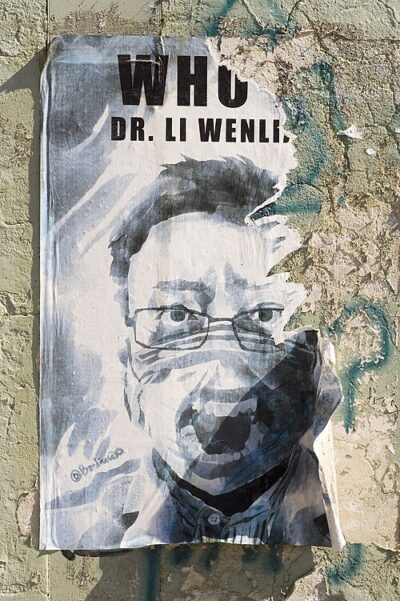
Li Wenliang
Li Wenliang was a Chinese ophthalmologist known for warning about the novel coronavirus in December 2019. Born October 12, 1985, in Beizhen City. Died February 7, 2020, in Wuhan. Educated at Wuhan University School of Medicine. Awards include Paracelsus Medal of the German Medical Association.
Facts
18 facts · 2 confirmed by two sources · 5 cited · 11 from one source
Where this comes from
Papalocal keeps its own record. It started from these sources; what each one said is kept here as it was copied, so a change on their side never changes this page by itself. Tap one to read its version.
What Wikidata says · copied November 16, 2026 · revision 2568469408
- Described as
- Chinese ophthalmologist known for warning about the novel coronavirus in December 2019 (1985-2020)
- Other names
- Li_Wenliang, Wenliang Li, Wen Liang Li, Li Wen Liang
- Born
- October 12, 1985 · 1 reference
- Died
- February 7, 2020 · 1 reference
- Born in
- Beizhen City
- Died in
- Wuhan · 1 reference
- Cause of death
- COVID-19 · 1 reference
- Citizen of
- People's Republic of China · 1 reference
- Occupation
- ophthalmologist · 2 references; physician
- Political party
- Chinese Communist Party (2005–2020) · 1 reference
- Worked for
- Central Hospital of Wuhan (2014–2020)
- Education
- Wuhan University School of Medicine (2004–2011)
- Awards
- Paracelsus Medal of the German Medical Association (2021)
- Field
- ophthalmology; COVID-19 pandemic
- Spouse
- Fu Xuejie · 1 reference
- Lived in
- Wuhan (2 times) (2004–2020); Xiamen (2011–2014); Beizhen City (1986–2004)
- Wikipedias with a page
- 63
Wikidata item Q84497471 (wikidata.org/wiki/Q84497471), public domain (CC0). Copied November 16, 2026.
What Wikipedia says · copied November 16, 2026 · revision 1374154167
Li Wenliang (Chinese: 李文亮; 12 October 1985 – 7 February 2020) was a Chinese ophthalmologist who warned his colleagues about early COVID-19 infections in Wuhan.
On 30 December 2019, Wuhan Centres for Disease Prevention and Control (Wuhan CDC) issued emergency warnings to local hospitals about a number of mysterious "pneumonia" cases discovered in the city in the previous week. On the same day, Li, who worked at the Central Hospital of Wuhan, received an internal diagnostic report of a suspected severe acute respiratory syndrome (SARS) patient from other doctors, which he in turn shared with his Wuhan University alumni through a WeChat group.
Li was dubbed a whistleblower when that shared report later circulated publicly, despite his messaging to his alumni WeChat group to not spread the message outside of the group with the exception to only "remind their family members and loved ones to be on the alert". Li did not appear to have intentions of warning the wider public. Rumors of a deadly SARS outbreak subsequently spread on Chinese social media platforms; Wuhan police summoned and admonished him and seven other doctors on 3 January for "making false comments on the Internet about unconfirmed SARS outbreak."
The outbreak was later confirmed not to be SARS, but rather a new coronavirus, SARS-CoV-2. Li returned to work and later contracted COVID-19, the disease caused by the virus, from a patient who was not known to be infected. He died from the disease on 7 February 2020, at age 34. A subsequent Chinese official inquiry exonerated him; Wuhan police formally apologized to his family and revoked his admonishment on 19 March. In April 2020, Li was posthumously awarded the May Fourth Medal by the government. By early June 2020, five more doctors from the Wuhan hospital had died from COVID-19.
- Born, in its opening lines
- October 12, 1985
- Died, in its opening lines
- February 7, 2020
From the Wikipedia article “Li Wenliang” (en.wikipedia.org/wiki/Li_Wenliang), by its contributors, under CC BY-SA 4.0 (creativecommons.org/licenses/by-sa/4.0/). Copied November 16, 2026; not changed.
Confirmed Two sources agree. Cited One source, and it names where it got it. One source One source, without a reference of its own. Sources disagree The sources disagree. We show the best-supported value and keep theirs below.
