
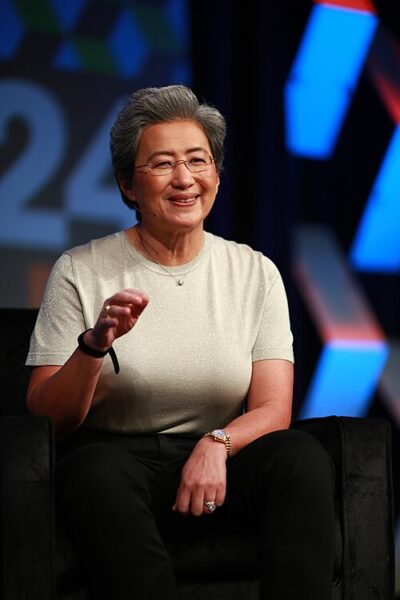
Lisa Su
Lisa Su is an American business executive and electrical engineer. Born November 7, 1969, in Tainan County. Positions held include chief executive officer (2014–) and board of directors member (2014–). Educated at Massachusetts Institute of Technology. Awards include IEEE Fellow, IEEE Robert N. Noyce Medal and Women in Technology Hall of Fame.
Facts
24 facts · 1 confirmed by two sources · 9 cited · 14 from one source
Where this comes from
Papalocal keeps its own record. It started from these sources; what each one said is kept here as it was copied, so a change on their side never changes this page by itself. Tap one to read its version.
What Wikidata says · copied November 15, 2026 · revision 2568561546
- Described as
- American business executive and electrical engineer
- Other names
- Lisa T. Su, Lisa Tzwu-Fang Su, Dr. Lisa Su
- Born
- November 7, 1969
- Born in
- Tainan County
- Citizen of
- United States
- Occupation
- chief executive officer; entrepreneur; electrical engineer
- Positions held
- chief executive officer (2014–) · 1 reference; board of directors member (2014–) · 1 reference
- Worked for
- AMD (2012–) · 1 reference; Texas Instruments (1994–); IBM Research (1995–); Freescale Semiconductor (2007–)
- Education
- Massachusetts Institute of Technology (1994) · 2 references
- Member of
- American Academy of Arts and Sciences; Analog Devices; Cisco
- Awards
- IEEE Fellow (2009) · 1 reference; IEEE Robert N. Noyce Medal (2021) · 1 reference; Women in Technology Hall of Fame (2021) · 1 reference; Time 100 (2025) · 1 reference; National Medal of Science (2026) · 1 reference
- Father
- Chun Hwai Tom Su
- Lived in
- Texas; Austin
- Wikipedias with a page
- 36
Wikidata item Q18207172 (wikidata.org/wiki/Q18207172), public domain (CC0). Copied November 15, 2026.
What Wikipedia says · copied November 15, 2026 · revision 1385668565
Lisa Tzwu-Fang Su (born November 7, 1969) is a Taiwanese and American business executive, computer scientist, and electrical engineer who has been the president and CEO of the American semiconductor company AMD since 2014.
Su was born in Taiwan and immigrated to the United States with her family as a young child. After earning three degrees from the Massachusetts Institute of Technology (MIT), she worked at Texas Instruments, IBM, and Freescale Semiconductor in engineering and management positions. She is known for her work developing silicon-on-insulator semiconductor manufacturing technologies and more efficient semiconductor chips during her time as vice president of IBM's Semiconductor Research and Development Center. Su is also a member of The Business Council.
Su was appointed president and CEO of AMD in October 2014, after joining the company in 2012 and holding roles such as senior vice president of AMD's global business units and chief operating officer. She previously was on the board of Cisco and is currently on the board of the U.S. Semiconductor Industry Association, in addition to being a fellow of the Institute of Electrical and Electronics Engineers (IEEE).
Recognized with a number of awards and accolades, Su was named Executive of the Year by EE Times in 2014, one of the World's Greatest Leaders in 2017 by Fortune and was the first woman to be named Time magazine CEO of the year in 2014, and a second time in 2024. She also became the first woman to receive the IEEE Robert Noyce Medal in 2021. During her tenure as CEO of AMD, the market capitalization of AMD has grown from roughly $3 billion to more than $1 trillion. AMD also overtook Intel in market capitalization for the first time. In 2024, Su was selected the Fellow of Industrial Technology Research Institute (ITRI). She was named the tenth most powerful woman in the world for 2025 by Forbes. She was named as one of the "Architects of AI" for Time's Person of the Year in 2025.
- Born, in its opening lines
- November 7, 1969
From the Wikipedia article “Lisa Su” (en.wikipedia.org/wiki/Lisa_Su), by its contributors, under CC BY-SA 4.0 (creativecommons.org/licenses/by-sa/4.0/). Copied November 15, 2026; not changed.
Confirmed Two sources agree. Cited One source, and it names where it got it. One source One source, without a reference of its own. Sources disagree The sources disagree. We show the best-supported value and keep theirs below.
