
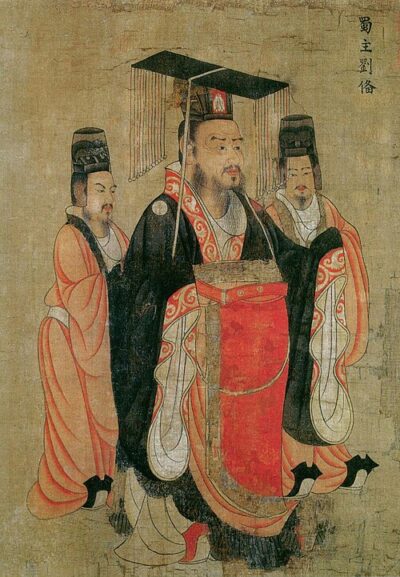
Liu Bei
Liu Bei was a Chinese warlord and founding Emperor of Shu Han. Born 161. Died June 10, 223, in Baidicheng. Positions held include Emperor of China (221–223).
Facts
14 facts · 2 confirmed by two sources · 2 cited · 10 from one source
Where this comes from
Papalocal keeps its own record. It started from these sources; what each one said is kept here as it was copied, so a change on their side never changes this page by itself. Tap one to read its version.
What Wikidata says · copied November 16, 2026 · revision 2553933345
- Described as
- Chinese warlord and founding Emperor of Shu Han (161–223)
- Other names
- Lau Bei, Zhaoliedi, Xuande, Liu Xuande
- Born
- 161 · 2 references
- Died
- June 10, 223
- Died in
- Baidicheng · 1 reference
- Citizen of
- Shu Han · 1 reference
- Occupation
- warlord · 1 reference
- Positions held
- Emperor of China (221–223)
- Spouse
- Lady Gan (195–); Lady Mi (196–); Lady Sun · 1 reference; Empress Wu (Zhaolie)
- Children
- Liu Shan; Liu Yong; Liu Li
- Father
- Liu Hong
- Wikipedias with a page
- 46
Wikidata item Q245315 (wikidata.org/wiki/Q245315), public domain (CC0). Copied November 16, 2026.
What Wikipedia says · copied November 16, 2026 · revision 1385662544
Liu Bei (Chinese: 劉備, ; Mandarin pronunciation: [ljǒʊ pêɪ]; 161 – 10 June 223 AD), courtesy name Xuande (玄德), was a Chinese warlord in the late Eastern Han dynasty who later became the founding emperor of Shu Han, one of the Three Kingdoms of China.
While unable to establish a permanent foothold in northern China, he gathered support among opponents of Cao Cao, the warlord who controlled the Han central government and the figurehead Emperor Xian, and was eventually able to carve out his own realm, which at its peak spanned present-day Sichuan, Chongqing, Guizhou, Hunan, and parts of Hubei, Yunnan, and Gansu.
Bolstered by the widespread influence of the 14th-century historical novel Romance of the Three Kingdoms and its portrayal of Liu Bei as an exemplar of virtuous Confucian rule, Liu Bei is widely revered in China and other East Asian societies as an ideal benevolent and humane ruler. Historically speaking, his style of governance has been said to have been "Confucian in appearance but Legalist in substance".
- Born, in its opening lines
- 161
- Died, in its opening lines
- June 10, 223
From the Wikipedia article “Liu Bei” (en.wikipedia.org/wiki/Liu_Bei), by its contributors, under CC BY-SA 4.0 (creativecommons.org/licenses/by-sa/4.0/). Copied November 16, 2026; not changed.
Confirmed Two sources agree. Cited One source, and it names where it got it. One source One source, without a reference of its own. Sources disagree The sources disagree. We show the best-supported value and keep theirs below.
