
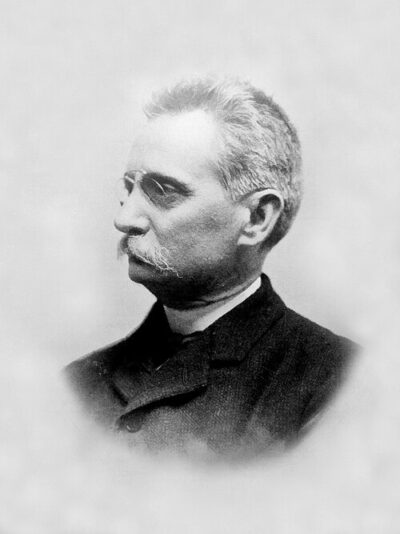
Lluís Domènech i Montaner
Lluís Domènech i Montaner was a Catalan architect. Born December 21, 1850, in Barcelona. Died December 27, 1923, in Barcelona. Positions held include member of the Congress of Deputies (1901–1905), Member of the Reial Acadèmia de Bones Lletres de Barcelona (1921–1923) and president (1891–1892). Known for Castle of the Three Dragons, Palau de la Música Catalana and Hospital de Sant Pau. Educated at University of Barcelona.
Facts
29 facts · 1 confirmed by two sources · 9 cited · 18 from one source · 1 where the sources disagree
What’s different
- Born: we show December 21, 1850 (Sources disagree). Wikipedia says December 21, 1849
Where this comes from
Papalocal keeps its own record. It started from these sources; what each one said is kept here as it was copied, so a change on their side never changes this page by itself. Tap one to read its version.
What Wikidata says · copied November 16, 2026 · revision 2567395455
- Described as
- Catalan architect (1850–1923)
- Other names
- Lluis Domenech i Fontaner, Lluís Domènech Montaner, Lluis Domènech, Luis Domènech y Montaner, Lluís Domènech i Fontaner, Lluis Domènech y Montaner, Lluis Domenech, Lluis Domenech Montaner, Luis Domènech i Montaner, Luís Doménechi Montaner, Lluis Domenech y Montaner, Lluis Doménech y Montaner
- Born
- December 21, 1850 · 1 reference
- Died
- December 27, 1923 · 3 references
- Born in
- Barcelona · 1 reference
- Died in
- Barcelona · 1 reference
- Buried in
- Sant Gervasi cemetery
- Citizen of
- Spain · 1 reference
- Occupation
- architect · 2 references; professor; politician
- Positions held
- member of the Congress of Deputies (1901–1905) · 1 reference; Member of the Reial Acadèmia de Bones Lletres de Barcelona (1921–1923) · 1 reference; president (1891–1892) · 1 reference; president of Ateneu Barcelonès (3 times) (1898–1914) · 1 reference
- Political party
- Jove Catalunya; Catalanist Union; Regionalist League
- Worked for
- University of Barcelona
- Education
- University of Barcelona
- Member of
- Royal Academy of Sciences and Arts of Barcelona; Reial Acadèmia Catalana de Belles Arts de Sant Jordi; Reial Acadèmia de Bones Lletres de Barcelona (1921–)
- Known for
- Castle of the Three Dragons; Palau de la Música Catalana; Hospital de Sant Pau; Casa Lleó Morera
- Children
- Pere Domènech i Roura; Fèlix Domènech i Roura
- Siblings
- Enric Domènech i Montaner · 1 reference; Eduard Domènech i Montaner
- Wikipedias with a page
- 34
Wikidata item Q317876 (wikidata.org/wiki/Q317876), public domain (CC0). Copied November 16, 2026.
What Wikipedia says · copied November 16, 2026 · revision 1367743000
Lluís Domènech i Montaner (Catalan pronunciation: [ʎuˈiz ðuˈmɛnək i muntəˈne]; 21 December 1849 – 27 December 1923) was a Catalan architect who was very much involved in and influential for the Catalan Modernisme català, the Art Nouveau/Jugendstil movement. He was also a Catalan politician.
Born in Barcelona, he initially studied physics and natural sciences, but soon switched to architecture. He was registered as an architect in Barcelona in 1873. He also held a 45-year tenure as a professor and director at the Escola d'Arquitectura, Barcelona's school of architecture, and wrote extensively on architecture in essays, technical books and articles in newspapers and journals.
His most famous buildings, the Hospital de Sant Pau and Palau de la Música Catalana in Barcelona, have been collectively designated as a UNESCO World Heritage Site.
As an architect, 45-year professor of architecture and prolific writer on architecture, Domènech i Montaner played an important role in defining the Modernisme arquitectonic in Catalonia. This style has become internationally renowned, mainly due to the work of Antoni Gaudí. Domènech i Montaner's article "En busca d'una arquitectura nacional" (In search of a national architecture), published 1878 in the journal La Renaixença, reflected the way architects at that time sought to build structures that reflected the Catalan character.
His buildings displayed a mixture between rationalism and fabulous ornamentation inspired by Spanish-Arabic architecture, and followed the curvilinear design typical of Art Nouveau. In the El castell dels 3 dragons restaurant in Barcelona (built for the World's Fair in 1888), which was for many years the Zoological Museum, he applied very advanced solutions (a visible iron structure and ceramics). He later developed this style further in other buildings, such as the Palau de la Música Catalana in Barcelona (1908), where he made extensive use of mosaic, ceramics and stained glass, the Hospital de Sant Pau in Barcelona, and the Institut Pere Mata in Reus.
Domènech i Montaner's work evolved towards more open structures and lighter materials, evident in the Palau de la Música Catalana. Other architects, like Gaudí, tended to move in the opposite direction.
Domènech i Montaner also played a prominent role in the Catalan autonomist movement. He was a member of the La Jove Catalunya and El Centre Català and later chaired the Lliga de Catalunya (1888) (Catalan League) and the Unió Catalanista (1892) (Catalan Union). He was one of the organisers of the commission that approved the Bases de Manresa, a list of demands for Catalan autonomy. He was a member of the Centre Nacional Català (1889) and Lliga Regionalista (1901), and was one of the four parliamentarians who won the so-called "candidature of the four presidents" in 1901. Though re-elected in 1903, he abandoned politics in 1904 to devote himself fully to archeological and architectural research.
He died in Barcelona in 1923 and was buried in the Sant Gervasi Cemetery in that city.
- Born, in its opening lines
- December 21, 1849
- Died, in its opening lines
- December 27, 1923
From the Wikipedia article “Lluís Domènech i Montaner” (en.wikipedia.org/wiki/Lluís_Domènech_i_Montaner), by its contributors, under CC BY-SA 4.0 (creativecommons.org/licenses/by-sa/4.0/). Copied November 16, 2026; not changed.
Confirmed Two sources agree. Cited One source, and it names where it got it. One source One source, without a reference of its own. Sources disagree The sources disagree. We show the best-supported value and keep theirs below.
