
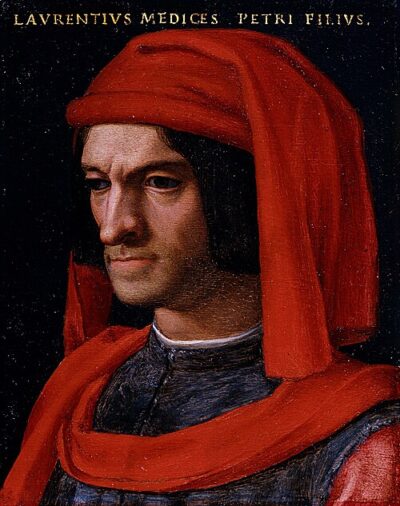
Lorenzo de' Medici
Lorenzo de' Medici was an Italian politician, literary man and humanist. Born January 1, 1449, in Florence. Died April 8, 1492, in Careggi.
Facts
30 facts · 2 confirmed by two sources · 12 cited · 16 from one source
Where this comes from
Papalocal keeps its own record. It started from these sources; what each one said is kept here as it was copied, so a change on their side never changes this page by itself. Tap one to read its version.
What Wikidata says · copied November 16, 2026 · revision 2568737884
- Described as
- Italian politician, literary man and humanist
- Other names
- Lorenzo il Magnifico, Lorenzo de'Medici, Lorenzo de Medici, Lorenzo de’ Medici, Lorenzo the Magnificent, il Magnifico Lorenzo de'Medici
- Born
- January 1, 1449 · 3 references
- Died
- April 8, 1492 · 1 reference
- Born in
- Florence · 3 references
- Died in
- Careggi · 1 reference
- Buried in
- Medici Chapels
- Citizen of
- Republic of Florence
- Occupation
- politician · 1 reference; writer · 2 references; poet; banker · 1 reference
- Field
- politics · 1 reference; renaissance humanism · 1 reference; Renaissance · 1 reference
- Spouse
- Clarice Orsini (1469–1487) · 1 reference
- Children
- Lucrezia de' Medici; Piero the Unfortunate · 1 reference; Maddalena de' Medici; Leo X · 1 reference; Giuliano de' Medici, Duke of Nemours; Contessina de' Medici; Luisa de' Medici
- Father
- Piero di Cosimo de' Medici · 1 reference
- Mother
- Lucrezia Tornabuoni
- Siblings
- Nannina de' Medici; Maria di Piero de' Medici; Bianca de' Medici; Giuliano de' Medici · 1 reference; Giovanni de' Medici
- Religion
- Catholic Church
- Lived in
- Palazzo Medici Riccardi · 1 reference
- Wikipedias with a page
- 86
Wikidata item Q177854 (wikidata.org/wiki/Q177854), public domain (CC0). Copied November 16, 2026.
What Wikipedia says · copied November 16, 2026 · revision 1385062102
Lorenzo di Piero de' Medici (Italian: [loˈrɛntso de ˈmɛːditʃi]; 1 January 1449 – 8 April 1492), known as Lorenzo the Magnificent (Italian: Lorenzo il Magnifico), was a statesman, de facto ruler of the Florentine Republic, and the most powerful patron of Renaissance culture. Lorenzo held the balance of power within the Italic League, an alliance of states that stabilized political conditions on the Italian Peninsula for decades, and his life coincided with the mature phase of the Italian Renaissance and the golden age of Florence. As a patron, he is best known for his sponsorship of artists such as Botticelli and Michelangelo. On the foreign policy front, Lorenzo manifested a clear plan to stem the territorial ambitions of Pope Sixtus IV, in the name of the balance of the Italic League of 1454. For these reasons, Lorenzo was the subject of the Pazzi conspiracy (1478), in which his brother Giuliano was assassinated. The Peace of Lodi of 1454 that he supported among the various Italian states collapsed with his death. He is buried in the Medici Chapel in Florence.
- Born, in its opening lines
- January 1, 1449
- Died, in its opening lines
- April 8, 1492
From the Wikipedia article “Lorenzo de' Medici” (en.wikipedia.org/wiki/Lorenzo_de'_Medici), by its contributors, under CC BY-SA 4.0 (creativecommons.org/licenses/by-sa/4.0/). Copied November 16, 2026; not changed.
Confirmed Two sources agree. Cited One source, and it names where it got it. One source One source, without a reference of its own. Sources disagree The sources disagree. We show the best-supported value and keep theirs below.
