
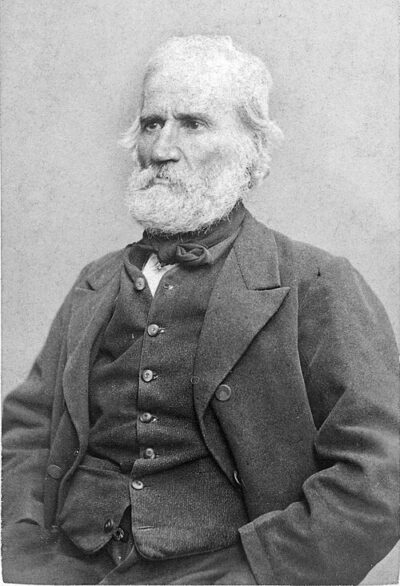
Louis Auguste Blanqui
Louis Auguste Blanqui was a French socialist and political activist. Born February 8, 1805, in Puget-Théniers. Died January 1, 1881, in Paris. Positions held include Deputy of the French Third Republic (1879). Educated at Lycée Charlemagne. Awards include Concours général.
Facts
17 facts · 2 confirmed by two sources · 3 cited · 12 from one source
Where this comes from
Papalocal keeps its own record. It started from these sources; what each one said is kept here as it was copied, so a change on their side never changes this page by itself. Tap one to read its version.
What Wikidata says · copied November 16, 2026 · revision 2567491616
- Described as
- French socialist and political activist (1805-1881)
- Other names
- Auguste Blanqui
- Born
- February 8, 1805 · 3 references
- Died
- January 1, 1881 · 11 references
- Born in
- Puget-Théniers · 1 reference
- Died in
- Paris · 1 reference
- Buried in
- Père Lachaise Cemetery
- Name at birth
- Louis Auguste Blanqui
- Citizen of
- France
- Occupation
- philosopher; politician · 1 reference; journalist; communard
- Positions held
- Deputy of the French Third Republic (1879)
- Education
- Lycée Charlemagne
- Awards
- Concours général
- Spouse
- Amélie-Suzanne Serre
- Father
- Jean Dominique Blanqui
- Siblings
- Jérôme-Adolphe Blanqui
- Wikipedias with a page
- 54
Wikidata item Q309722 (wikidata.org/wiki/Q309722), public domain (CC0). Copied November 16, 2026.
What Wikipedia says · copied November 16, 2026 · revision 1379366630
Louis-Auguste Blanqui (French: [blɑ̃ki]; 8 February 1805 – 1 January 1881) was a French socialist revolutionary and philosopher. A pivotal figure of the 19th-century French radical left, he was a staunch advocate for communism and a proponent of the revolutionary theory that came to be known as Blanquism. His political career was marked by a relentless opposition to all forms of monarchy and capitalism, leading to his repeated imprisonment by every French regime of his lifetime. He spent 33 of his 75 years in prison, earning him the nickname L'Enfermé ("The Prisoner").
Blanqui's political thought was shaped by the legacy of the French Revolution, particularly its radical Jacobin phase. He argued for the necessity of a highly organised, revolutionary vanguard to seize power on behalf of the working class. Once in power, this vanguard would establish a temporary revolutionary dictatorship, centred in Paris, tasked with disarming the bourgeoisie, arming the proletariat, and implementing a programme of mass education. He believed that only after a period of enlightenment, which would eradicate the ignorance he saw as the root of oppression, could a truly egalitarian and communist society be established.
A key figure in the major popular uprisings of his era, Blanqui participated in the July Revolution of 1830 and was a leading voice in the radical clubs of the French Revolution of 1848. His attempts to channel popular discontent into successful insurrections, notably in May 1839 and August 1870, were unsuccessful and resulted in long prison sentences. He was arrested just before the Paris Commune of 1871 and was unable to participate, though many of his followers played key roles.
During his lifetime, Blanqui was both a revered and reviled figure. Early in his career, Karl Marx identified him as the foremost leader of the French proletariat. However, later Marxist critiques, particularly from Friedrich Engels, defined "Blanquism" as a pejorative term for naive, conspiratorial putschism led by a small elite, a characterisation that has largely shaped his posthumous reputation. Despite being largely forgotten by mainstream socialism, his life and extensive writings present a developed theory of popular empowerment based on conscious political volition, organisation, and the rejection of historical determinism.
- Born, in its opening lines
- February 8, 1805
- Died, in its opening lines
- January 1, 1881
From the Wikipedia article “Louis-Auguste Blanqui” (en.wikipedia.org/wiki/Louis-Auguste_Blanqui), by its contributors, under CC BY-SA 4.0 (creativecommons.org/licenses/by-sa/4.0/). Copied November 16, 2026; not changed.
Confirmed Two sources agree. Cited One source, and it names where it got it. One source One source, without a reference of its own. Sources disagree The sources disagree. We show the best-supported value and keep theirs below.
