
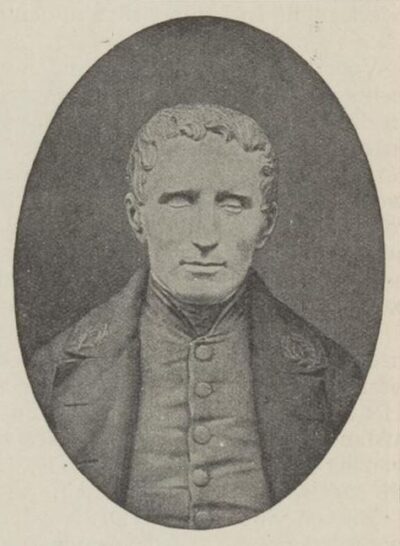
Louis Braille
Louis Braille was a French organist and teacher (1809-1852), inventor of braille, a system for reading and writing text and music, used by people who are blind or visually impaired. Born January 4, 1809, in Coupvray. Died January 6, 1852, in Paris.
Facts
13 facts · 2 confirmed by two sources · 4 cited · 7 from one source
Where this comes from
Papalocal keeps its own record. It started from these sources; what each one said is kept here as it was copied, so a change on their side never changes this page by itself. Tap one to read its version.
What Wikidata says · copied November 16, 2026 · revision 2568788582
- Described as
- French organist and teacher (1809-1852), inventor of braille, a system for reading and writing text and music, used by people who are blind or visually impaired
- Other names
- Braille
- Born
- January 4, 1809 · 10 references
- Died
- January 6, 1852 · 10 references
- Born in
- Coupvray · 4 references
- Died in
- Paris · 2 references
- Buried in
- Panthéon (1952–) · 1 reference; Coupvray (1852–) · 1 reference
- Cause of death
- tuberculosis
- Citizen of
- France
- Occupation
- organist; inventor; educator of the blind
- Instrument
- pipe organ
- Religion
- Catholicism
- Wikipedias with a page
- 90
Wikidata item Q93182 (wikidata.org/wiki/Q93182), public domain (CC0). Copied November 16, 2026.
What Wikipedia says · copied November 16, 2026 · revision 1384891716
Louis Braille ( BRAYL; French: [lwi bʁɑj] ; 4 January 1809 – 6 January 1852) was a French educator and the inventor of a reading and writing system named after him, braille, intended for use by visually impaired people. His system is used worldwide and remains virtually unchanged to this day.
Braille was blinded in one eye at the age of three. This occurred as a result from an accident with a stitching awl in his father's harness-making shop. Consequently, an infection set in and spread to both eyes, resulting in total blindness. At that time, there were not many resources in place for the blind, but he nevertheless excelled in his education and received a scholarship to France's Royal Institute for Blind Youth. While still a student there, he began developing a system of tactile code that could allow blind people to read and write quickly and efficiently. Inspired by a system invented by Charles Barbier, Braille's new method was more compact and lent itself to a range of uses, including music. He presented his work to his peers for the first time in 1825
when he was fifteen years old.
In adulthood, Braille served as a professor at the Institute and had an avocation as a musician, but he largely spent the remainder of his life refining and extending his system. It went unused by most educators for many years after his death, but posterity has recognized braille as a revolutionary invention, and it has been adapted for use in languages worldwide.
- Born, in its opening lines
- January 4, 1809
- Died, in its opening lines
- January 6, 1852
From the Wikipedia article “Louis Braille” (en.wikipedia.org/wiki/Louis_Braille), by its contributors, under CC BY-SA 4.0 (creativecommons.org/licenses/by-sa/4.0/). Copied November 16, 2026; not changed.
Confirmed Two sources agree. Cited One source, and it names where it got it. One source One source, without a reference of its own. Sources disagree The sources disagree. We show the best-supported value and keep theirs below.
