
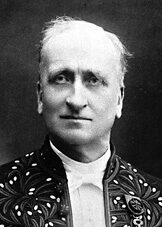
Louis Renault
Louis Renault was a French jurist. Born May 21, 1843, in Autun. Died February 8, 1918, in Barbizon. Positions held include president and President of the Institut de Droit International (1894–1895). Educated at University of Burgundy Europe. Awards include Nobel Peace Prize, Honorary doctor of Leiden University and Commander of the Legion of Honour.
Facts
24 facts · 2 confirmed by two sources · 8 cited · 14 from one source
Where this comes from
Papalocal keeps its own record. It started from these sources; what each one said is kept here as it was copied, so a change on their side never changes this page by itself. Tap one to read its version.
What Wikidata says · copied November 16, 2026 · revision 2563195793
- Described as
- French jurist (1843–1918)
- Other names
- Jean Louis Renault
- Born
- May 21, 1843 · 7 references
- Died
- February 8, 1918 · 7 references
- Born in
- Autun
- Died in
- Barbizon
- Buried in
- Montparnasse Cemetery
- Citizen of
- France
- Occupation
- jurist · 1 reference; pedagogue; university teacher; judge; lawyer · 1 reference
- Positions held
- president; President of the Institut de Droit International (1894–1895) · 1 reference
- Worked for
- University of Paris
- Education
- University of Burgundy Europe
- Member of
- Académie des Sciences Morales et Politiques; Institut de Droit International (1875–)
- Awards
- Nobel Peace Prize (1907) · 2 references; Honorary doctor of Leiden University (1913) · 1 reference; Commander of the Legion of Honour
- Field
- law · 1 reference; international law · 1 reference; Roman law · 1 reference; commercial law · 1 reference
- Wikipedias with a page
- 65
Wikidata item Q230814 (wikidata.org/wiki/Q230814), public domain (CC0). Copied November 16, 2026.
What Wikipedia says · copied November 16, 2026 · revision 1381559031
Louis Renault (21 May 1843 – 8 February 1918) was a French jurist and educator, and the co-winner in 1907 (with Ernesto Teodoro Moneta) of the Nobel Peace Prize.
Renault was born at Autun. From 1868 to 1873, Renault was professor of Roman and commercial law at the University of Dijon. From 1873 until his death, he was professor in the faculty of law at the Paris Institute of Political Studies (Sciences Po) and the University of Paris, where in 1881 he became professor of international law. In 1890, he was appointed jurisconsult of the Ministry of Foreign Affairs, a post created for him in which he scrutinized French foreign policy in the light of international law. He served at numerous conferences in this capacity, notably at the two Hague Conventions (1899 and 1907) and the London Naval Conference (1908–1909).
Renault was prominent as an arbitrator, his more famous cases including the Japanese House Tax case of 1905, the Casa Blanca Case of 1909, the Sarvarkar Case of 1911, the Carthage case of 1913, and the Manouba case of 1913. Among his writings are articles and monographs on the specialized topics of international law. Together with his friend and colleague C. Lyon-Caen, he produced several works on commercial law, including a compendium in two volumes, a treatise in eight volumes, and a manual that ran to many editions.
In 1879, Renault published his Introduction to the Study of International Law and in 1917 First Violations of International Law by Germany, concerning the invasion of Belgium and of Luxembourg in breach of Germany's treaty obligations.
- Born, in its opening lines
- May 21, 1843
- Died, in its opening lines
- February 8, 1918
From the Wikipedia article “Louis Renault (jurist)” (en.wikipedia.org/wiki/Louis_Renault_(jurist)), by its contributors, under CC BY-SA 4.0 (creativecommons.org/licenses/by-sa/4.0/). Copied November 16, 2026; not changed.
Confirmed Two sources agree. Cited One source, and it names where it got it. One source One source, without a reference of its own. Sources disagree The sources disagree. We show the best-supported value and keep theirs below.
