
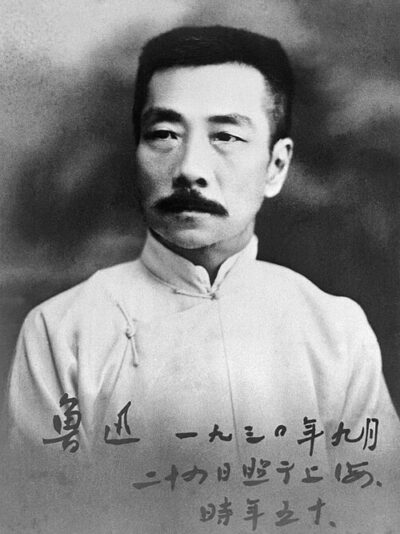
Lu Xun
Lu Xun was a Chinese novelist and essayist. Born September 25, 1881, in Shaoxing. Died October 19, 1936, in Shanghai. Known for The True Story of Ah Q, A Madman's Diary and Panghuang. Educated at Tohoku University and Kobun Institute. Awards include 100 heroes and model figures who have made outstanding contributions to the founding of New China.
Facts
46 facts · 2 confirmed by two sources · 16 cited · 28 from one source
Where this comes from
Papalocal keeps its own record. It started from these sources; what each one said is kept here as it was copied, so a change on their side never changes this page by itself. Tap one to read its version.
What Wikidata says · copied November 16, 2026 · revision 2567462607
- Described as
- Chinese novelist and essayist (1881–1936)
- Other names
- Loe Sjunn, Lu Siun, Shun Luo, Chou Shu-jen, Sjunn Loe, Lou Siun, Xun Lu, Shuren Zhou, Jin Ro, Hsün Lu, Zhou Shuren, Yü-tsʻai Chou
- Born
- September 25, 1881 · 9 references
- Died
- October 19, 1936 · 9 references
- Born in
- Shaoxing · 1 reference
- Died in
- Shanghai · 1 reference
- Buried in
- Lu Xun's tomb · 1 reference
- Cause of death
- tuberculosis
- Name at birth
- 周樹人
- Citizen of
- Qing dynasty (–1912); Republic of China (1912–)
- Occupation
- essayist · 1 reference; poet · 1 reference; literary critic · 2 references; Esperantist; translator · 2 references; novelist; writer · 3 references; short story writer
- Worked for
- Peking University
- Education
- Tohoku University; Kobun Institute; Sendai Medical College
- Member of
- League of Left-Wing Writers
- Genre
- essay
- Known for
- The True Story of Ah Q; A Madman's Diary; Panghuang; Kong Yiji · 1 reference; Old Tales Retold; Call to Arms; Picking the morning flower in the evening; A Brief History of Chinese Fiction; Wild cockroach · 1 reference; Blessing
- Awards
- 100 heroes and model figures who have made outstanding contributions to the founding of New China
- Field
- creative and professional writing · 1 reference; poetry · 1 reference; essay · 1 reference; literary criticism · 1 reference; translation · 1 reference
- Spouse
- Zhu An (1906–1936); Xu Guangping · 1 reference
- Children
- Zhou Haiying
- Father
- Zhou Boyi
- Siblings
- Zhou Zuoren · 1 reference; Zhou Jianren
- Lived in
- Shanghai (1933–1936) · 1 reference
- Wikipedias with a page
- 128
Wikidata item Q23114 (wikidata.org/wiki/Q23114), public domain (CC0). Copied November 16, 2026.
What Wikipedia says · copied November 16, 2026 · revision 1384608197
Lu Xun (Chinese: 魯迅; pinyin: Lǔ Xùn, [lù ɕŷn]; 25 September 1881 – 19 October 1936), pen name of Zhou Shuren, born Zhou Zhangshou, was a Chinese writer. A leading figure of modern Chinese literature, he wrote in both vernacular and literary Chinese as a novelist, literary critic, essayist, poet, translator and political commentator, known for his sharp, satirical style and critical reflections on Chinese history and culture.
Lu Xun was born into a declining family of landlords and scholar-officials in Shaoxing, Zhejiang, and was the elder brother of Zhou Zuoren. Although he initially aspired to sit for the imperial examination, his family's declining fortunes led him to attend government-funded schools established under the Self-Strengthening Movement, where he was introduced to Western science and thought. In 1904, he enrolled at the Sendai Medical College in Japan, but left medicine to pursue literature. Financial difficulties forced his return to China, where he taught at various schools and colleges before taking a position at the Ministry of Education of the Beiyang government.
Lu Xun pioneered the New Culture Movement by publishing the first novel in vernacular Chinese, Diary of a Madman, in 1918. He gained prominence through his political writings in La Jeunesse following the May Fourth Movement in 1919. From the late 1920s onward, Lu Xun became increasingly engaged with Marxist thought and leftist politics. In the 1930s, he maintained a close but fraught relationship with the League of Left-Wing Writers. His works have been canonized in the People's Republic of China owing to Mao Zedong's high regard for him.
- Born, in its opening lines
- September 25, 1881
- Died, in its opening lines
- October 19, 1936
From the Wikipedia article “Lu Xun” (en.wikipedia.org/wiki/Lu_Xun), by its contributors, under CC BY-SA 4.0 (creativecommons.org/licenses/by-sa/4.0/). Copied November 16, 2026; not changed.
Confirmed Two sources agree. Cited One source, and it names where it got it. One source One source, without a reference of its own. Sources disagree The sources disagree. We show the best-supported value and keep theirs below.
