
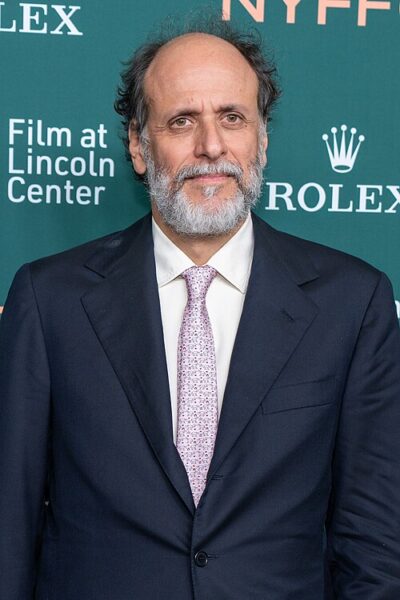
Luca Guadagnino
Luca Guadagnino is an Italian filmmaker. Born August 10, 1971, in Palermo. Educated at Sapienza University of Rome and University of Palermo. Awards include David di Donatello for Adapted Screenplay.
Facts
12 facts · 1 confirmed by two sources · 6 cited · 5 from one source
Where this comes from
Papalocal keeps its own record. It started from these sources; what each one said is kept here as it was copied, so a change on their side never changes this page by itself. Tap one to read its version.
What Wikidata says · copied November 16, 2026 · revision 2566916295
- Described as
- Italian filmmaker (born 1971)
- Born
- August 10, 1971 · 3 references
- Born in
- Palermo · 1 reference
- Citizen of
- Italy
- Occupation
- film director · 1 reference; screenwriter · 1 reference; film producer; director · 2 references
- Education
- Sapienza University of Rome · 1 reference; University of Palermo · 1 reference
- Awards
- David di Donatello for Adapted Screenplay (2019)
- Field
- film direction · 1 reference; film screenwriting · 1 reference
- Wikipedias with a page
- 44
Wikidata item Q1335528 (wikidata.org/wiki/Q1335528), public domain (CC0). Copied November 16, 2026.
What Wikipedia says · copied November 16, 2026 · revision 1385868204
Luca Guadagnino (Italian: [ˈluːka ɡwadaɲˈɲiːno]; born 10 August 1971) is an Italian film director and producer. His films are characterized by their emotional complexity, eroticism, and lavish visuals. Guadagnino has received numerous accolades, including a Silver Lion and an Independent Spirit Award, alongside nominations for an Academy Award, three Golden Globes, and three BAFTAs.
Born in Palermo to an Algerian mother and a Sicilian father, Guadagnino spent part of his childhood in Ethiopia, but the family moved back to Italy to escape the Ethiopian Civil War. Guadagnino began his career directing short films and documentaries. He made his feature-film debut with The Protagonists (1999), the first of his many collaborations with actress Tilda Swinton. His follow-up Melissa P. (2005) was a commercial success in Italy but was met with mixed critical reception.
Guadagnino gained further acclaim with his Desire trilogy, which consists of the films I Am Love (2009), A Bigger Splash (2015), and Call Me by Your Name (2017). The latter brought him international recognition. Suspiria (2018), a remake of the 1977 film, was Guadagnino's first foray into the horror genre. It was a box office failure and polarized critics. Guadagnino made his television debut with the HBO coming-of-age miniseries We Are Who We Are (2020). He directed the romantic horror film Bones and All (2022), the romantic sports film Challengers (2024), the period romantic drama Queer (2024), the psychological thriller After the Hunt (2025), and the tech-dramedy Artificial (2026).
Guadagnino directed several documentaries including Salvatore: The Shoemaker of Dreams (2020) and Joie de vivre (2026). Aside from filmmaking, he has been involved in the world of fashion, directing advertisements for brands like Fendi and Salvatore Ferragamo. In 2012, Guadagnino founded the production company Frenesy Film Company. He also produced Belluscone: A Sicilian Story (2014), The Truffle Hunters (2020), Holiday (2023), and Enea (2023).
- Born, in its opening lines
- August 10, 1971
From the Wikipedia article “Luca Guadagnino” (en.wikipedia.org/wiki/Luca_Guadagnino), by its contributors, under CC BY-SA 4.0 (creativecommons.org/licenses/by-sa/4.0/). Copied November 16, 2026; not changed.
Confirmed Two sources agree. Cited One source, and it names where it got it. One source One source, without a reference of its own. Sources disagree The sources disagree. We show the best-supported value and keep theirs below.
