
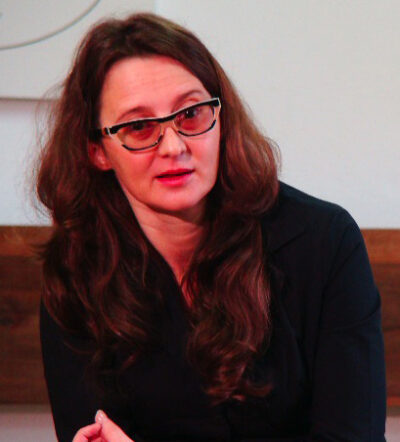
Lucrecia Martel
Lucrecia Martel is an Argentine film director, screenwriter and film producer. Born December 14, 1966, in Salta. Known for The Salta Trilogy, Zama and La Ciénaga. Educated at Escuela Nacional de Experimentación y Realización Cinematográfica and University of Buenos Aires. Awards include honorary doctor of the Katholieke Universiteit Leuven and Honorary Doctorate of University of Buenos Aires.
Facts
15 facts · 1 confirmed by two sources · 8 cited · 6 from one source
Where this comes from
Papalocal keeps its own record. It started from these sources; what each one said is kept here as it was copied, so a change on their side never changes this page by itself. Tap one to read its version.
What Wikidata says · copied November 16, 2026 · revision 2568215344
- Described as
- Argentine film director, screenwriter and film producer
- Born
- December 14, 1966 · 1 reference
- Born in
- Salta
- Citizen of
- Argentina · 2 references
- Occupation
- film director · 2 references; screenwriter · 1 reference; film producer
- Education
- Escuela Nacional de Experimentación y Realización Cinematográfica · 1 reference; University of Buenos Aires · 1 reference; Bachillerato Humanista Moderno
- Known for
- The Salta Trilogy; Zama · 1 reference; La Ciénaga · 1 reference; The Holy Girl
- Awards
- honorary doctor of the Katholieke Universiteit Leuven (2023) · 1 reference; Honorary Doctorate of University of Buenos Aires (2023) · 1 reference
- Wikipedias with a page
- 32
Wikidata item Q254152 (wikidata.org/wiki/Q254152), public domain (CC0). Copied November 16, 2026.
What Wikipedia says · copied November 16, 2026 · revision 1372485025
Lucrecia Martel (born December 14, 1966) is an Argentine film director, screenwriter, and producer whose feature films have frequented Cannes, Venice, Berlin, Toronto, and many other international film festivals. Film scholar Paul Julian Smith wrote in 2015 that she is "arguably the most critically acclaimed auteur in Spanish-language art cinema outside Latin America" and that her "transnational auteurism and demanding features have earned her a hard-won reputation in the world art cinema festival circuit". Similarly, film scholar Haden Guest has called her "one of the most prodigiously talented filmmakers in contemporary world cinema", and film scholar David Oubiña has called her body of work a "rare perfection". In April 2018, Vogue referred to her as "one of the greatest directors in the world right now".
Her 2001 debut feature film, La Ciénaga (The Swamp), about an indulgent bourgeois extended family spending the summertime in a decrepit vacation home in provincial Salta, Argentina, was internationally highly acclaimed upon release and introduced a new and vital voice to Argentine cinema. David Oubiña called it "one of the highest achievements" of the New Argentine Cinema, a wave of contemporary filmmaking that began in the mid-1990s in reaction to decades of political and economic crises in the country. The film, Oubiña wrote, is "a rare expression of an extremely troubled moment in the nation's recent history. It is a masterpiece of singular maturity".
Martel's succeeding three feature films received further international acclaim: the adolescent drama The Holy Girl (La niña santa) (2004), the psychological thriller The Headless Woman (La mujer sin cabeza) (2008), and the period drama Zama (2017).
- Born, in its opening lines
- December 14, 1966
From the Wikipedia article “Lucrecia Martel” (en.wikipedia.org/wiki/Lucrecia_Martel), by its contributors, under CC BY-SA 4.0 (creativecommons.org/licenses/by-sa/4.0/). Copied November 16, 2026; not changed.
Confirmed Two sources agree. Cited One source, and it names where it got it. One source One source, without a reference of its own. Sources disagree The sources disagree. We show the best-supported value and keep theirs below.
