
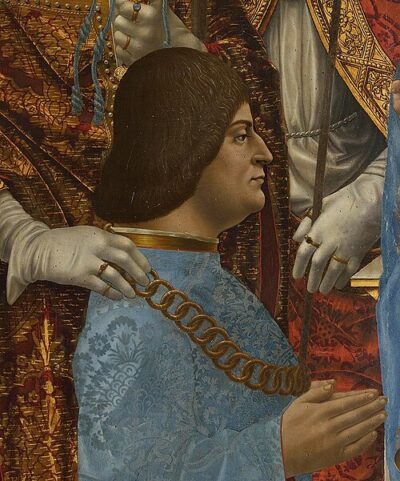
Ludovico Sforza
Ludovico Sforza was a duke of Milan. Born July 27, 1452, in Vigevano. Died May 27, 1508, in Loches. Positions held include Duke of Milan (1494–1500).
Facts
22 facts · 1 confirmed by two sources · 6 cited · 14 from one source · 1 where the sources disagree
What’s different
- Born: we show July 27, 1452 (Sources disagree). Wikipedia says August 3, 1452
Where this comes from
Papalocal keeps its own record. It started from these sources; what each one said is kept here as it was copied, so a change on their side never changes this page by itself. Tap one to read its version.
What Wikidata says · copied November 16, 2026 · revision 2569840853
- Described as
- duke of Milan
- Other names
- Ludovico il Moro, Duke of Milan Ludovico Sforza, Duke of Milan Lodovico Sforza, il Moro Ludivico, Ludovicus, Duke of Milan Sfortia, il Moro Ludovico, Ludovico, Duke of Milan Sforza, Lodovico, Duke of Milan Sforza, le More Ludovic, il Moro Lodovico, Duke of Milan Ludovicus Sfortia, Ludovico Maria Sforza
- Born
- July 27, 1452 · 2 references
- Died
- May 27, 1508 · 2 references
- Born in
- Vigevano · 2 references
- Died in
- Loches · 2 references
- Occupation
- statesperson; duke; politician; patron of the arts
- Positions held
- Duke of Milan (1494–1500)
- Spouse
- Beatrice d’Este (1491–) · 1 reference
- Children
- Maximilian Sforza · 1 reference; Francesco II Sforza · 1 reference; Giovanni Paolo I Sforza; Bianca Giovanna Sforza; Leone Sforza; Galeazzo Sforza Visconti
- Father
- Francesco I Sforza · 1 reference
- Mother
- Bianca Maria Visconti · 1 reference
- Siblings
- Galeazzo Maria Sforza; Ippolita Maria Sforza; Ascanio Sforza · 1 reference
- Lived in
- Bellagio (1499–)
- Wikipedias with a page
- 53
Wikidata item Q236853 (wikidata.org/wiki/Q236853), public domain (CC0). Copied November 16, 2026.
What Wikipedia says · copied November 16, 2026 · revision 1381234627
Ludovico Maria Sforza (Italian: [ludoˈviːko maˈriːa ˈsfɔrtsa]; 3 August 1452 – 27 May 1508), also known as Ludovico il Moro (Italian: [il ˈmɔːro]; 'the Moor'), and called the "arbiter of Italy" by historian Francesco Guicciardini, was an Italian nobleman who ruled as the Duke of Milan from 1494 to 1499.
Although he was the fourth son and excluded from his family's succession, Ludovico was ambitious and managed to obtain dominion over Milan. He first assumed the regency from his sister-in-law Bona, then took over from his deceased nephew Gian Galeazzo, whom some say he poisoned. Considered enlightened, generous, and peaceful, he became a patron of artists and writers. His court in Milan became one of the most important in Europe during the Italian Renaissance.
Ludovico was considered fearful and of a fickle nature. To face the threats of King Alfonso II of Naples, Ludovico called the French to Italy; when threatened by the French, he could not face the danger, and was saved only thanks to the intervention of his wife, Beatrice. When she died, he went into a depression and the state of his court fell from jubilance to despair. He finally succumbed to King of France Louis XII, who imprisoned him in France where he died.
- Born, in its opening lines
- August 3, 1452
- Died, in its opening lines
- May 27, 1508
From the Wikipedia article “Ludovico Sforza” (en.wikipedia.org/wiki/Ludovico_Sforza), by its contributors, under CC BY-SA 4.0 (creativecommons.org/licenses/by-sa/4.0/). Copied November 16, 2026; not changed.
Confirmed Two sources agree. Cited One source, and it names where it got it. One source One source, without a reference of its own. Sources disagree The sources disagree. We show the best-supported value and keep theirs below.
