
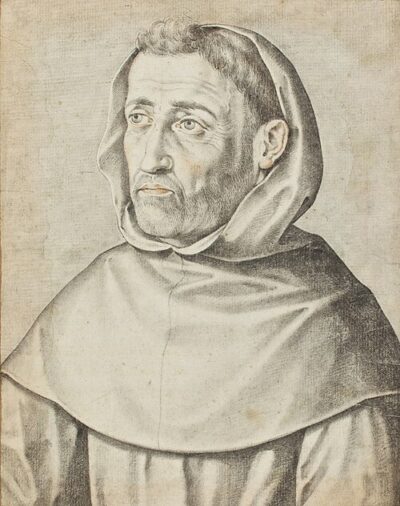
Luis de León
Luis de León was a Spanish poet and Augustinian friar. Born 1527, in Belmonte. Died August 23, 1591, in Madrigal de las Altas Torres. Educated at University of Salamanca and University of Alcalá.
Facts
17 facts · 0 confirmed by two sources · 8 cited · 9 from one source
Where this comes from
Papalocal keeps its own record. It started from these sources; what each one said is kept here as it was copied, so a change on their side never changes this page by itself. Tap one to read its version.
What Wikidata says · copied November 16, 2026 · revision 2565598530
- Described as
- Spanish poet and Augustinian friar (1527-1591)
- Other names
- Luis de Leon
- Born
- 1527 · 1 reference
- Died
- August 23, 1591 · 7 references
- Born in
- Belmonte · 1 reference
- Died in
- Madrigal de las Altas Torres · 1 reference
- Buried in
- University of Salamanca
- Citizen of
- Spain
- Occupation
- linguist; poet · 1 reference; writer · 1 reference; translator · 1 reference; university teacher; friar; Catholic theologian · 1 reference
- Worked for
- University of Salamanca
- Education
- University of Salamanca; University of Alcalá
- Religion
- Christianity
- Wikipedias with a page
- 38
Wikidata item Q450246 (wikidata.org/wiki/Q450246), public domain (CC0). Copied November 16, 2026.
What Wikipedia says · copied November 16, 2026 · revision 1372899801
Luis de León (Belmonte, Cuenca, 1527 – Madrigal de las Altas Torres, Castile, Spain, 23 August 1591), was a Spanish lyric poet, Augustinian friar, theologian and academic.
While serving as professor of Biblical scholarship at the University of Salamanca, Fray Luis also wrote many immortal works of Spanish Christian poetry and translated both Biblical Hebrew poetry and Latin Christian poetry into the Spanish language. Despite being a devout and believing Roman Catholic priest, Fray Luis was descended from a family of Spanish Jewish Conversos and this, as well as his vocal advocacy for teaching the Hebrew language in Catholic universities and seminaries, drew false accusations from the Dominican Order of the heresies of being both a Marrano and a Judaiser. Fray Luis was accordingly imprisoned for four years by the Spanish Inquisition before he was ruled to be completely innocent of any wrongdoing and released without charge. While the conditions of his imprisonment were never harsh and he was allowed complete access to books, according to legend, Fray Luis started his first post-Inquisition University of Salamanca lecture with the words, "As I was saying the other day..."
According to Edith Grossman, "Fray Luis is generally considered the leading poet in the far-reaching Christianization of the Renaissance in Spain during the sixteenth-century. This means that as a consequence of the Counter-Reformation, and especially of the judgments and rulings of the Council of Trent, the secular Italianate forms and themes brought into Spain by Garcilaso were used by subsequent writers to explore moral, spiritual, and religious topics. The poets and humanists who were the followers of Fray Luis in the sixteenth-century formed the influential School of Salamanca."
From the Wikipedia article “Luis de León” (en.wikipedia.org/wiki/Luis_de_León), by its contributors, under CC BY-SA 4.0 (creativecommons.org/licenses/by-sa/4.0/). Copied November 16, 2026; not changed.
Confirmed Two sources agree. Cited One source, and it names where it got it. One source One source, without a reference of its own. Sources disagree The sources disagree. We show the best-supported value and keep theirs below.
