
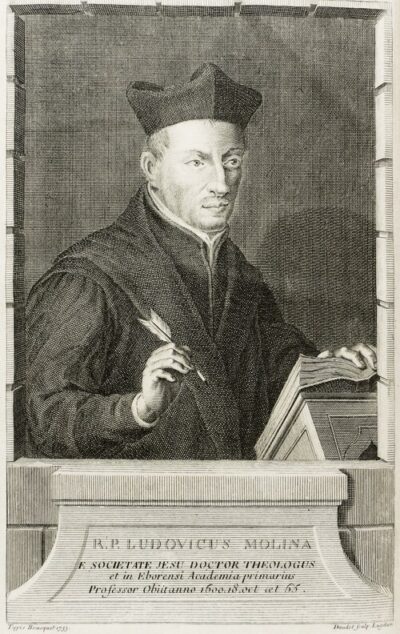
Luis de Molina
Luis de Molina was a Spanish priest and writer. Born September 29, 1535, in Cuenca. Died October 12, 1600, in Madrid. Positions held include ambassador of Spain to the Kingdom of Portugal. Educated at University of Salamanca and University of Alcalá.
Facts
18 facts · 2 confirmed by two sources · 2 cited · 14 from one source
Where this comes from
Papalocal keeps its own record. It started from these sources; what each one said is kept here as it was copied, so a change on their side never changes this page by itself. Tap one to read its version.
What Wikidata says · copied November 18, 2026 · revision 2567834341
- Described as
- Spanish priest and writer
- Other names
- Luis Molina
- Born
- September 29, 1535
- Died
- October 12, 1600 · 7 references
- Born in
- Cuenca
- Died in
- Madrid
- Citizen of
- Spain
- Occupation
- jurist; philosopher; university teacher; economist; moral theologian · 1 reference; Catholic theologian · 1 reference
- Positions held
- ambassador of Spain to the Kingdom of Portugal
- Worked for
- University of Coimbra; University of Évora · 1 reference
- Education
- University of Salamanca; University of Alcalá; University of Coimbra
- Religion
- Catholicism
- Wikipedias with a page
- 24
Wikidata item Q436077 (wikidata.org/wiki/Q436077), public domain (CC0). Copied November 18, 2026.
What Wikipedia says · copied November 18, 2026 · revision 1379805416
Luis de Molina (29 September 1535 – 12 October 1600) was a Spanish Jesuit Catholic priest, jurist, economist and theologian renowned for his contributions to philosophy and economics within the framework of the second scholasticism.
A prominent member of the School of Salamanca, pioneered a distinctive theory of divine grace and human freedom known as Molinism, which defends human autonomy in the face of divine omniscience.
His pro-liberty perspectives influenced not only theological debates on free will but also extended to economic and political thought, making him an intellectual precursor to individual rights and market dynamics. His work in developing early economic principles, particularly regarding human action, voluntarism, and property rights, laid a foundation that later contributed to Austrian economic theory and the evolution of modern libertarian thought.
- Born, in its opening lines
- September 29, 1535
- Died, in its opening lines
- October 12, 1600
From the Wikipedia article “Luis de Molina” (en.wikipedia.org/wiki/Luis_de_Molina), by its contributors, under CC BY-SA 4.0 (creativecommons.org/licenses/by-sa/4.0/). Copied November 18, 2026; not changed.
Confirmed Two sources agree. Cited One source, and it names where it got it. One source One source, without a reference of its own. Sources disagree The sources disagree. We show the best-supported value and keep theirs below.
