
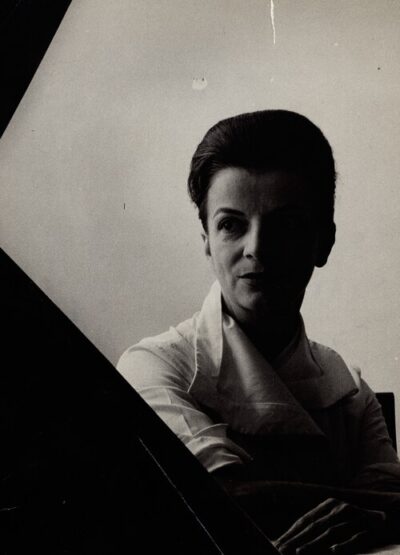
Lygia Clark
Lygia Clark was a Brazilian artist. Born October 23, 1920, in Belo Horizonte. Died April 25, 1988, in Rio de Janeiro.
Facts
22 facts · 2 confirmed by two sources · 17 cited · 3 from one source
What’s different
- Born: we show October 23, 1920 (Confirmed). Wikidata also lists September 23, 1920
- Died: we show April 25, 1988 (Confirmed). Wikidata also lists April 26, 1988
Where this comes from
Papalocal keeps its own record. It started from these sources; what each one said is kept here as it was copied, so a change on their side never changes this page by itself. Tap one to read its version.
What Wikidata says · copied November 18, 2026 · revision 2567398049
- Described as
- Brazilian artist (1920–1988)
- Other names
- Ligia Clark, Lygia Pimentel Lins Clark, Lígia Pimentel Lins, Ligia Pimentel Lins, Lygia Pimentel Lins
- Born
- October 23, 1920 · 10 references; September 23, 1920 · 1 reference
- Died
- April 25, 1988 · 4 references; April 26, 1988 · 2 references
- Born in
- Belo Horizonte · 1 reference
- Died in
- Rio de Janeiro · 1 reference
- Cause of death
- myocardial infarction
- Citizen of
- Brazil · 3 references
- Occupation
- painter · 2 references; sculptor · 2 references; university teacher; performance artist · 2 references; installation artist · 1 reference; artist · 2 references; visual artist · 1 reference
- Worked for
- University of Paris · 1 reference
- Member of
- Grupo Frente · 1 reference; neo-concrete movement · 2 references
- Field
- painting · 1 reference; visual arts · 1 reference; objet d'art · 1 reference; installation art · 1 reference; performance artwork · 1 reference; art of sculpture · 1 reference
- Wikipedias with a page
- 20
Wikidata item Q1791520 (wikidata.org/wiki/Q1791520), public domain (CC0). Copied November 18, 2026.
What Wikipedia says · copied November 18, 2026 · revision 1376117175
Lygia Pimentel Lins (23 October 1920 – 25 April 1988), better known as Lygia Clark, was a Brazilian artist best known for her painting and installation work. She was often associated with the Brazilian Constructivist movements of the mid-20th century and the Tropicalia movement. Along with Brazilian artists Amilcar de Castro, Franz Weissmann, Lygia Pape and poet Ferreira Gullar, Clark co-founded the Neo-Concrete movement. From 1960 on, Clark discovered ways for viewers (who would later be referred to as "participants") to interact with her art works. Clark's work dealt with the relationship between inside and outside, and, ultimately, between self and world.
- Born, in its opening lines
- October 23, 1920
- Died, in its opening lines
- April 25, 1988
From the Wikipedia article “Lygia Clark” (en.wikipedia.org/wiki/Lygia_Clark), by its contributors, under CC BY-SA 4.0 (creativecommons.org/licenses/by-sa/4.0/). Copied November 18, 2026; not changed.
Confirmed Two sources agree. Cited One source, and it names where it got it. One source One source, without a reference of its own. Sources disagree The sources disagree. We show the best-supported value and keep theirs below.
