
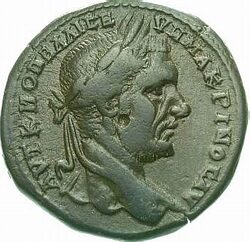
Macrinus
Macrinus was a Roman emperor from 217 to 218. Born 165, in Cherchell. Died 218, in Cappadocia. Positions held include Roman emperor (217–218), ancient Roman senator and Praetorian prefect.
Facts
13 facts · 2 confirmed by two sources · 0 cited · 11 from one source
What’s different
- Born: we show 165 (Confirmed). Wikidata also lists 164
Where this comes from
Papalocal keeps its own record. It started from these sources; what each one said is kept here as it was copied, so a change on their side never changes this page by itself. Tap one to read its version.
What Wikidata says · copied November 16, 2026 · revision 2568845026
- Described as
- Roman emperor from 217 to 218
- Other names
- Marcus Opellius Severus Macrinus Augustus
- Born
- 164 · 3 references; 165 · 3 references
- Died
- 218 · 6 references
- Born in
- Cherchell
- Died in
- Cappadocia
- Citizen of
- Ancient Rome
- Occupation
- politician; lawyer
- Positions held
- Roman emperor (217–218); ancient Roman senator; Praetorian prefect
- Spouse
- Nonia Celsa
- Children
- Diadumenian
- Religion
- ancient Roman religion
- Wikipedias with a page
- 79
Wikidata item Q1752 (wikidata.org/wiki/Q1752), public domain (CC0). Copied November 16, 2026.
What Wikipedia says · copied November 16, 2026 · revision 1371225331
Marcus Opellius Macrinus (; c. 165 – June 218) was a Roman emperor who reigned from April 217 to June 218, jointly with his young son Diadumenianus. Born in Caesarea (now called Cherchell, in modern Algeria), in the Roman province of Mauretania Caesariensis to an equestrian family of Berber origins, he became the first emperor who did not hail from the senatorial class and also the first emperor who never visited Rome during his reign. Before becoming emperor, Macrinus served under Emperor Caracalla as a praetorian prefect and dealt with Rome's civil affairs. He later conspired against Caracalla and had him murdered in a bid to protect his own life and succeeded Caracalla as emperor.
Macrinus was proclaimed emperor of Rome by 11 April 217 while in the eastern provinces of the empire and was subsequently confirmed as such by the Senate; however, for the duration of his reign, he never had the opportunity to return to Rome. His predecessor's policies had left Rome's coffers empty and the empire at war with several kingdoms, including Parthia, Armenia, and Dacia. As emperor, Macrinus first attempted to enact reform to restore economic and diplomatic stability in Rome. While Macrinus' diplomatic actions brought about peace with each of the individual kingdoms, the additional monetary costs and subsequent fiscal reforms generated unrest in the Roman military.
Caracalla's aunt, Julia Maesa, took advantage of the unrest and instigated a rebellion to have her fourteen-year-old grandson, Elagabalus, recognized as emperor. Macrinus was overthrown at the Battle of Antioch on 8 June 218 and Elagabalus proclaimed himself emperor with support from the rebelling Roman legions. Macrinus fled the battlefield and tried to reach Rome, but was captured in Chalcedon and later executed in Cappadocia. He sent his son to the care of Artabanus IV of Parthia, but Diadumenian was also captured before he could reach his destination and executed. After Macrinus' death, the Senate declared him and his son enemies of Rome and had their names struck from the records and their images destroyed, a procedure known as damnatio memoriae.
- Born, in its opening lines
- c. 165
- Died, in its opening lines
- June 218
From the Wikipedia article “Macrinus” (en.wikipedia.org/wiki/Macrinus), by its contributors, under CC BY-SA 4.0 (creativecommons.org/licenses/by-sa/4.0/). Copied November 16, 2026; not changed.
Confirmed Two sources agree. Cited One source, and it names where it got it. One source One source, without a reference of its own. Sources disagree The sources disagree. We show the best-supported value and keep theirs below.
