
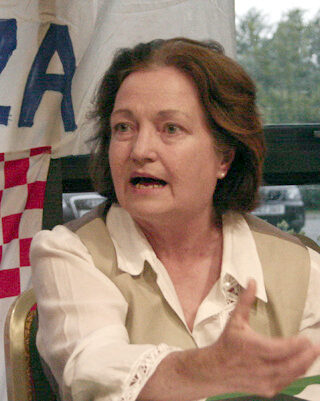
Mairead Maguire
Mairead Maguire is a peace activist. Born January 27, 1944, in Belfast. Educated at Trinity College, Dublin. Awards include Nobel Peace Prize, People's Peace Prize and Pacem in Terris Award.
Facts
12 facts · 1 confirmed by two sources · 3 cited · 8 from one source
Where this comes from
Papalocal keeps its own record. It started from these sources; what each one said is kept here as it was copied, so a change on their side never changes this page by itself. Tap one to read its version.
What Wikidata says · copied November 16, 2026 · revision 2563195758
- Described as
- peace activist (born 1944)
- Other names
- Mairead Corrigan Maguire
- Born
- January 27, 1944 · 6 references
- Born in
- Belfast · 1 reference
- Citizen of
- United Kingdom
- Occupation
- peace activist; politician · 1 reference
- Education
- Trinity College, Dublin
- Member of
- Nobel Women's Initiative
- Awards
- Nobel Peace Prize (1976) · 2 references; People's Peace Prize (1976); Pacem in Terris Award (1990); Carl von Ossietzky Medal (1976) · 1 reference
- Religion
- Catholic Church
- Wikipedias with a page
- 82
Wikidata item Q157655 (wikidata.org/wiki/Q157655), public domain (CC0). Copied November 16, 2026.
What Wikipedia says · copied November 16, 2026 · revision 1379988058
Mairead Maguire (born 27 January 1944), also known as Mairead Corrigan Maguire and formerly as Mairéad Corrigan, is a peace activist from Northern Ireland. She co-founded, with Betty Williams and Ciaran McKeown, the Women for Peace, which later became the Community for Peace People, an organization dedicated to encouraging a peaceful resolution of the Troubles in Northern Ireland. Maguire and Williams were awarded the 1976 Nobel Peace Prize.
- Born, in its opening lines
- January 27, 1944
From the Wikipedia article “Mairead Maguire” (en.wikipedia.org/wiki/Mairead_Maguire), by its contributors, under CC BY-SA 4.0 (creativecommons.org/licenses/by-sa/4.0/). Copied November 16, 2026; not changed.
Confirmed Two sources agree. Cited One source, and it names where it got it. One source One source, without a reference of its own. Sources disagree The sources disagree. We show the best-supported value and keep theirs below.
