
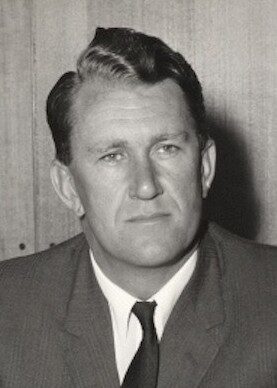
Malcolm Fraser
Malcolm Fraser was an Australian politician, 22nd Prime Minister of Australia. Born May 21, 1930, in Toorak. Died March 20, 2015, in Melbourne. Positions held include Prime Minister of Australia (1975–1983), member of the Australian House of Representatives (1955–1983) and Minister for Defence (1969–1971). Educated at Magdalen College and The King's School, Tudor House. Awards include Order of the Rising Sun, 1st class, Human Rights Medal and Companion of Honour.
Facts
24 facts · 2 confirmed by two sources · 5 cited · 17 from one source
Where this comes from
Papalocal keeps its own record. It started from these sources; what each one said is kept here as it was copied, so a change on their side never changes this page by itself. Tap one to read its version.
What Wikidata says · copied November 16, 2026 · revision 2562941741
- Described as
- Australian politician, 22nd Prime Minister of Australia (1930-2015)
- Other names
- John Malcolm Fraser, The Right Honourable Malcolm Fraser
- Born
- May 21, 1930 · 9 references
- Died
- March 20, 2015 · 7 references
- Born in
- Toorak
- Died in
- Melbourne · 1 reference
- Buried in
- Melbourne General Cemetery · 1 reference
- Citizen of
- Australia
- Occupation
- politician · 1 reference; head of government · 1 reference
- Positions held
- Prime Minister of Australia (1975–1983); member of the Australian House of Representatives (1955–1983); Minister for Defence (1969–1971); Minister for Education (1971–1972); Member of the Privy Council of the United Kingdom
- Political party
- Liberal Party of Australia (1954–2009)
- Education
- Magdalen College; The King's School, Tudor House
- Awards
- Order of the Rising Sun, 1st class; Human Rights Medal; Companion of Honour (1977) · 1 reference; Fellow of the Royal Commonwealth Society; Companion of the Order of Australia (1988) · 1 reference; Australian National Living Treasure
- Spouse
- Tamie Fraser (1956–)
- Father
- Neville Fraser
- Wikipedias with a page
- 51
Wikidata item Q315979 (wikidata.org/wiki/Q315979), public domain (CC0). Copied November 16, 2026.
What Wikipedia says · copied November 16, 2026 · revision 1385950294
John Malcolm Fraser (; 21 May 1930 – 20 March 2015) was the 22nd prime minister of Australia, serving from 1975 to 1983. He held office as the leader of the Liberal Party of Australia, and is the fourth longest-serving prime minister in Australian history.
Born in Melbourne, Fraser was raised on his father's sheep stations in rural New South Wales and studied philosophy, politics and economics at Magdalen College, Oxford. After an initial defeat in 1954, he was elected to the House of Representatives at the 1955 federal election, winning the rural south-western Victoria seat of Wannon. At 25 years old, he was one of the youngest people ever elected to Parliament. He is the latest prime minister as of 2025 to represent a rural constituency. When Harold Holt became prime minister in 1966, Fraser was appointed Minister for the Army. After Holt's disappearance and replacement by John Gorton, Fraser became Minister for Education and Science (1968–1969) and then Minister for Defence (1969–1971). In 1971, Fraser resigned from cabinet and denounced Gorton as "unfit to hold the great office of prime minister"; this precipitated the replacement of Gorton with William McMahon. He subsequently returned to his old education and science portfolio.
After the Liberal–National Coalition was defeated at the 1972 election, Fraser unsuccessfully stood for the Liberal leadership, losing to Billy Snedden. When the party lost the 1974 election, he began to move against Snedden, eventually mounting a successful challenge in March 1975. As Leader of the Opposition, Fraser used the Coalition's control of the Australian Senate to block supply to the Whitlam government, precipitating the 1975 Australian constitutional crisis. This culminated with Gough Whitlam being dismissed as prime minister by the governor-general, Sir John Kerr, a unique occurrence in Australian history. The correctness of Fraser's actions in the crisis and the exact nature of his involvement in Kerr's decision have since been a topic of debate. Fraser remains the only Australian prime minister to ascend to the position upon the dismissal of his predecessor.
After Whitlam's dismissal, Fraser was sworn in as prime minister on an initial caretaker basis. The Coalition won a landslide victory at the 1975 election, and was re-elected in 1977 and 1980. Fraser took a keen interest in foreign affairs as prime minister, and was more active in the international sphere than many of his predecessors. He was a strong supporter of multiculturalism, and during his term in office Australia admitted significant numbers of non-white immigrants (including Vietnamese boat people) for the first time, effectively ending the White Australia policy. His government also established the Special Broadcasting Service (SBS). Particularly in his final years in office, Fraser came into conflict with the "dry" economic rationalist and fiscal conservative faction of his party. His government made few major changes to economic policy.
After losing the 1983 election, Fraser retired from politics. In his post-political career, he held advisory positions with the United Nations (UN) and the Commonwealth of Nations, and was president of the aid agency CARE from 1990 to 1995. He resigned his membership of the Liberal Party in 2009 after the election of Tony Abbott as leader, Fraser having been a critic of the Liberals’ policy direction for a number of years. Evaluations of Fraser's prime ministership have been mixed. He is generally credited with restoring stability to the country after a series of short-term leaders and has been praised for his commitment to multiculturalism and opposition to apartheid in South Africa, but the circumstances of his entry to office remains controversial and many have viewed his government as a lost opportunity for economic reform. He was the last Australian prime minister entitled to the style "the Right Honourable" as a member of the Privy Council of the United Kingdom. His seven and a half-year tenure as prime minister is the fourth-longest in Australian history, only surpassed by Bob Hawke, John Howard and Robert Menzies.
- Born, in its opening lines
- May 21, 1930
- Died, in its opening lines
- March 20, 2015
From the Wikipedia article “Malcolm Fraser” (en.wikipedia.org/wiki/Malcolm_Fraser), by its contributors, under CC BY-SA 4.0 (creativecommons.org/licenses/by-sa/4.0/). Copied November 16, 2026; not changed.
Confirmed Two sources agree. Cited One source, and it names where it got it. One source One source, without a reference of its own. Sources disagree The sources disagree. We show the best-supported value and keep theirs below.
