
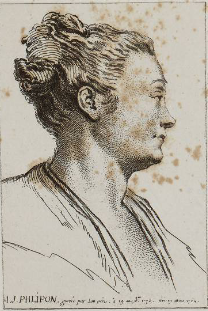
Manon Roland
Manon Roland was a French revolutionary. Born March 17, 1754, in Paris. Died November 8, 1793, in Paris.
Facts
13 facts · 2 confirmed by two sources · 5 cited · 5 from one source · 1 where the sources disagree
What’s different
- Buried in: we show Madeleine Cemetery (Sources disagree). Wikidata also lists Catacombs of Paris
Where this comes from
Papalocal keeps its own record. It started from these sources; what each one said is kept here as it was copied, so a change on their side never changes this page by itself. Tap one to read its version.
What Wikidata says · copied November 16, 2026 · revision 2568763754
- Described as
- French revolutionary
- Other names
- Madame Roland, Marie-Jeanne 'Manon' Roland de la Platière, Marie-Jeanne Philipon
- Born
- March 17, 1754 · 10 references
- Died
- November 8, 1793 · 9 references
- Born in
- Paris · 2 references
- Died in
- Paris · 1 reference
- Buried in
- Madeleine Cemetery; Catacombs of Paris
- Cause of death
- decapitation
- Name at birth
- Jeanne-Marie Philipon · 1 reference
- Citizen of
- France
- Occupation
- writer · 2 references; politician · 1 reference; memoirist
- Political party
- Girondists
- Spouse
- Jean-Marie Roland de la Platière (1780–) · 1 reference
- Wikipedias with a page
- 58
Wikidata item Q236554 (wikidata.org/wiki/Q236554), public domain (CC0). Copied November 16, 2026.
What Wikipedia says · copied November 16, 2026 · revision 1383293821
Marie-Jeanne "Manon" Roland de la Platière (Paris, March 17, 1754 – Paris, November 8, 1793), born Marie-Jeanne Phlipon, and best known under the name Madame Roland (French pronunciation: [madam ʁɔlɑ̃]) was a French revolutionary, salonnière and writer.
From a young age Roland was interested in philosophy and political theory and studied a broad range of writers and thinkers. She was however dissatisfied with the opportunities available to her as a woman. After marrying the economist Jean-Marie Roland de la Platière, she developed with him a husband and wife team which made it possible for her to engage in writing and research.
She moved from Paris to Lyon, where she initially led a quiet and unremarkable life as a provincial intellectual with her husband. She became actively involved in politics when the French Revolution broke out in 1789. She spent the first years of the revolution in Lyon, where her husband was elected to the city council. During this period she developed a network of contacts with politicians and journalists. Her reports on developments in Lyon in letters to people in her network were published in national revolutionary newspapers.
In 1791 the couple settled in Paris, where Madame Roland soon established herself as a leading figure within the political group the Girondins, one of the more moderate revolutionary factions. She was known for her intelligence, astute political analyses and her tenacity, and was a good lobbyist and negotiator. The salon she hosted in her home several times a week was an important meeting place for politicians. However, she was also convinced of her own intellectual and moral superiority and alienated important political leaders like Robespierre and Danton.
Unlike the feminist revolutionaries Olympe de Gouges and Etta Palm, Madame Roland was not an advocate for political rights for women. She accepted that women should play a very modest role in public and political life. Even during her lifetime, many found this position difficult to reconcile with her own active involvement in politics and her important role within the Girondins.
When her husband unexpectedly became Minister of the Interior in 1792, her political influence grew. She had control over the content of ministerial letters, memorandums and speeches, was involved in decisions about political appointments, and was in charge of a bureau set up to influence public opinion in France. She was both admired and reviled, and particularly hated by the sans-culottes of Paris. The publicists Marat and Hébert conducted a smear campaign against Madame Roland as part of the power struggle between the Girondins and the more radical Jacobins and Montagnards. In June 1793, she was the first Girondin to be arrested during the Terror and was guillotined a few months later.
Madame Roland wrote her memoirs while she was imprisoned in the months before her execution. They are – like her letters – a valuable source of information about the first years of the French Revolution.
- Born, in its opening lines
- March 17, 1754
- Died, in its opening lines
- November 8, 1793
From the Wikipedia article “Madame Roland” (en.wikipedia.org/wiki/Madame_Roland), by its contributors, under CC BY-SA 4.0 (creativecommons.org/licenses/by-sa/4.0/). Copied November 16, 2026; not changed.
Confirmed Two sources agree. Cited One source, and it names where it got it. One source One source, without a reference of its own. Sources disagree The sources disagree. We show the best-supported value and keep theirs below.
