
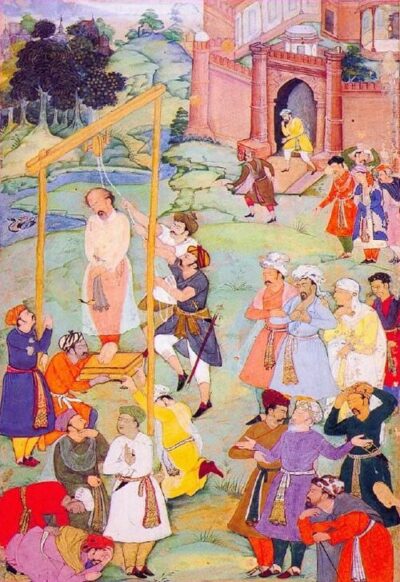
Mansur Al-Hallaj
Mansur Al-Hallaj was a Persian mystic, poet and Sufi teacher (c.858–922). Born 858, in Wasit. Died March 26, 922, in Baghdad.
Facts
13 facts · 2 confirmed by two sources · 0 cited · 11 from one source
Where this comes from
Papalocal keeps its own record. It started from these sources; what each one said is kept here as it was copied, so a change on their side never changes this page by itself. Tap one to read its version.
What Wikidata says · copied November 16, 2026 · revision 2568674367
- Described as
- Persian mystic, poet and Sufi teacher (c.858–922)
- Other names
- Husayn ibn Mausur al- Hallaj, Abū 'l-Muġīṭ Al-Ḥusayn bin Manṣūr al-Ḥallāğ, Al-Hallaj, Mansour Hallaj, Abu ʾl–Mughīth al-Ḥusain b. Mansur al-Hallāj, Abu al-Mughith al-Husayn al-Hallaj
- Born
- 858 · 7 references
- Died
- March 26, 922 · 2 references
- Born in
- Wasit
- Died in
- Baghdad
- Cause of death
- decapitation
- Citizen of
- Abbasid Caliphate
- Occupation
- poet · 1 reference; mystic; teacher; writer
- Field
- Sufism
- Religion
- Islam; Alevism
- Wikipedias with a page
- 64
Wikidata item Q172862 (wikidata.org/wiki/Q172862), public domain (CC0). Copied November 16, 2026.
What Wikipedia says · copied November 16, 2026 · revision 1382885938
Mansour al-Hallaj (Arabic: ابو المغيث الحسين بن منصور الحلاج, romanized: Abū 'l-Muġīth al-Ḥusayn ibn Manṣūr al-Ḥallāj), also known as Mansour Hallaj (Persian: منصور حلاج, romanized: Mansūr-e Hallāj; c. 858 – 26 March 922; c. 244 AH – 309 AH), was a Muslim Iranian mystic, poet, preacher, and teacher of Sufism, and one of the most controversial figures in Islamic history. During his lifetime he attracted a large popular following and was acclaimed as a saint by many ordinary believers, while Muslim jurists condemned him as a heretic. Most of his contemporary Sufis likewise disapproved of his actions, although he later became a major figure in the Sufi tradition.
Al-Hallaj was associated with the doctrine of fanāʾ, the extinction of individual consciousness, and with ideas described as ḥulūl, or union and identity with God. His mystical teaching sought to overcome the perceived gulf between the human being and God, expressing the relationship between the mystic and the divine in terms of an intimate union of lover and beloved. His most famous utterance, anā al-Ḥaqq ("I am the Truth"), was interpreted by many as a claim to divinity, while others understood it as an expression of the annihilation of the individual ego in which God, rather than the individual self, speaks through the mystic. To contemporary jurists, however, such teaching appeared blasphemously incompatible with the Islamic doctrine of tanzīh, the transcendence of God, and was also perceived as potentially threatening to the social order.
According to tradition, al-Hallaj was also known as Ḥallāj al-asrār, the "Carder of Consciences", because he was believed capable of discerning the secret thoughts of others. He deliberately taught a path of mystical union with God in opposition to what he regarded as the excessively dry and law-bound theology of his age. As a powerful public preacher, he was capable of moving audiences deeply and presented mystical experience as a condition in which the self is overwhelmed by divine presence and can no longer regard itself as autonomous from God.
Al-Hallaj spent many years teaching and travelling extensively through Central Asia and India. He eventually became implicated in political struggles at the Abbasid court, was arrested and subjected to a prolonged period of imprisonment, and was ultimately executed in Baghdad on religious and political charges in 922. His execution was brutal, and later Sufi tradition came to regard him as a pre-eminent mystical martyr. Accounts of his final words portray him as accepting his own fate while asking forgiveness for those responsible for his death and interpreting his execution as the culmination of the mystic's longing for complete solitude with God.
His only surviving work is Kitāb al-Tawāsīn, is dated to 902 CE. It contains the celebrated formula anā al-Ḥaqq, "I am the Truth", whose meaning in the work is presented in the context of divine signs and mystical participation in the Truth rather than simply as an unqualified assertion of personal divinity. His teachings, execution, and subsequent reinterpretation made him one of the most enduring and disputed symbols of ecstatic mysticism in the Sufi tradition.
- Born, in its opening lines
- c. 858
- Died, in its opening lines
- March 26, 922
From the Wikipedia article “Al-Hallaj” (en.wikipedia.org/wiki/Al-Hallaj), by its contributors, under CC BY-SA 4.0 (creativecommons.org/licenses/by-sa/4.0/). Copied November 16, 2026; not changed.
Confirmed Two sources agree. Cited One source, and it names where it got it. One source One source, without a reference of its own. Sources disagree The sources disagree. We show the best-supported value and keep theirs below.
