
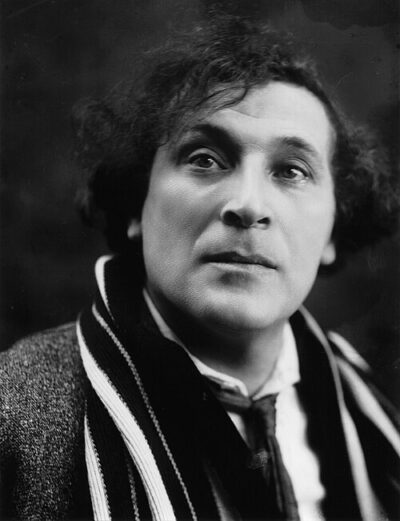
Marc Chagall
Marc Chagall was a Belarusian-French artist. Born June 24, 1887, in Liozna. Died March 28, 1985, in Saint-Paul-de-Vence. Known for White Crucifixion, I and the Village and La Mariée. Educated at School Yehuda Pen in Vitebsk and Académie de La Palette. Awards include Carnegie Prize, Yakir Yerushalayim and Grand Cross of the Legion of Honour.
Facts
53 facts · 1 confirmed by two sources · 24 cited · 26 from one source · 2 where the sources disagree
What’s different
- Born: we show June 24, 1887 (Sources disagree). Wikipedia says July 6, 1887
- Name at birth: we show Моисей Хацкелевич Шагал (Sources disagree). Wikidata also lists Мойша Захаравіч Шагалаў
Where this comes from
Papalocal keeps its own record. It started from these sources; what each one said is kept here as it was copied, so a change on their side never changes this page by itself. Tap one to read its version.
What Wikidata says · copied November 16, 2026 · revision 2570046804
- Described as
- Belarusian-French artist (1887–1985)
- Other names
- Marc Zakharovich Chagall, Moshe Segal, Marḳ Shagal, Chagall, m. chagall, Mark Zakharovich Shagal', Syagal, Moses Shagal, Mark Zakharovich Shagal, Mark Sacharovich Schagal Chagall, Marc Szagal, Mark Shagal
- Born
- June 24, 1887 · 1 reference
- Died
- March 28, 1985 · 16 references
- Born in
- Liozna · 2 references
- Died in
- Saint-Paul-de-Vence · 2 references
- Buried in
- Cimetière de Saint-Paul-de-Vence · 1 reference
- Name at birth
- Моисей Хацкелевич Шагал; Мойша Захаравіч Шагалаў
- Citizen of
- France (1937–) · 1 reference; Russian Empire (1887–1917); Russian Socialist Federative Soviet Republic (1917–1922) · 1 reference; statelessness (1922–1937) · 1 reference
- Occupation
- painter · 5 references; printmaker · 1 reference; poet · 1 reference; lithographer · 1 reference; designer · 3 references; graphic artist · 1 reference; illustrator · 3 references; scenographer · 3 references
- Education
- School Yehuda Pen in Vitebsk · 1 reference; Académie de La Palette
- Member of
- Comité national de l'estampe; Royal Academy of Arts; Koninklijke Vlaamse Academie van België voor Wetenschappen en Kunsten · 1 reference; Accademia delle Arti del Disegno
- Genre
- avant-garde; animal painting · 1 reference; landscape painting · 1 reference; portrait · 1 reference; religious art · 1 reference
- Known for
- White Crucifixion; I and the Village; La Mariée; Self-Portrait with Seven Fingers; Paris Through the Window
- Awards
- Carnegie Prize (1939) · 1 reference; Yakir Yerushalayim; Grand Cross of the Legion of Honour (1977) · 2 references; Erasmus Prize (1960) · 2 references; Wolf Prize in Arts (1981); honorary doctor of the Hebrew University of Jerusalem (1975) · 1 reference; Honorary doctor of the Catholic University of Louvain; honorary doctorate of the University of Glasgow
- Spouse
- Bella Rosenfeld (1915–1944) · 1 reference; Virginia Haggard (1945–1952); Valentina Brodsky (1952–1985) · 1 reference; Valentina Chagall · 1 reference
- Children
- David McNeil · 1 reference; Ida Chagall · 1 reference
- Lived in
- Saint Petersburg (1907–) · 1 reference; Moscow (1920–); France (1923–); United States (1941–)
- Website
- https://www.marcchagall.com
- Wikipedias with a page
- 103
Wikidata item Q93284 (wikidata.org/wiki/Q93284), public domain (CC0). Copied November 16, 2026.
What Wikipedia says · copied November 16, 2026 · revision 1384924389
Marc Chagall (born Moishe Shagal; 6 July [O.S. 24 June] 1887 – 28 March 1985) was a Russian and French artist of Jewish ancestry. An early modernist, he was associated with the École de Paris, as well as several major artistic styles and created works in a wide range of artistic formats, including painting, drawings, book illustrations, stained glass, stage sets, ceramics, tapestries and fine art prints.
Chagall was born in 1887, into a Jewish family near Vitebsk, today in Belarus, but at that time in the Pale of Settlement of the Russian Empire. Before World War I, he travelled between Saint Petersburg, Paris, and Berlin. During that period, he created his own mixture and style of modern art, based on his ideas of Eastern European and Jewish folklore. He spent the wartime years in Vitebsk and Petrograd, becoming one of the Russia's most distinguished artists and a member of the modernist avant-garde, founding the Vitebsk Museum of Modern Art and People's Art School. He later worked in and near Moscow in difficult conditions during hard times in Russia following the Bolshevik Revolution, before leaving again for Paris in 1923. During World War II, he escaped occupied France to the United States, where he lived in New York City for seven years before returning to France in 1948.
Art critic Robert Hughes referred to Chagall as "the quintessential Jewish artist of the twentieth century." According to art historian Michael J. Lewis, Chagall was considered to be "the last survivor of the first generation of European modernists.” For decades, he "had also been respected as the world's pre-eminent Jewish artist.” Using the medium of stained glass, he produced windows for the cathedrals of Reims and Metz as well as the Fraumünster in Zürich, windows for the UN and the Art Institute of Chicago and the Jerusalem Windows in Israel. He also did large-scale paintings, including part of the ceiling of the Paris Opéra. He experienced modernism's "golden age" in Paris, where "he synthesized the art forms of Cubism, Symbolism, and Fauvism, and the influence of Fauvism gave rise to Surrealism". Yet throughout these phases of his style he remained "most emphatically a Jewish artist, whose work was one long dreamy reverie of life in his native Vitebsk." "When Matisse dies,” Pablo Picasso remarked in the 1950s, "Chagall will be the only painter left who understands what colour really is.”
- Born, in its opening lines
- July 6, 1887
- Died, in its opening lines
- March 28, 1985
From the Wikipedia article “Marc Chagall” (en.wikipedia.org/wiki/Marc_Chagall), by its contributors, under CC BY-SA 4.0 (creativecommons.org/licenses/by-sa/4.0/). Copied November 16, 2026; not changed.
Confirmed Two sources agree. Cited One source, and it names where it got it. One source One source, without a reference of its own. Sources disagree The sources disagree. We show the best-supported value and keep theirs below.
