
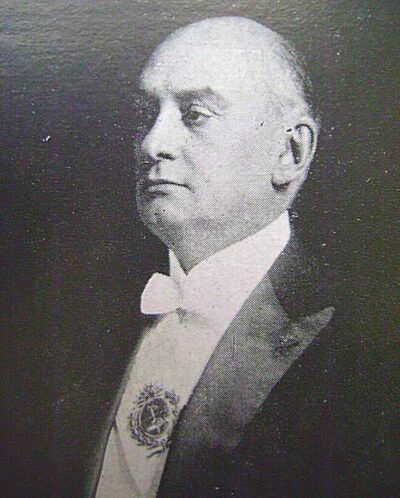
Marcelo Torcuato de Alvear
Marcelo Torcuato de Alvear was an Argentine politician, former president of Argentina. Born October 4, 1868, in Buenos Aires. Died March 23, 1942, in Don Torcuato. Positions held include President of Argentina (1922–1928) and member of the Argentine Chamber of Deputies. Educated at University of Buenos Aires and National School of Buenos Aires. Awards include Collar of the Order of Charles III.
Facts
19 facts · 2 confirmed by two sources · 1 cited · 16 from one source
Where this comes from
Papalocal keeps its own record. It started from these sources; what each one said is kept here as it was copied, so a change on their side never changes this page by itself. Tap one to read its version.
What Wikidata says · copied November 16, 2026 · revision 2567791736
- Described as
- Argentine politician, former president of Argentina (1868-1942)
- Born
- October 4, 1868 · 4 references
- Died
- March 23, 1942 · 1 reference
- Born in
- Buenos Aires
- Died in
- Don Torcuato
- Buried in
- Recoleta Cemetery
- Citizen of
- Argentina
- Occupation
- lawyer; politician · 1 reference; sport shooter · 1 reference
- Positions held
- President of Argentina (1922–1928); member of the Argentine Chamber of Deputies
- Political party
- Radical Civic Union
- Education
- University of Buenos Aires; National School of Buenos Aires
- Sport
- shooting sports
- Awards
- Collar of the Order of Charles III
- Spouse
- Regina Pacini
- Father
- Torcuato de Alvear
- Siblings
- Carlos Torcuato de Alvear
- Wikipedias with a page
- 32
Wikidata item Q363586 (wikidata.org/wiki/Q363586), public domain (CC0). Copied November 16, 2026.
What Wikipedia says · copied November 16, 2026 · revision 1373138861
Máximo Marcelo Torcuato de Alvear y Pacheco (4 October 1868 – 23 March 1942) served as president of Argentina from 1922 to 1928.
His period of government coincided precisely with the end of the postwar world crisis, which allowed him to improve the economy and finances of the country without major setbacks. He also stood out in the development of the automotive industry and the successful oil exploitation, with which he achieved an economic prosperity unknown until then for Argentina, and that was demonstrated with the great increase achieved in the GDP per inhabitant. In 1928, it had reached the sixth position among the highest in the world. In the labor and social sphere, this period was characterized by a process of urban concentration in the Litoral and Greater Buenos Aires, in addition to the establishment of half a million immigrants; there was an increase in the middle class, a rise in real wages, and a decrease in strikes and similar conflicts.
When he left the presidency he settled in France. He returned to the country a few years later to reunify his party and try to become president for the second time in 1931, but his candidacy was prohibited by the military regime of José Félix Uriburu. Alvear, along with other radical coreligionists, was persecuted, imprisoned or had to go into exile on repeated occasions by the repressive regime of the infamous decade, for which he experienced the Martín García prison on the island.
On 23 March 1942 struck down by a heart attack, Marcelo Torcuato de Alvear died next to his wife Regina Pacini at their home in Don Torcuato.
- Born, in its opening lines
- October 4, 1868
- Died, in its opening lines
- March 23, 1942
From the Wikipedia article “Marcelo Torcuato de Alvear” (en.wikipedia.org/wiki/Marcelo_Torcuato_de_Alvear), by its contributors, under CC BY-SA 4.0 (creativecommons.org/licenses/by-sa/4.0/). Copied November 16, 2026; not changed.
Confirmed Two sources agree. Cited One source, and it names where it got it. One source One source, without a reference of its own. Sources disagree The sources disagree. We show the best-supported value and keep theirs below.
