
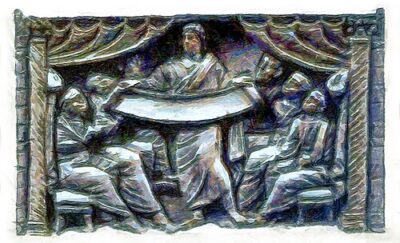
Marcion of Sinope
Marcion of Sinope was an Anatolian Christian theologian (c.85–c.160). Born 85, in Sinop. Died 160, in Rome. Known for Gospel of Marcion and Antithesis.
Facts
14 facts · 0 confirmed by two sources · 0 cited · 14 from one source
Where this comes from
Papalocal keeps its own record. It started from these sources; what each one said is kept here as it was copied, so a change on their side never changes this page by itself. Tap one to read its version.
What Wikidata says · copied November 16, 2026 · revision 2563312021
- Described as
- Anatolian Christian theologian (c.85–c.160)
- Other names
- Marcion
- Born
- 85
- Died
- 160
- Born in
- Sinop
- Died in
- Rome
- Occupation
- theologian; philosopher
- Known for
- Gospel of Marcion; Antithesis
- Field
- philosophy; theology; exegete
- Father
- Philologus of Sinope
- Religion
- Christianity; Marcionism
- Wikipedias with a page
- 52
Wikidata item Q201346 (wikidata.org/wiki/Q201346), public domain (CC0). Copied November 16, 2026.
What Wikipedia says · copied November 16, 2026 · revision 1382841739
Marcion of Sinope (Ancient Greek: Μαρκίων Σινώπης; c. 85 – c. 160) was a theologian in early Christianity. Marcion preached that God had sent Jesus Christ, who was distinct from the "vengeful" God (Demiurge) who had created the world. He considered himself a follower of Paul the Apostle, whom he believed to have been the only true apostle of Jesus Christ; his doctrine is called Marcionism. Marcion published the earliest record of a canon of New Testament books.
Early Church writers such as Justin Martyr, Irenaeus, and Tertullian denounced Marcion as a heretic or antichrist, and he was excommunicated by the church of Rome around 144. He published his own canon of Christian sacred scriptures, which contained ten Pauline epistles (including the Epistle to the Laodiceans, while excluding the Pastoral epistles) and the Gospel of Marcion, which the majority of scholars agree was a later revised version of the Gospel of Luke.
This made Marcionism a catalyst in the process of the development of the New Testament canon by forcing the proto-orthodox Church to respond to his canon.
From the Wikipedia article “Marcion of Sinope” (en.wikipedia.org/wiki/Marcion_of_Sinope), by its contributors, under CC BY-SA 4.0 (creativecommons.org/licenses/by-sa/4.0/). Copied November 16, 2026; not changed.
Confirmed Two sources agree. Cited One source, and it names where it got it. One source One source, without a reference of its own. Sources disagree The sources disagree. We show the best-supported value and keep theirs below.
