
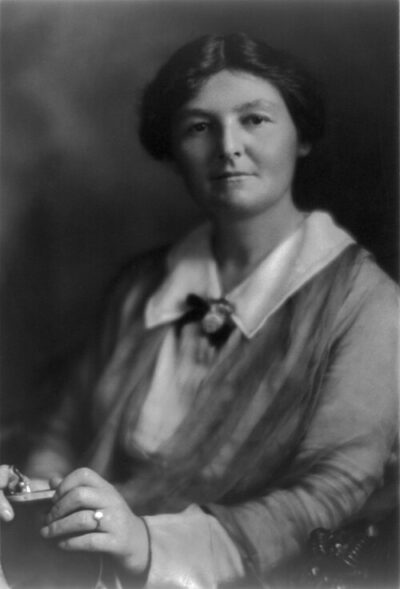
Margaret Bondfield
Margaret Bondfield was a British feminist and trade unionist. Born March 17, 1873, in Chard. Died June 16, 1953, in Sanderstead. Positions held include Secretary of State for Employment (1929–1931), Member of the Privy Council of the United Kingdom and member of the 35th Parliament of the United Kingdom (1929–1931). Awards include Order of the Companions of Honour.
Facts
21 facts · 2 confirmed by two sources · 10 cited · 9 from one source
Where this comes from
Papalocal keeps its own record. It started from these sources; what each one said is kept here as it was copied, so a change on their side never changes this page by itself. Tap one to read its version.
What Wikidata says · copied November 16, 2026 · revision 2562735147
- Described as
- British feminist and trade unionist (1873–1953)
- Other names
- Margaret (Grace) Bondfield
- Born
- March 17, 1873 · 5 references
- Died
- June 16, 1953 · 5 references
- Born in
- Chard · 1 reference
- Died in
- Sanderstead · 1 reference
- Citizen of
- United Kingdom
- Occupation
- politician · 2 references; trade unionist; political activist · 1 reference; suffragist · 1 reference
- Positions held
- Secretary of State for Employment (1929–1931); Member of the Privy Council of the United Kingdom; member of the 35th Parliament of the United Kingdom (1929–1931) · 1 reference; member of the 34th Parliament of the United Kingdom (1926–1929) · 1 reference; member of the 33rd Parliament of the United Kingdom (1923–1924) · 1 reference
- Political party
- Labour Party
- Member of
- General Council of the Trades Union Congress
- Awards
- Order of the Companions of Honour (1948)
- Field
- politics · 1 reference; labor union · 1 reference; women's rights · 1 reference
- Religion
- Congregational churches
- Wikipedias with a page
- 30
Wikidata item Q182904 (wikidata.org/wiki/Q182904), public domain (CC0). Copied November 16, 2026.
What Wikipedia says · copied November 16, 2026 · revision 1371916746
Margaret Grace Bondfield (17 March 1873 – 16 June 1953) was a British Labour Party politician, trade unionist and women's rights activist. She became the first female cabinet minister, and the first woman to be a privy counsellor in the UK, when she was appointed Minister of Labour in the Labour government of 1929–31. She had earlier become the first woman to chair the General Council of the Trades Union Congress (TUC).
Bondfield was born in humble circumstances and received limited formal education. After serving an apprenticeship to an embroideress she worked as a shop assistant in Brighton and London. She was shocked by the working conditions of shop staff, particularly within the "living-in" system, and became an active member of the shopworkers' union. She began to move in socialist circles, and in 1898 was appointed assistant secretary of the National Amalgamated Union of Shop Assistants, Warehousemen and Clerks (NAUSAWC). She was later prominent in several women's socialist movements: she helped to found the Women's Labour League (WLL) in 1906, and was chair of the Adult Suffrage Society. Her standpoint on women's suffrage—she favoured extending the vote to all adults regardless of gender or property, rather than the limited "on the same terms as men" agenda pursued by the militant suffragists—divided her from the militant leadership.
After leaving her union post in 1908 Bondfield worked as organising secretary for the WLL and later as women's officer for the National Union of General and Municipal Workers (NUGMW). She was elected to the TUC Council in 1918, and became its chairman in 1923, the year she was first elected to parliament. In the short-lived minority Labour government of 1924 she served as parliamentary secretary in the Ministry of Labour. Her term of cabinet office in 1929–31 was marked by the economic crises that beset the second Labour government. Her willingness to contemplate cuts in unemployment benefits alienated her from much of the Labour movement, although she did not follow Ramsay MacDonald into the National Government that assumed office when the Labour government fell in August 1931. Bondfield remained active in NUGMW affairs until 1938, and during the Second World War carried out investigations for the Women's Group on Public Welfare.
- Born, in its opening lines
- March 17, 1873
- Died, in its opening lines
- June 16, 1953
From the Wikipedia article “Margaret Bondfield” (en.wikipedia.org/wiki/Margaret_Bondfield), by its contributors, under CC BY-SA 4.0 (creativecommons.org/licenses/by-sa/4.0/). Copied November 16, 2026; not changed.
Confirmed Two sources agree. Cited One source, and it names where it got it. One source One source, without a reference of its own. Sources disagree The sources disagree. We show the best-supported value and keep theirs below.
