
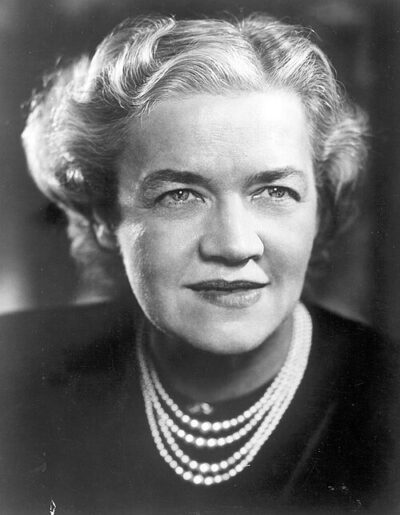
Margaret Chase Smith
Margaret Chase Smith was a member of the United States Senate from Maine. Born December 14, 1897, in Skowhegan. Died May 29, 1995, in Skowhegan. Positions held include United States representative (1940–1949), Republican Conference Chairman of the United States Senate (1967–1973) and secretary (1937–1940). Educated at Colby College and Skowhegan Area High School. Awards include Presidential Medal of Freedom, National Women's Hall of Fame and Maine Women's Hall of Fame.
Facts
33 facts · 2 confirmed by two sources · 21 cited · 10 from one source
Where this comes from
Papalocal keeps its own record. It started from these sources; what each one said is kept here as it was copied, so a change on their side never changes this page by itself. Tap one to read its version.
What Wikidata says · copied November 15, 2026 · revision 2567398417
- Described as
- member of the United States Senate from Maine (1897-1995)
- Other names
- Margaret Madeline Chase Smith, Margaret Smith, Margaret Madeline Chase
- Born
- December 14, 1897 · 6 references
- Died
- May 29, 1995 · 8 references
- Born in
- Skowhegan · 3 references
- Died in
- Skowhegan · 2 references
- Cause of death
- lung cancer
- Name at birth
- Margaret Madeline Chase · 1 reference
- Citizen of
- United States
- Occupation
- politician · 1 reference; teacher (1916–1917) · 1 reference; business executive (1919–1930) · 1 reference
- Positions held
- United States representative (1940–1949) · 3 references; Republican Conference Chairman of the United States Senate (1967–1973); secretary (1937–1940) · 1 reference; United States senator (1949–1973) · 1 reference
- Political party
- Republican Party
- Education
- Colby College · 1 reference; Skowhegan Area High School (–1916) · 3 references
- Member of
- American Academy of Arts and Sciences; Daughters of the American Revolution
- Awards
- Presidential Medal of Freedom (1989) · 3 references; National Women's Hall of Fame (1973) · 1 reference; Maine Women's Hall of Fame (1990) · 1 reference; Distinguished Americans series (2007); Elizabeth Blackwell Award (1991) · 1 reference; Fellow of the American Academy of Arts and Sciences; honorary doctor of Brandeis University; honorary doctor of the Northwestern University; Time 100 (2020) · 1 reference
- Field
- mass media · 1 reference
- Spouse
- Clyde H. Smith (1930–1940) · 1 reference
- Father
- George Emery Chase · 1 reference
- Military branch
- Air Force Reserve Command (1950–1957) · 1 reference
- Military rank
- Lieutenant Colonel · 1 reference
- Wikipedias with a page
- 37
Wikidata item Q456750 (wikidata.org/wiki/Q456750), public domain (CC0). Copied November 15, 2026.
What Wikipedia says · copied November 15, 2026 · revision 1380113330
Margaret Madeline Chase Smith (née Chase; December 14, 1897 – May 29, 1995) was an American politician. A member of the Republican Party, she served as a U.S. representative (1940–1949) and a U.S. senator (1949–1973) from Maine. She was the first woman to serve in both houses of the U.S. Congress. A Republican, she was among the first to criticize the tactics of Joseph McCarthy in her 1950 speech "Declaration of Conscience".
Smith was a candidate in the 1964 Republican Party presidential primaries; she was the first woman to be placed in nomination for the U.S. presidency at a major party's convention. Upon leaving office, she was the longest-serving female senator in history, a distinction that was not surpassed until January 4, 2011, when Senator Barbara Mikulski from Maryland exceeded her record. Smith was ranked as the longest-serving Republican woman in the Senate, a distinction that was not surpassed until January 3, 2021, when Susan Collins, who holds the same Senate seat she previously held, was sworn in for a fifth term.
- Born, in its opening lines
- December 14, 1897
- Died, in its opening lines
- May 29, 1995
From the Wikipedia article “Margaret Chase Smith” (en.wikipedia.org/wiki/Margaret_Chase_Smith), by its contributors, under CC BY-SA 4.0 (creativecommons.org/licenses/by-sa/4.0/). Copied November 15, 2026; not changed.
Confirmed Two sources agree. Cited One source, and it names where it got it. One source One source, without a reference of its own. Sources disagree The sources disagree. We show the best-supported value and keep theirs below.
