
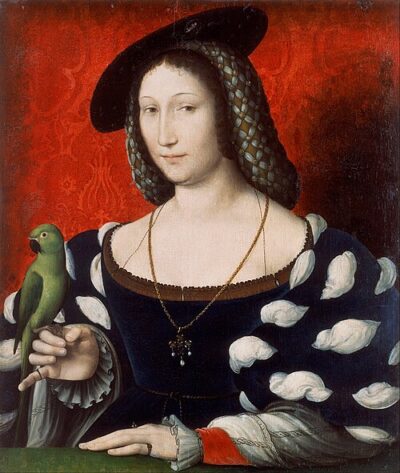
Margaret of Valois-Angoulême
Margaret of Valois-Angoulême was a queen consort of Navarre. Born April 11, 1492, in Angoulême. Died December 21, 1549, in Gascony. Positions held include royal consort (1527–1549). Known for Heptaméron, Les prisons and Letters.
Facts
35 facts · 2 confirmed by two sources · 8 cited · 25 from one source
Where this comes from
Papalocal keeps its own record. It started from these sources; what each one said is kept here as it was copied, so a change on their side never changes this page by itself. Tap one to read its version.
What Wikidata says · copied November 16, 2026 · revision 2553823795
- Described as
- queen consort of Navarre (1492–1549)
- Other names
- Marguerite de Valois-Angoulême, Margaret of Navarre, Marguerite d’Angoulême, Margaret of Angoulême, Marguerite de Navarre, Margaret de Valois Queen of Navarre
- Born
- April 11, 1492
- Died
- December 21, 1549
- Born in
- Angoulême
- Died in
- Gascony
- Buried in
- Lescar Cathedral
- Name at birth
- Marguerite de Valois-Angoulême
- Citizen of
- Kingdom of France; Kingdom of Navarre beyond the Pyrenees
- Occupation
- writer · 1 reference; poet; salonnière; playwright; king
- Positions held
- royal consort (1527–1549)
- Known for
- Heptaméron; Les prisons; Letters; Oraison à Jésus-Christ; Miroir de l'âme pécheresse; Oraison de l'âme fidèle; Le triomphe de l'agneau; Petit oeuvre devot; Pater Noster; Le miroir de Jhesus Christ crucifié
- Field
- poetry; French literature · 1 reference
- Spouse
- Henri II of Navarre (1526–) · 2 references; Charles IV, Duke of Alençon (1509–) · 2 references
- Children
- Jeanne d'Albret · 1 reference; John of Navarre
- Father
- Charles, Count of Angoulême · 1 reference
- Mother
- Louise of Savoy · 1 reference
- Siblings
- Jeanne d'Angoulême; Francis I of France · 1 reference
- Religion
- Reformed Christianity
- Wikipedias with a page
- 68
Wikidata item Q190058 (wikidata.org/wiki/Q190058), public domain (CC0). Copied November 16, 2026.
What Wikipedia says · copied November 16, 2026 · revision 1385674363
Marguerite de Navarre (French: Marguerite d'Angoulême, Marguerite d'Alençon; 11 April 1492 – 21 December 1549), also known as Marguerite of Angoulême and Margaret of Navarre, was a princess of France, Duchess of Alençon and Berry, and Queen of Navarre by her second marriage to King Henry II of Navarre. Her brother became King of France, as Francis I, and the two siblings were responsible for the celebrated intellectual and cultural court and salons of their day in France. Marguerite is the ancestress of the Bourbon kings of France, being the mother of Jeanne d'Albret, whose son, Henry of Navarre, succeeded as Henry IV of France, the first Bourbon king. As an author and a patron of humanists and reformers, she was an outstanding figure of the French Renaissance. Samuel Putnam called her "The First Modern Woman".
- Born, in its opening lines
- April 11, 1492
- Died, in its opening lines
- December 21, 1549
From the Wikipedia article “Marguerite de Navarre” (en.wikipedia.org/wiki/Marguerite_de_Navarre), by its contributors, under CC BY-SA 4.0 (creativecommons.org/licenses/by-sa/4.0/). Copied November 16, 2026; not changed.
Confirmed Two sources agree. Cited One source, and it names where it got it. One source One source, without a reference of its own. Sources disagree The sources disagree. We show the best-supported value and keep theirs below.
