
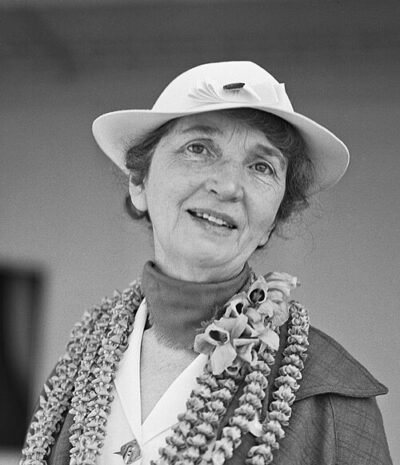
Margaret Sanger
Margaret Sanger was an American birth control activist and nurse. Born September 14, 1879, in Corning. Died September 6, 1966, in Tucson. Educated at Claverack College. Awards include Humanist of the Year, National Women's Hall of Fame and Arizona Women's Hall of Fame.
Facts
24 facts · 2 confirmed by two sources · 8 cited · 14 from one source
Where this comes from
Papalocal keeps its own record. It started from these sources; what each one said is kept here as it was copied, so a change on their side never changes this page by itself. Tap one to read its version.
What Wikidata says · copied November 13, 2026 · revision 2558151743
- Described as
- American birth control activist and nurse (1879–1966)
- Other names
- Margaret Sanger Slee, Margaret Higgins, Margaret Hennessy Higgins, Margaret H. Sanger, Margaret Higgins Sanger
- Born
- September 14, 1879 · 5 references
- Died
- September 6, 1966 · 5 references
- Born in
- Corning · 2 references
- Died in
- Tucson · 1 reference
- Buried in
- Green-Wood Cemetery
- Cause of death
- heart failure
- Name at birth
- Margaret Louise Higgins
- Citizen of
- United States
- Occupation
- nurse · 1 reference; sex columnist; activist · 1 reference; trade unionist; women's rights activist · 1 reference; film director; writer · 1 reference; educator
- Political party
- Socialist Party of America
- Education
- Claverack College
- Awards
- Humanist of the Year (1957); National Women's Hall of Fame (1981) · 1 reference; Arizona Women's Hall of Fame (1991) · 1 reference
- Field
- reform movement; birth control
- Siblings
- Ethel Byrne
- Wikipedias with a page
- 64
Wikidata item Q285514 (wikidata.org/wiki/Q285514), public domain (CC0). Copied November 13, 2026.
What Wikipedia says · copied November 13, 2026 · revision 1385465137
Margaret Sanger (née Higgins; September 14, 1879 – September 6, 1966) was an American birth control activist, sex educator, writer, and nurse. She opened the first birth control clinic in the United States, founded Planned Parenthood, and was instrumental in the development of the first birth control pill. Sanger is regarded as a founder and leader of the U.S. birth control movement.
In the early 1900s, contraceptives, abortion, and birth control literature were illegal in much of the U.S. Working as a nurse in the slums of New York City, Sanger often treated mothers desperate to avoid conceiving additional children, many of whom had resorted to back-alley abortions. Sanger was a first-wave feminist and believed that women should be able to decide if and when to have children, leading her to campaign for the legalization of contraceptives. As an adherent of the eugenics movement, she argued that birth control would reduce the number of unfit people and improve the overall health of the human race. She was also influenced by Malthusian concerns about the detrimental effects of overpopulation.
To promote birth control, Sanger gave speeches, wrote books, and published periodicals. Sanger deliberately flouted laws that prohibited distribution of information about contraceptives, and was arrested eight times. Her activism led to court rulings that legalized birth control, including one that enabled physicians to dispense contraceptives; and another – Griswold v. Connecticut – which legalized contraception without a prescription for couples nationwide.
Sanger established a network of dozens of birth control clinics across the country, which provided reproductive health services to hundreds of thousands of patients. She discouraged abortion, and her clinics never offered abortion services during her lifetime. She founded several organizations dedicated to family planning, including Planned Parenthood and International Planned Parenthood Federation. In the early 1950s, Sanger persuaded philanthropists to provide funding for biologist Gregory Pincus to develop the first birth control pill. She died in Arizona in 1966.
- Born, in its opening lines
- September 14, 1879
- Died, in its opening lines
- September 6, 1966
From the Wikipedia article “Margaret Sanger” (en.wikipedia.org/wiki/Margaret_Sanger), by its contributors, under CC BY-SA 4.0 (creativecommons.org/licenses/by-sa/4.0/). Copied November 13, 2026; not changed.
Confirmed Two sources agree. Cited One source, and it names where it got it. One source One source, without a reference of its own. Sources disagree The sources disagree. We show the best-supported value and keep theirs below.
